

TL;DR:
- Short notice relocations in Ontario often occur within 1 to 7 days due to emergencies or lease issues.
- Professional moving services with rapid, flexible options help manage the logistics and protect belongings.
- Prioritising communication, organisation, and trusted experts increases success in urgent moves.
Most people assume they’ll have at least a month to plan a move. The reality in Ontario is quite different. Unexpected job transfers, sudden lease terminations, and family emergencies can leave you scrambling to relocate in days rather than weeks. Short notice relocation means moving in less than 2 to 3 weeks, sometimes within days, and it’s more common than you might think. In this guide, we’ll walk you through what urgent relocation actually involves, which service types exist, how professionals execute these moves, and what pitfalls to avoid so your family lands safely on the other side.
Table of Contents
- What does short notice relocation mean in Ontario?
- Types of short notice relocation services in Ontario
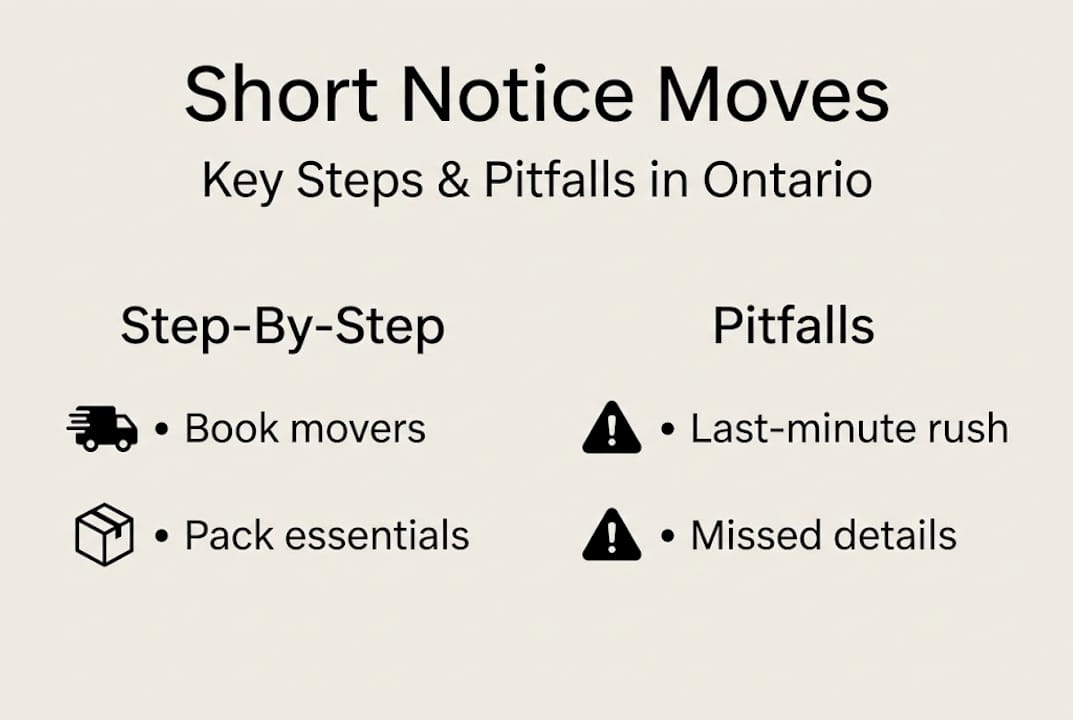
- The step-by-step process: how experts execute a short notice move
- Common pitfalls and how to avoid them in short notice moves
- The real secret to successful short notice moves in Ontario
- Connect with Ontario’s trusted short notice relocation experts
- Frequently asked questions
Key Takeaways
| Point | Details |
|---|---|
| Short notice moves defined | Moves arranged in less than two weeks due to emergencies or sudden changes are considered short notice relocations. |
| Range of urgent services | Ontario families can access rapid packing, handling, and storage through specialized movers for stress-free last-minute relocation. |
| Efficient planning is critical | Following a proven, step-by-step process helps minimize disruption and risk during urgent moves. |
| Avoid common mistakes | Proper labelling, clear communication, and trusting experienced pros are essential for a smooth short notice move. |
What does short notice relocation mean in Ontario?
Urgent circumstances can upend standard moving timeframes without warning. So let’s clarify exactly what short notice relocation looks like and when it typically arises in Ontario.
Last-minute moving basics describes short notice relocation as moving with minimal advance notice, typically less than 2 to 3 weeks, often 1 to 7 days or even same-day, triggered by urgent circumstances such as sudden job transfers, lease terminations, family emergencies, or health issues. It’s a situation where normal planning simply isn’t an option.
In Ontario, these moves happen more often than most people realise. Here are the most common triggers:
- Lease termination notices from landlords, sometimes with as little as a week’s practical time to leave
- Emergency job transfers requiring employees to report to a new city quickly
- Family medical events, including a loved one’s sudden illness or the need to move in with family
- Safety concerns such as domestic issues or hazardous living conditions
- Relationship breakdowns that require one party to vacate immediately
Ontario’s rental market adds particular pressure. With vacancy rates in major cities like Toronto and Ottawa often below 2%, finding replacement housing quickly while simultaneously managing a rushed departure creates a compounding stress that families in slower markets simply don’t face.
From a legal standpoint, most moves in Ontario carry no minimum waiting period. Adults can leave a rental as soon as they’ve provided proper notice under the Residential Tenancies Act. However, there is one critical exception:
Family law note: If your relocation involves children and a change of residence that affects custody or access arrangements, Ontario and federal family law require 60 days’ written notice to the other parent in most circumstances, unless a court orders otherwise. Always seek legal advice in this situation before you move.
For the majority of Ontario families facing an urgent move, the legal pathway is clear. The challenge isn’t permission. It’s logistics, speed, and staying organised under pressure.
Types of short notice relocation services in Ontario
Now that you know what qualifies as a short notice move, let’s look at the actual services that can address these urgent needs.
Not all emergency moves are the same. A family relocating from Mississauga to Sudbury has very different needs compared to someone moving across town in Hamilton on a Saturday morning. That’s why it helps to understand the range of options available.
According to types of last-minute moving services available in Ontario, emergency local moving includes 24 to 48 hour scheduling, same-day packing and unpacking, rapid storage, and fast furniture transport, with professional services covering heavy lifting, insurance, and damage protection.
Here’s a comparison of the main service types:
| Service type | Typical lead time | Best suited for |
|---|---|---|
| Emergency local move | 24 to 48 hours | Same city or nearby town |
| Urgent long-distance move | 48 to 72 hours | Cross-region or interprovincial |
| Same-day packing | Same day | Unprepared households |
| Rapid storage | Same day to 24 hours | Temporary or transitional needs |
| Fast furniture transport | 24 hours | Single item or partial loads |
Some key advantages of hiring professional movers for urgent situations include:
- Insurance coverage protects your belongings if something is damaged in the rush
- Trained crews can pack an entire home far faster than you could alone
- Standby availability means some companies maintain crews ready on short notice
- Proper equipment prevents damage to floors, walls, and fragile items
If you’re still deciding how to approach your upcoming move, reviewing Ontario moving preparation resources can help you see how professional support fits into your overall plan. The right service type can turn what feels like chaos into a manageable sequence of tasks.
The step-by-step process: how experts execute a short notice move
Understanding available service types is key, but successful urgent moves depend on a tightly managed process. Here’s how experts make it happen.
Professionals who specialise in urgent relocations don’t rely on luck. They follow a structured workflow that accounts for compressed timelines while protecting your belongings and your peace of mind. The stress-free moving workflow involves rapid needs assessment, securing movers with standby crews, efficient packing prioritising essentials with a digital inventory, coordinating logistics and utilities, and post-move verification.
Here’s a simplified timeline of how the process works:
| Time period | Key actions |
|---|---|
| First 24 hours | Assess essentials, confirm moving team, notify key contacts |
| Days 2 to 3 | Pack priority items, arrange utility transfers, confirm building access |
| Moving day | Load, transport, unload, and verify all items on arrival |
| Post-move | Complete paperwork, update address, begin settling in |
In numbered terms, the expert approach looks like this:
- Assess your essentials first. Identify what must move immediately versus what can follow later.
- Secure a professional crew with confirmed availability and liability insurance.
- Create a digital inventory by photographing each room before packing begins.
- Pack in priority layers: medications and documents first, then clothes, then everything else.
- Notify utilities and building management as early as possible to avoid access or service gaps.
- Verify all items on arrival by checking your photo inventory before the crew leaves.
The Ontario emergency checklist available from specialists outlines each stage in more detail if you need a printable reference.
Pro Tip: Before the movers arrive, take a quick video walkthrough of every room. This takes under five minutes and gives you an indisputable record if any disputes about damage arise after the move.
Common pitfalls and how to avoid them in short notice moves
While knowing the right process is crucial, many short notice moves fail because of simple missteps. Here’s how to avoid them.
Rushed decisions are where most moving problems begin. When you’re under pressure, small oversights compound quickly. Here are the most common mistakes Ontario families make and how to prevent them:
- Skipping box labels. In a rush, people stack boxes without noting contents or destination rooms. Unlabelled boxes mean chaos on the other end. Even a quick marker note on the top flap helps.
- Forgetting utility transfers. Arriving at your new home without power or internet because you didn’t notify providers in time is completely avoidable. Make a simple list and call providers on day one.
- Booking unverified movers. Desperation can lead families to hire whoever is available without checking credentials. Always confirm the company has valid CVOR certification, insurance, and a track record.
- Poor communication with professionals. Not telling your movers about a third-floor walk-up or a narrow hallway costs time and money. Share every relevant detail upfront.
- Trying to do it all yourself. Short notice movers recommend client prep and prioritisation to cut costs and time, with pros offering 24/7 flexible coverage for the best outcomes.
For practical guidance, stress-free tips for homeowners covers how to organise your approach so nothing critical falls through the cracks. If packing is your main worry, packing advice for urgent moves offers a straightforward method to pack efficiently without damaging your belongings.
Pro Tip: Designate one person in your household as the single point of contact for all logistics. When multiple people are calling movers, landlords, and utility companies, messages get mixed and things get missed. One person, one phone, one list.
The real secret to successful short notice moves in Ontario
Most guides focus on logistics. Boxes, trucks, timelines. But after years of helping Ontario families through urgent relocations, we’ve noticed that the families who come out of short notice moves intact share one trait: they prioritise emotional readiness alongside practical planning.
Here’s the uncomfortable truth. Doing it yourself almost never saves money in an urgent move. The hours you spend hauling furniture, the damage to walls or appliances, the rental van fees, and the physical exhaustion often cost more than a professional flat-rate quote. The myth that DIY is cheaper in a rush is one we see disproven regularly.
The families who fare best are those who have honest conversations early. With their employer, their landlord, and with each other. As soon as a move looks likely, start talking openly. That honesty creates the breathing room needed to make good decisions instead of reactive ones.
Choosing a mover with genuinely transparent policies and proven 24/7 capacity is not a luxury in an urgent situation. It’s the single biggest variable you can control. The last-minute expert insights we’ve seen consistently show that families who trust professionals to handle the complexity are the ones who settle in quickly and recover fastest from the disruption.
Flexible planning beats perfect planning every time. Things will shift. Adapt, communicate, and let experienced people carry the weight.
Connect with Ontario’s trusted short notice relocation experts
If you’re facing a last-minute move, professional backup can make all the difference. Urgency doesn’t have to mean disorder.

At Aleks Moving, we’ve supported Ontario families and individuals through urgent relocations for over 18 years. Our Ontario moving experts are available for same-day and next-day bookings, with flat-rate pricing and no hidden fees so you always know what you’re paying. Whether you need a fast local move, a cross-province relocation, or professional Ontario packing services to get your home sorted quickly, we have the crews and equipment ready. We also offer dedicated employee relocation support for job-related urgent moves. Contact us today for a free, no-obligation quote and let us handle the hard part.
Frequently asked questions
How fast can a short notice move be arranged in Ontario?
Many professionals offer packing and relocation with less than 24 to 48 hours’ notice. Some can assist on the same day if crews are available.
What situations commonly require urgent relocation?
Common triggers include sudden job transfers, unexpected lease cancellations, family emergencies, and safety or health issues that require immediate action.
Are there legal notice requirements for short notice moves in Ontario?
Most moves have no legal minimum waiting period. However, family relocations involving children require 60 days’ written notice to the other parent under the Divorce Act and the Children’s Law Reform Act, unless a court orders otherwise.
Do professional movers charge more for last-minute or emergency services?
Yes, urgent bookings typically cost more. However, reputable companies provide transparent quotes and insurance coverage, so you’re protected and there are no surprise charges on moving day.
Recommended
- Emergency relocation workflow: your step-by-step Ontario guide
- What Is Last-Minute Moving – Solutions for Urgent Relocations
- Employee relocation explained: Smooth transitions for Ontario moves
- How to prepare for a move: Ontario’s essential guide
- What is relocation planning? A guide for long-distance moves