
Yes, if you’re storing household items off-site in Canada, you need to confirm coverage before you sign a lease. Most home and tenant policies extend only limited protection to stored belongings, so check your existing policy’s off-premises limit and ask the storage facility about its insurance requirements or approved-facility list. Canadian programs like StorageShield and broker-placed policies fill the gaps most home policies leave open.
TL;DR:
- Standard home, condo, or tenant policies rarely provide full coverage for belongings stored off-site, especially for long-term or high-value items.
- Dedicated storage insurance offers coverage up to $100,000 with all-risk wording, including optional flood or earthquake endorsements, essential for high-value possessions.
- Confirm your off-premises coverage limits, wording type, flood exclusions, and duration caps before storing belongings, especially if stored longer than a few months.
- Storage providers may require your facility to be on a pre-approved insurer list or conduct a site review, focusing on security and flood history for coverage approval.
- Always document stored items with photos and itemized lists, store evidence off-site, and report losses promptly to ensure smooth claims processing.
Table of Contents
- What does storage insurance cover in Canada?
- Does my existing home, condo or tenant insurance cover items in storage?
- Where can you buy storage insurance in Canada?
- How much does storage insurance cost in Canada?
- What do storage facilities require before you can insure your unit?
- How do storage insurance claims work in Canada?
- How Aleks Moving supports secure storage and insurance documentation
- What Canadians most often get wrong about storage insurance
- Get help arranging secure storage during your move
- Sources
What does storage insurance cover in Canada?
A dedicated contents-in-storage policy protects belongings against a defined set of perils while they sit outside your home. Coverage generally responds to loss from fire, theft, vandalism, escape of water, and sewer backup, with many insurers offering optional endorsements for flood or earthquake. Some policies extend limited protection during transit between your home and the storage unit, which matters if a mover drops or damages an item en route.
StorageShield from Cowan Insurance Group offers coverage up to $100,000 per policy with a $1,000 deductible and 24/7 claims support. That gives you a real benchmark for comparing quotes: anything offering far less coverage for a similar premium deserves a second look.
The wording matters as much as the limit. All-risk policies cover any cause of loss except what’s specifically excluded, while named-perils policies only pay out for the perils explicitly listed. For high-value items like art, antiques, or business inventory, an all-risk policy usually offers stronger protection because it doesn’t force you to prove the loss matches a listed peril.
Key coverage elements to compare across quotes:
- Named perils versus all-risk wording
- Deductible amount and how it scales with declared value
- Optional flood, earthquake, or sewer-backup endorsements
- Whether transit coverage applies before items reach the facility
Does my existing home, condo or tenant insurance cover items in storage?
Sometimes, but rarely to the extent you’d assume. Many standard home, condo, or tenant policies automatically extend limited off-premises coverage to items stored away from your residence. The catch is the limit: it’s frequently capped as a percentage of your total contents coverage, not the full amount.
Before you rely on your existing policy, confirm these four things directly with your insurer:
- Off-premises limit. Ask what percentage of your contents coverage applies to stored items, and whether that figure is a hard dollar cap.
- Named-perils versus all-risk. Find out whether the off-premises extension uses the same wording as your main policy or a narrower version.
- Flood and sewer-backup exclusions. These are commonly excluded or capped separately, even when fire and theft are covered.
- Duration limits. Some insurers only extend off-premises coverage for a set number of days, which creates a gap for long-term storage.
If you’re storing high-value items, keeping belongings in a unit for more than a few months, or storing commercial inventory, separate contents-in-storage insurance is worth the extra premium. SS Insurance notes that standard policies often lack the flood and sewer-backup protection that dedicated storage products build in from the start.
Where can you buy storage insurance in Canada?
Three main channels sell storage coverage, and they don’t perform the same way. Insurer-direct programs like StorageShield and broker-placed products from PAL Canada sit at one end, offering purpose-built contents-in-storage wording. Facility-offered protection plans sit at the other, sold directly by the storage operator as an add-on when you rent your unit.
Here’s how they stack up:
- Insurer or broker policies (StorageShield, PAL, Insurance Store) typically offer clearer all-risk wording, higher coverage ceilings, and dedicated claims teams.
- Facility-offered plans are convenient at move-in but often carry narrower exclusions, and it’s worth confirming whether the plan is a true insurance policy or a limited liability waiver.
- Broker-arranged coverage simplifies comparison shopping since a broker can pull quotes from multiple insurers at once.
PAL Canada’s underwriting can shift with local conditions. Its contents-in-storage product may carry special conditions during regional hazards like nearby forest fires, which can delay a new submission if you’re applying during wildfire season.
Pro Tip: Ask every provider for their approved-facility list before you sign a storage lease. If your chosen facility isn’t on it, some insurers will still cover you after a site review rather than declining outright.
How much does storage insurance cost in Canada?
Price depends on what you’re storing and where, not a flat national rate. The main drivers behind your premium:
- Declared value of your stored items, since higher value means higher potential payout
- Duration of storage, with long-term arrangements generally costing more in total premium
- Unit type, particularly whether it’s climate-controlled, which can lower risk of humidity or temperature damage
- Facility location and security, including whether the building has sprinklers, monitored alarms, or a flood history
- Your claims history, which insurers factor in the same way they do for home policies
Higher deductibles typically lower your premium, and vice versa. A policy with a $1,000 deductible, like StorageShield’s standard tier, sits in the middle range compared to lower-deductible options that cost more upfront.
Before requesting a quote, prepare an inventory list, timestamped photos of your belongings, and the exact facility address. Insurers use all three to price accurately and to speed up any future claim.
What do storage facilities require before you can insure your unit?
Insurers don’t automatically cover every facility. Some require your storage location to appear on a pre-approved list, and if it doesn’t, they may conduct a site review rather than refuse coverage outright, checking things like sprinkler systems, security cameras, and flood history for the building.
Before you commit to a facility, work through this checklist:
- Ask whether the facility appears on your insurer’s approved list, or whether a site review is available.
- Confirm what security measures are in place: cameras, gated access, on-site staff.
- Ask directly about the building’s flood or sewer-backup history.
- Find out whether the facility sells its own protection plan and how its wording compares to a broker or insurer policy.
- Build a documented inventory, including photos, serial numbers, and receipts, before you move anything in.
That last step does more work than most people expect. Insurance Store points out that photos and itemized lists materially speed up both quoting and claims, because they remove disputes about what condition an item was in before the loss.
How do storage insurance claims work in Canada?
Report a loss the moment you discover it. Most insurers, including StorageShield, offer 24/7 claims support, so call as soon as possible, document the damage with photos, and request an incident report from the facility if theft or a security breach is involved.
Common exclusions to watch for:
- General wear and tear or gradual deterioration
- Damage from vermin or insects
- Certain flood definitions that exclude groundwater seepage while covering burst pipes
- Commercial inventory, unless you’ve specifically declared and scheduled it
Off-premises coverage under a standard home policy is often capped at a fraction of your total contents limit, sometimes leaving a gap of several thousand dollars between what you assumed was covered and what your policy actually pays. That gap is exactly why declared-value schedules matter for anything expensive.
Pro Tip: Store your inventory photos somewhere other than the unit itself, ideally in cloud storage, so you’re not left trying to prove a loss with evidence that was destroyed alongside your belongings.
How Aleks Moving supports secure storage and insurance documentation
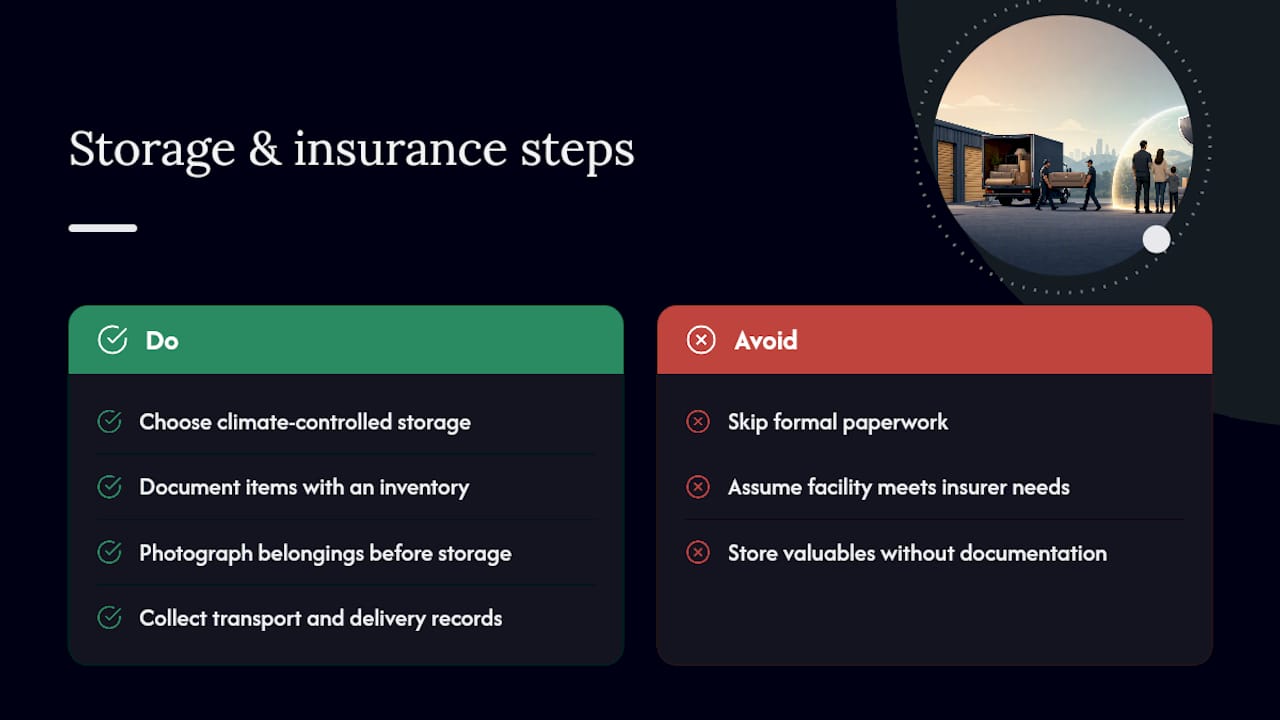
Professional moving companies often arrange both short-term and long-term storage, including climate-controlled options, which can reduce exposure to humidity and temperature swings that trigger claims; you can learn more about such storage models in how it works. Moving crews typically build the documentation insurers ask for: itemized inventories, photos, and transport records that back up a claim if something goes wrong.
Some moving services work with secure facility partners and can help you confirm whether a location meets insurer requirements before you commit. When arranging storage for antiques, art, or a full household move, having the proper paperwork can make a difference in handling claims smoothly.
What Canadians most often get wrong about storage insurance
The biggest mistake is assuming a home policy covers stored belongings in full. It rarely does. The second is skipping documentation, leaving no proof of value if a claim ever comes up. Read your policy’s off-premises wording carefully, photograph everything before it goes into storage, and ask the facility about its loss history before you sign anything.
— Ali
Get help arranging secure storage during your move
Aleksmoving is a practical alternative to sorting storage and insurance details entirely on your own. We arrange short-term and long-term storage options with climate control where you need it, and our packing crews document everything with photos and itemized lists, exactly the paperwork insurers ask for when you request a quote or file a claim.
If you’re planning a move that includes storage, get a free quote through our moving company page or contact us directly to talk through your unit size, timeline, and documentation needs. We’ll help you arrange the move and the storage in one conversation, so you’re not juggling separate bookings while trying to figure out coverage on your own.
Sources
- StorageShield Storage Unit Insurance | Cowan Insurance Group
- Contents In Storage | PAL Canada
- Coverage for items in storage | Sonnet
- Contents in storage insurance | Insurance Store