Skip to content


TL;DR:
- Effective office move logistics coordinate assets, vendors, and timing to minimize downtime and control costs. Treating the move as a supply chain project, especially involving IT early, ensures operational readiness and reduces delays. Proper planning, cross-functional leadership, and strategic sequencing are essential for a successful, cost-effective relocation.
Logistics in office moves is defined as the coordinated management of physical assets, timing, vendor relationships, and information flows to execute a corporate relocation with minimal downtime and cost. The role of logistics in office moves goes far beyond hiring a truck and packing boxes. It is the operational backbone that determines whether your team is back to full productivity on Monday morning or still waiting for internet access two weeks later. For business owners and office managers across Ontario, understanding this distinction is the difference between a move that protects your margins and one that quietly destroys them.
What are the key components of logistics in office relocation?
Successful corporate relocations integrate seven core logistics components that directly reduce downtime and cost per workstation: inventory management, transit mode selection, timing and sequencing, compliance, vendor contracting, risk mitigation, and post-move verification. Each component is interdependent. Skipping one creates a gap that the others cannot compensate for.
Here is what each component demands in practice:
- Inventory management: Every asset, from workstations and server racks to filing cabinets and ergonomic chairs, must be catalogued, labelled, and assigned a destination before move day. This is not optional. Undocumented assets get lost, damaged, or left behind.
- Transit mode selection: Not all freight moves the same way. Prioritising mission-critical assets first, while consolidating archival materials into container freight, reduces per-unit costs and frees up staging space at the new location.
- Timing and sequencing: Departments that depend on shared infrastructure, such as IT and reception, must move in a deliberate order. Moving sales before the phone system is live is a costly mistake.
- Vendor contracting: Your movers, IT installers, internet service provider, and security contractor all need aligned timelines. A single vendor running late cascades into every other workstream.
- Risk mitigation: Identify backup carriers, document contingency plans, and build buffer time into the schedule. Moves rarely go exactly to plan.
- Post-move verification: Confirm that every department is operationally ready before declaring the move complete. This includes network connectivity, access credentials, and physical asset placement.
Pro Tip: Create a master move register in a shared spreadsheet or project management tool like Asana or Monday.com. Assign each asset a status column: packed, in transit, delivered, verified. This single document eliminates the most common post-move confusion.
| Logistics component | Why it matters |
|---|---|
| Inventory management | Prevents asset loss and ensures accurate placement at the new site. |
| Transit mode selection | Reduces per-unit freight costs by matching asset type to the right vehicle. |
| Vendor coordination | Aligns all contractors to a single timeline, preventing cascade delays. |
| Risk mitigation | Protects the move schedule against single-point failures. |
| Post-move verification | Confirms operational readiness before staff return to full capacity. |
How does logistics affect downtime and productivity during an office move?
Downtime is the single largest hidden cost in any office relocation. IT systems often require 14 to 90 days of lead time for provisioning at a new address, covering internet circuits, VoIP lines, and security systems. When that provisioning is not started early enough, your team arrives at a functional building with no working phones and no internet. The first week of operations becomes a write-off.
Poor logistics coordination compounds this problem in predictable ways:
- Network and VoIP setup delayed because the IT contractor was not booked until after lease signing
- Security access cards not programmed because facilities and IT did not share a unified timeline
- Workstations placed in the wrong zones because no floor plan was distributed to the moving crew
- Staff arriving to find their department’s equipment still in transit
Effective communication and early staff involvement directly reduces this disruption. Sharing move timelines and role-specific expectations with employees at least four weeks out allows teams to prepare, back up critical files, and plan their own workflows around the transition. This is not a soft benefit. It is a measurable reduction in the number of support tickets, confusion calls, and lost hours on move day.
Office relocations are supply chain projects that require synchronous coordination of physical and digital infrastructure changes with operational readiness. Treating the move as a facilities task alone, without IT co-leadership, is the most common reason businesses experience first-week productivity disasters. The logistics of who moves when, and what infrastructure must be live before they arrive, is the critical path that every other decision should follow.
What logistics strategies help optimise office move planning?
The most effective logistics strategies for office relocation treat the move as a project with a defined scope, a cross-functional team, and a critical path. Here is a structured approach that works for businesses of any size:
- Appoint a dedicated relocation lead. IT infrastructure is the most common risk factor for downtime, so the relocation lead should have authority over both IT and facilities decisions. This person owns the master timeline and resolves conflicts between workstreams.
- Build a cross-functional team. Include representatives from IT, HR, finance, and facilities from the outset. Each function has dependencies that affect the others. HR needs to communicate with staff. Finance needs to track costs against budget. IT needs six to twelve weeks to provision infrastructure.
- Apply supply chain frameworks. Treat vendors as a supply network, not a list of phone numbers. Map dependencies between contractors, set performance expectations in writing, and build penalty clauses for delays that affect the critical path.
- Use technology for visibility. Modern logistics integrates automation, IoT, and analytics to provide real-time visibility across multi-provider networks. For an office move, this means using asset tracking labels, shared project dashboards, and digital floor plans rather than paper checklists.
- Sequence by asset criticality. Move mission-critical infrastructure first. Archive and storage items move last, ideally consolidated to reduce trips and cost.
- Build flexibility into the plan. Poorly planned sequencing and vendor dependency failures are the primary reasons office moves exceed budget. A 10 to 15 percent time buffer on each major milestone is not pessimism. It is standard project management practice.
Pro Tip: Review your office relocation planning guide before finalising your vendor list. Knowing the full scope of what needs to be coordinated helps you ask the right questions when interviewing moving companies and IT contractors.
How does logistics differ from supply chain management in office moves?
Logistics manages the physical flow and storage of goods and information. Supply chain management is the overarching strategy that aligns sourcing, production, and distribution across an entire network. In the context of an office move, logistics is the execution layer. Supply chain management is the planning layer that determines which vendors to use, how to structure contracts, and how to sequence the entire operation.
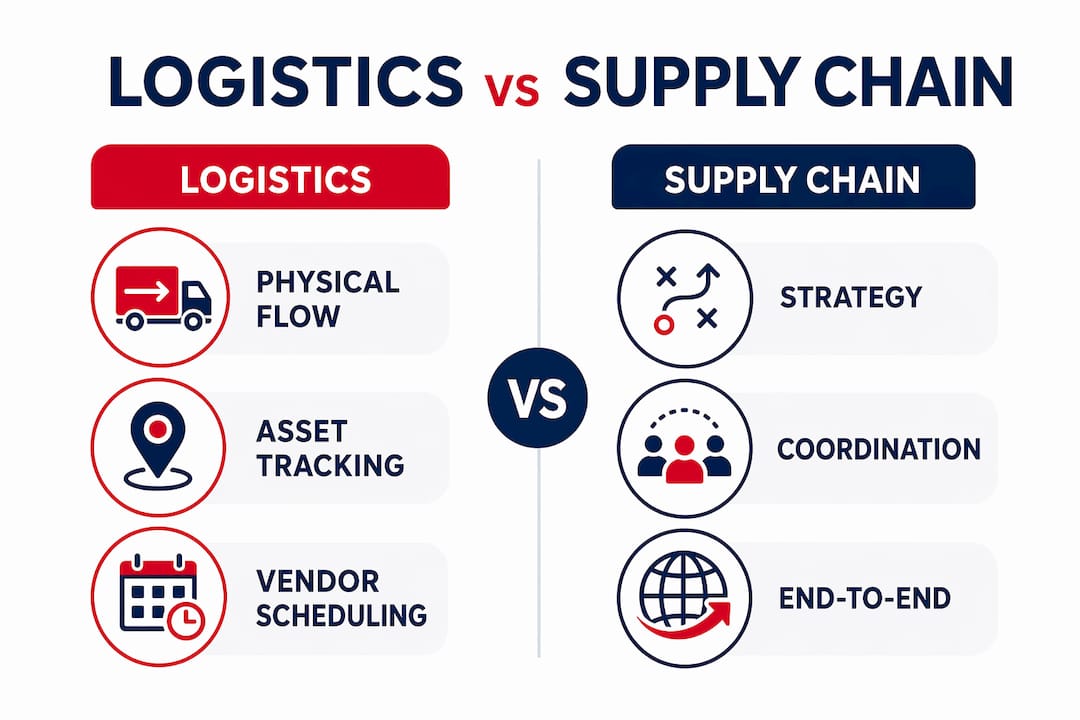
The distinction matters because many businesses manage their office moves at the logistics level only, focusing on trucks and boxes, without applying supply chain thinking to vendor selection, risk management, and cost control. This is why moves run over budget.
| Dimension | Logistics | Supply chain management |
|---|---|---|
| Scope | Physical movement, storage, and delivery of assets | Strategic coordination of vendors, sourcing, and operational readiness |
| Focus | Execution and timing | Planning, risk management, and cost optimisation |
| Tools | Move schedules, asset tracking, floor plans | Vendor contracts, performance metrics, contingency frameworks |
| Outcome | Assets arrive at the right place on time | The entire relocation delivers on budget and on schedule |
Logistics serves as the operational backbone that executes supply chain strategy. When you elevate logistics from a cost centre to a strategic function, you gain the ability to control outcomes rather than react to problems. For an Ontario business managing a 50-person office move, this means the difference between a two-day transition and a two-week recovery. You can explore inventory management in relocation to see how this plays out at the asset level.
Key takeaways
Effective office relocation logistics requires coordinating IT, facilities, vendors, and timing as a unified supply chain project, not a series of independent tasks.
| Point | Details |
|---|---|
| Logistics is the execution backbone | It covers inventory, transport, timing, and vendor coordination, not just physical moving. |
| IT provisioning drives the critical path | Internet, VoIP, and security systems need 14 to 90 days of lead time before move day. |
| Cross-functional leadership reduces risk | A relocation lead with authority over IT and facilities prevents the most common delays. |
| Sequencing by criticality cuts costs | Moving mission-critical assets first and consolidating archive freight reduces per-unit costs. |
| Supply chain thinking elevates outcomes | Applying vendor performance frameworks and contingency planning keeps moves on budget. |
Why most office moves fail before the first box is packed
After working with businesses across Ontario on relocations of every size, the pattern I see most often is this: the move is treated as a facilities project right up until something breaks, and then it becomes a crisis. The IT team finds out about the move date three weeks before it happens. The internet circuit at the new address has a six-week provisioning window. Nobody told the ISP in time. The result is a fully furnished office with no working network on day one.
Treating office moves solely as facilities projects rather than integrated supply chain projects with IT co-leadership is the most reliable way to cause infrastructure delays and productivity loss. I have seen this happen to well-run businesses with experienced operations teams. It is not a competence problem. It is a framing problem.
The businesses that execute moves well share one habit: they plan the IT and facilities workstreams in parallel from the first day of planning, not sequentially. They also treat their office move logistics planning as a margin protection exercise. Every day of downtime has a cost. Every delayed vendor has a cost. When you frame logistics as a financial control function rather than a moving task, the decisions become much clearer.
My advice is to start with infrastructure, not furniture. Know your internet circuit lead time, your VoIP porting timeline, and your security system installation window before you book a single moving truck. Everything else can flex around those constraints. The physical move is the easy part. The digital infrastructure is where moves succeed or fail.
— Ali
How Aleksmoving supports your office relocation logistics
Planning an office move across Ontario involves more coordination than most businesses anticipate. Aleksmoving has over 18 years of experience supporting corporate and commercial relocations, with a clear focus on minimising downtime and keeping costs transparent from the first quote.

Aleksmoving handles inventory management, asset transport, and coordinated scheduling so your team can focus on staying operational during the transition. With flat-rate pricing and no hidden fees, you know exactly what the move costs before it begins. Whether you are relocating a 10-person office or a multi-floor operation, Aleksmoving tailors the logistics to your timeline and your budget. Explore Aleksmoving’s office moving services to get a free quote and see how a well-coordinated move feels from start to finish.
FAQ
What is the role of logistics in an office move?
Logistics in an office move coordinates the physical movement of assets, vendor scheduling, IT provisioning, and timing to minimise downtime and cost. It is the execution layer that determines whether the business is operational on day one at the new location.
How far in advance should office move logistics planning begin?
Office move logistics planning should begin at least three to six months before the move date. IT infrastructure provisioning alone can require 14 to 90 days of lead time, making early planning critical to avoiding first-week productivity loss.
Why does IT need to co-lead an office relocation?
IT infrastructure, including internet circuits, VoIP, and security systems, sits on the critical path of every office move. When IT is not involved from the start, provisioning delays cause the most common and costly post-move disruptions.
What is the difference between logistics and supply chain management in a move?
Logistics covers the physical execution of the move, including transport, asset tracking, and timing. Supply chain management is the broader strategy that governs vendor selection, risk planning, and cost control across the entire relocation project.
How can businesses reduce costs during an office relocation?
Sequencing assets by criticality, consolidating non-urgent freight into container shipments, and applying performance-based vendor contracts are the most direct ways to reduce cost overruns during an office relocation.