Skip to content


TL;DR:
- Mover liability covers goods damage based on weight, not full asset value.
- Businesses should supplement mover coverage with their own insurance for comprehensive protection.
- Verify coverage limits in writing and document inventory to prevent financial losses during moves.
Many Ontario businesses assume their moving company’s insurance will fully cover everything during a commercial relocation. It won’t. The reality is that movers carry liability coverage, not a standalone insurance policy designed to replace your assets at full value. This distinction matters enormously when something goes wrong. Whether you’re moving a downtown Toronto office or relocating a warehouse in Mississauga, understanding how commercial moving insurance actually works can be the difference between a smooth recovery and a costly dispute. This guide walks you through definitions, coverage types, critical gaps, and practical steps to ensure your business assets are genuinely protected.
Table of Contents
- What is commercial moving insurance?
- Types of coverage available for business moves in Ontario
- Limits, requirements, and gaps: what Ontario businesses must know
- How to get comprehensive protection for your business move
- What most Ontario businesses miss about moving insurance
- Get moving confidently with expert support
- Frequently asked questions
Key Takeaways
| Point | Details |
|---|---|
| Mover liability is not enough | Mover-provided liability covers basics but rarely protects the full value of your business assets. |
| Layer your coverage | Combine both mover liability and your own policy for the broadest, most reliable protection. |
| Verify insurance proof | Always demand certified proof of insurance and declare high-value assets before your Ontario move. |
| Act fast on claims | Submit detailed claims with inventory records quickly—within 30 to 60 days—to avoid denial. |
What is commercial moving insurance?
Let’s start by clearing up the most common source of confusion. Commercial moving insurance refers to the protection options available for businesses relocating office or commercial assets in Ontario, primarily through movers’ liability coverage rather than standalone insurance policies. In other words, when you hire a mover, you are not automatically purchasing insurance. You are engaging a company that carries its own liability coverage, which is a very different thing.
Mover liability sets a ceiling on what the moving company will pay if your goods are damaged or lost. That ceiling is often based on weight, not actual value. A $5,000 monitor that weighs 10 kilograms at a rate of $0.60 per pound might yield a payout of less than $15. That is not a typo.
Dedicated business insurance policies, by contrast, are held by you or your company and designed to replace assets at current market or replacement value. Understanding Ontario mover liability helps clarify exactly what your mover is and isn’t responsible for before you sign anything.
| Feature | Mover liability | Dedicated business insurance |
|---|---|---|
| Who holds the policy | Moving company | Your business |
| Payout basis | Weight or declared value | Replacement or market value |
| Scope of coverage | Goods in mover’s direct care | Broader, often includes transit gaps |
| Claim flexibility | Limited by contract terms | Depends on your policy |
| Typical limit | $0.60/lb or declared amount | Up to full asset value |
Here’s what businesses often expect versus what actually exists:
- Expected: Full replacement cost for any damaged item during the move
- Reality: Payout based on weight or a pre-declared value, rarely full replacement
- Expected: Mover’s policy covers business interruption losses
- Reality: Mover liability covers physical goods only, not lost revenue
- Expected: All items automatically insured the moment they’re loaded
- Reality: High-value or specialty items may be explicitly excluded
Types of coverage available for business moves in Ontario
With a clear definition in place, let’s look at the specific coverage options Ontario companies can use to protect their assets during a move.
There are four main types to know. Basic mover liability is the default and comes included with your moving contract. Cargo insurance is held by the moving company and covers goods in transit. Inland marine insurance is a specialised commercial policy covering business property, equipment, and tools while they’re away from your permanent location. All-risk endorsements can be added to an existing commercial property policy to extend protection during transit.
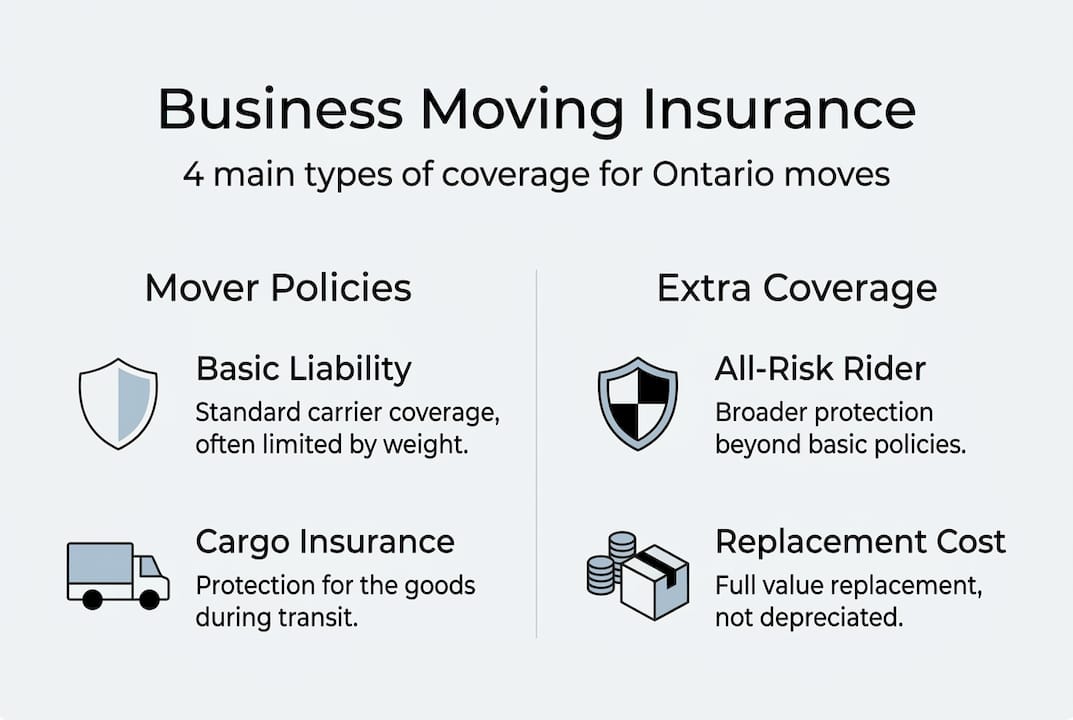
Movers typically carry cargo insurance of $1 million and general liability of $2 million or more. Businesses can supplement this with their own commercial property or inland marine coverage to achieve full replacement value.
| Coverage type | Typical limit | Estimated annual premium |
|---|---|---|
| Basic mover liability | $0.60 per pound | Included in move cost |
| Cargo insurance (general freight) | $100,000 | $400 to $800/year |
| Inland marine insurance | Custom per asset | Varies by value |
| All-risk endorsement | Up to full asset value | Negotiated with insurer |
For long-distance coverage across Ontario or interprovincially, the risk of loss or damage increases significantly. This is where supplementary coverage pays for itself. And understanding business moving costs helps you plan coverage alongside your overall budget rather than treating it as an afterthought.
Situations where additional coverage is critical:
- Moving high-value electronics, servers, or data equipment
- Relocating specialised machinery or custom-fabricated tools
- Moving artwork, antiques, or irreplaceable archival materials
- Moving business assets across provincial borders
- Any move involving inventory that directly supports ongoing revenue
Pro Tip: Before the move date, request written confirmation from your mover listing exactly what their cargo policy covers and excludes. Verbal assurances are not enforceable. Get it in writing.
Limits, requirements, and gaps: what Ontario businesses must know
Understanding coverage types is only half the picture. Knowing what could still leave you exposed is just as important.
First, the regulatory reality. Mover liability is not full insurance and your own policy will cover catastrophic loss far more reliably. Ontario law does not legally require businesses to purchase moving insurance, but most professional movers and commercial landlords will expect proof of liability acknowledgment or coverage before a move proceeds.
Second, the gap risk. Enhanced mover coverage, often priced at around $6 per pound, provides roughly ten times the protection of basic liability. But even this won’t cover every loss type, particularly consequential losses like business interruption or data recovery costs tied to damaged equipment.
Here is a checklist to review before signing with any mover:
- Confirm the mover’s cargo insurance limit in writing
- Request a certificate of insurance directly from their insurer
- Clarify whether high-value or specialty items are excluded
- Ask about the declared value option and its added cost
- Review Ontario cargo insurance requirements for interprovincial moves
- Complete a full inventory with photos before moving day
- Understand the mover’s claims process and deadlines
“Claims must be filed promptly. For local Ontario moves, the window is typically 30 days from delivery. For interprovincial moves, you have 60 days. Missing these deadlines can forfeit your right to compensation entirely.”
For businesses moving specialty items such as art, scientific equipment, or antiques, the stakes are even higher. Standard cargo coverage almost never applies to these categories without a specific endorsement.
Pro Tip: Contact your commercial insurer before the move and ask about adding a goods in transit rider to your existing policy. This extension is often surprisingly affordable and fills the gaps that mover liability leaves open.
How to get comprehensive protection for your business move
Now for the practical part. Here is how Ontario businesses can layer coverage effectively and avoid surprises on moving day.
Ontario businesses should obtain written estimates and contracts detailing liability limits, buy declared value protection for high-value assets, verify mover cargo and liability certificates, and consult their own insurer for transit extensions to close coverage gaps. For all-risk protection, prioritise all-risk policies over named-perils policies for the broadest coverage during an office relocation.
Follow these steps for full protection:
- Assess your asset risk. List every item being moved and assign a replacement value. Flag items worth more than $1,000 individually.
- Review your mover’s insurance. Request their cargo and liability certificates. Confirm limits and exclusions in writing.
- Contact your commercial insurer. Ask about extending your existing policy to cover goods in transit or adding an inland marine rider.
- Choose a declared value option. If your mover offers enhanced coverage at $6 per pound or by declared value, calculate whether it covers your most expensive assets.
- Document everything. Photograph all items before packing. Store the inventory and photos in a cloud location offsite.
- Explore inland marine options. For businesses with equipment-heavy operations, inland marine insurance provides specialised transit protection that standard cargo policies don’t match.
- Confirm post-move. Upon delivery, inspect everything before signing off. Note any damage immediately and begin the claims process without delay.
Knowing how to prepare for a move operationally goes hand in hand with preparing financially. And partnering with experienced movers who understand commercial insurance documentation reduces the administrative burden significantly.
Pro Tip: Always request two certificates of insurance from your mover: one for cargo and one for general liability. Keep both copies with your move contract and inventory list.
What most Ontario businesses miss about moving insurance
After working with businesses across Ontario through countless commercial relocations, we’ve noticed a pattern. The companies that suffer the worst losses aren’t necessarily moving the most valuable assets. They’re the ones who treated insurance as a formality rather than a genuine risk management step.
Most businesses check a box by confirming their mover is insured, then assume the job is done. It isn’t. The real risk lies in what people assume is covered without verifying. A vague contract clause or an unchecked exclusion can unravel a legitimate claim entirely.
Our recommendation is to run what we call a coverage drill before your move date. Pretend your most expensive piece of equipment is damaged in transit. Walk through the claims process on paper. Who do you call? What documentation do you need? Is there a deadline you might miss? This exercise almost always reveals a gap that nobody noticed before.
The emerging best practice among well-prepared Ontario companies is layering both mover and third-party coverage, maintaining a digital inventory, and reviewing contract language with someone who understands commercial insurance. When you’re thinking about controlling moving costs, don’t cut corners on coverage. The economics are clear.
“A single uninsured loss during a move can cost more than ten years of premiums.”
That’s not an exaggeration. It’s a reality we’ve seen firsthand, and it’s entirely preventable.
Get moving confidently with expert support
Protecting your business assets during a commercial move is not something to leave to chance or assumptions. The combination of mover liability and tailored third-party coverage gives Ontario companies the strongest possible foundation for a smooth relocation.
At Aleks Moving, we’ve been supporting Ontario businesses through commercial relocations for over 18 years. Our team helps you navigate the insurance documentation process, handles your assets with care, and provides flat-rate pricing with no hidden fees. Whether you’re moving across town or across the province, explore our trusted moving services or browse our full range of professional moving services to request a free quote and take the first step toward a protected, stress-free move.
Frequently asked questions
Is commercial moving insurance required by law in Ontario?
No, Ontario law does not mandate commercial moving insurance, but most movers require some proof of coverage or liability acknowledgment before proceeding. It’s not legally required but shippers and movers often mandate proof.
How much does commercial moving insurance cost for Ontario businesses?
Cargo premiums for general freight coverage of $100,000 typically range from $400 to $800 per year, while household goods coverage runs $1,000 to $2,000 annually depending on asset type and risk level.
What’s the difference between mover liability and inland marine insurance?
Mover liability covers loss or damage to goods while they are in the mover’s direct care; inland marine insurance is a specialised commercial policy that covers business equipment and tools in transit with broader, more flexible protection. Businesses may supplement mover coverage with their own commercial property insurance for full replacement value.
How quickly must a claim be filed after a moving loss?
For local Ontario moves, claims must be filed within 30 days of delivery. For interprovincial moves, you have 60 days. Missing these windows can forfeit your right to any compensation.
Recommended
- IT Equipment Moving: Protecting Your Business Assets
- Long-Distance Commercial Moving: Impact on Ontario Offices
- Tips For A Successful Commercial Move | Aleks Moving
- Understanding Moving Insurance with Movers Brampton
- What is moving insurance and how to protect your items