Skip to content


TL;DR:
- Cross-provincial moving involves more than just driving; it triggers legal, administrative, and financial changes that require careful planning. Proper documentation, timelines for updating licenses, healthcare, and taxes are essential to ensure a smooth relocation. Hiring experienced movers and booking six to eight weeks in advance can save costs, reduce stress, and prevent delays during this complex process.
Moving from one province to another feels straightforward on the surface. You pack your things, hire a truck, and go. But what is cross-provincial moving, really? It involves far more than a long drive. Interprovincial moving means crossing a provincial boundary with the intent to settle in a new province, and that triggers a cascade of logistical, administrative, and financial changes that a local move simply does not. This guide breaks down everything you need to know, from legal obligations to cost factors, so you can plan with confidence and avoid the surprises that catch most people off guard.
Table of Contents
- Key takeaways
- What cross-provincial moving actually means
- Transportation options for moving across provinces
- Cost of cross-provincial moving: what to expect
- Your cross-provincial moving checklist
- Common challenges and how to handle them
- My take on cross-provincial moving
- Plan your cross-provincial move with Aleksmoving
- FAQ
Key takeaways
| Point | Details |
|---|---|
| It is more than a long drive | Cross-provincial moving triggers legal, administrative, and financial changes that local moves do not. |
| Costs vary significantly | Distance, volume, and added services are the biggest cost drivers; always get a flat-rate quote upfront. |
| Administration takes time | Updating your healthcare, driver’s licence, and vehicle registration can take weeks after arrival. |
| Professional movers reduce risk | Experienced interprovincial movers offer packing, liability coverage, and better coordination for long-distance jobs. |
| Early planning is the real advantage | Starting your checklist eight to twelve weeks out dramatically reduces stress and last-minute costs. |
What cross-provincial moving actually means
Cross-provincial relocation is defined as any move in which you cross a provincial or territorial boundary with the intention of establishing your primary residence in the new location. This is the line that separates it from a long local move or even a cross-border moving situation involving the United States. Intention matters here. Driving goods from Ontario to Quebec for storage is not a cross-provincial move. Relocating your family there permanently very much is.
Why does this distinction matter? Because the moment you establish residency in a new province, a series of legal and administrative obligations kick in. These are not optional, and they come with deadlines.
Here is what changes when you move between provinces:
- Driver’s licence and vehicle registration: New residents must update their vehicle registration and obtain a new provincial driver’s licence, typically within 30 to 90 days of arriving, depending on the province.
- Healthcare coverage: Most provinces have a waiting period of up to three months before your new provincial health card activates. You will need to arrange bridging coverage during this gap.
- Income tax residency: Your province of residence on December 31st determines which provincial tax rates apply to your entire year’s income. Timing your move around this date can have real financial consequences.
- Car insurance: Policies are provincially regulated. Your Ontario insurer may not cover you the same way once you are living in British Columbia or Alberta.
- School enrolment and professional licences: Tradespeople, nurses, teachers, and other regulated professionals may need to re-certify or register with the new province’s licensing body.
Understanding these obligations before you move, not after, is what separates a smooth cross-provincial relocation from a stressful one.
Transportation options for moving across provinces
Getting your belongings from one province to another requires a clear plan. You have three primary options, and each has genuine trade-offs.
- Self-move with a rented truck: You rent a commercial moving truck and drive it yourself. This can appear cost-effective on the surface, but fuel, insurance, accommodations along the route, and the physical toll of a multi-day drive add up quickly. It also puts the responsibility for packing, loading, and potential damage entirely on you.
- Consolidated groupage shipping: This option is worth knowing about. Groupage shipping combines your household goods with other customers’ shipments in one truck or container, which splits the transportation cost. It is more affordable than booking a dedicated truck, though delivery windows tend to be less flexible.
- Full-service professional movers: A company specialising in interprovincial moving services handles packing, loading, transportation, and unloading. This is the most dependable option for families with significant household contents, specialty items, or tight timelines.
Vehicle transport is a separate consideration entirely. If you own two cars and only one driver is making the trip, you will need to arrange auto transport through a carrier or flatbed service. This adds cost but is often worth it compared to the logistics of a second cross-country drive.
Timeline coordination is where most people underestimate the complexity. Professional movers booking cross-provincial moves during peak season (May through August) can have lead times of three to six weeks. Planning your move across Canada in the shoulder seasons (late September through April) generally means better availability and lower prices.
Pro Tip: Book your moving company at least six to eight weeks in advance for a cross-provincial move, and confirm all dates in writing. Verbal commitments are not enough when your entire household is on the line.
Cost of cross-provincial moving: what to expect
The cost of a cross-provincial move is almost never a flat, predictable number. Several factors work together to produce the final figure.
Moving expenses rise with distance and the volume or weight of your belongings. A one-bedroom apartment moving from Toronto to Ottawa will cost far less than a four-bedroom home relocating from Ontario to British Columbia. Here is a general comparison to orient your budgeting:
| Moving method | Estimated cost range (2-bedroom home) | Best for |
|---|---|---|
| Self-move (truck rental) | $1,500 to $3,500 | Budget-conscious, minimal furniture |
| Consolidated shipping | $2,000 to $5,000 | Cost savings with flexible delivery |
| Full-service movers | $4,000 to $12,000+ | Families, large volumes, specialty items |
These are estimates only. Always request a written, flat-rate quote that itemises every service.
Beyond the base transport cost, budget for these additional items:
- Moving insurance: Proper insurance coverage protects your belongings against damage or loss during transit. Basic carrier liability is often inadequate for high-value items. Full-value replacement coverage costs more but provides genuine peace of mind.
- Packing materials: Boxes, tape, bubble wrap, and specialty containers for fragile and valuable items add a few hundred dollars for a medium-sized home.
- Storage: If your new home is not ready on arrival, short-term storage can run $100 to $300 per month depending on the volume and facility.
- Travel and accommodation: Fuel, hotels, and meals during a multi-day drive are easy to forget in the initial budget.
Pro Tip: Ask every moving company you contact whether their quote is binding or non-binding. A non-binding estimate can increase significantly on moving day if your inventory is larger than expected. A flat-rate quote removes that uncertainty entirely.
Your cross-provincial moving checklist
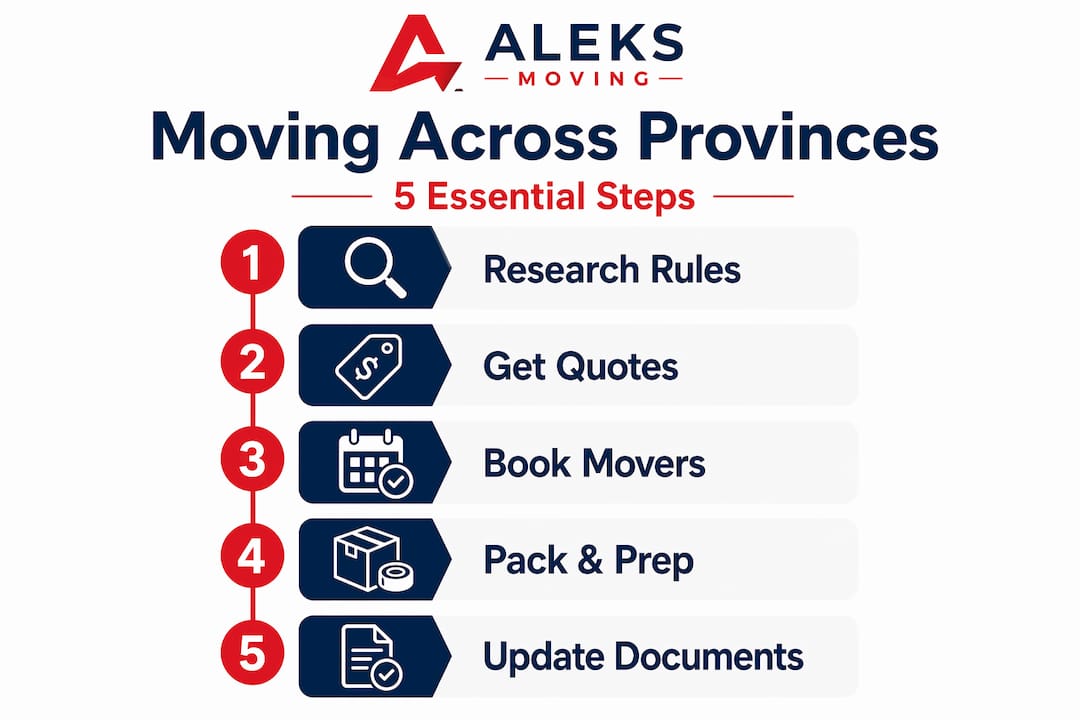
A detailed moving checklist is not just a nice-to-have. It is the difference between a move that goes smoothly and one that falls apart in the final week. Here is what your preparation should cover, organised by timeframe:
Eight to twelve weeks before moving day:
- Research and obtain quotes from at least three interprovincial moving companies
- Book your preferred mover and confirm dates in writing
- Begin sorting and decluttering (less to move means lower cost)
- Notify your current employer, landlord, or real estate agent
Four to six weeks before moving day:
- Notify service providers including your bank, insurance companies, and utility providers
- Contact your province’s healthcare office to understand the transition process
- Register your children’s school records for transfer
- Arrange for a professional health card application in your destination province
One to two weeks before moving day:
- Pack non-essential items room by room, labelling boxes clearly with contents and destination room
- Use proper packing techniques for electronics, antiques, and fragile items to minimise damage risk during long-distance transport
- Confirm final details with your moving company including arrival window and payment terms
- Back up important documents and digital files
Moving day and after:
- Do a final walkthrough of your old home before the truck leaves
- Document the condition of your belongings with photos before loading
- Update your driver’s licence and vehicle registration in the new province within the required window
- Apply for your new provincial health card as soon as possible
Common challenges and how to handle them
Even with careful planning, cross-provincial moves come with challenges that are difficult to predict. Knowing what to expect helps you respond calmly rather than reactively.
Scheduling conflicts are common when your possession date and delivery window do not perfectly align. Professional movers will give you a delivery range, not always a precise day, on long-distance hauls. Build a buffer of at least two to three days between when you leave your old home and when you absolutely need your belongings in the new one.
Weather and road conditions across thousands of kilometres can cause genuine delays. Planning for seasonal weather and discussing contingency plans with your mover before moving day is worth the conversation.
Selecting a reputable moving company is the single most effective decision you can make to reduce delays, damage, and stress during a cross-provincial move. Experienced movers bring coordination, proper equipment, and accountability that a self-move simply cannot replicate.
Family logistics add another layer of complexity. If you have children, pets, or elderly family members, coordinate their travel and care separately from the moving logistics. Trying to manage everything at once on moving day is a recipe for exhaustion and mistakes.
My take on cross-provincial moving
I have seen hundreds of families go through cross-provincial moves, and the pattern that keeps coming up is this: people underestimate the administrative side and over-focus on the physical side. They spend weeks deciding what furniture to keep and almost no time researching when their new province’s health card kicks in. That three-month healthcare gap catches people completely off guard, especially families with young children.
The other thing I have noticed is that the cost-versus-convenience calculation rarely goes the way people expect. A lot of people choose the self-move to save money, then end up paying for a damaged sofa, a delayed vehicle, and two extra nights in a hotel. When you add it all up, the gap between a truck rental and a professional mover is often smaller than people think, especially on routes over 1,000 kilometres.
My honest advice? Get your moving cost factors on paper early. Talk to a professional mover before you decide anything. The conversation itself is free, and it will give you a much more realistic picture of what you are actually choosing between. Understanding cross-provincial moving means respecting both its physical and its administrative weight equally.
— Ali
Plan your cross-provincial move with Aleksmoving

If you are getting ready for a cross-provincial relocation and want a dependable team behind you, Aleksmoving has over 18 years of experience helping Ontario families move across the country with confidence. We offer residential moving services that cover everything from professional packing and secure transportation to flexible storage solutions. Our flat-rate pricing means no surprises on moving day. Whether you are moving to British Columbia, Alberta, or anywhere else in Canada, we are ready to help. Request your free quote today and get a clear picture of what your move will actually cost.
FAQ
What is cross-provincial moving in Canada?
Cross-provincial moving refers to any relocation that crosses a provincial boundary with the intent to establish permanent residence in the new province. It differs from a local move in both its logistical complexity and the legal and administrative changes it triggers.
How much does a cross-provincial move cost?
Costs typically range from $1,500 for a small self-move to over $12,000 for a full-service professional move on a long route. Distance, volume of belongings, and added services like packing and storage are the primary cost drivers.
Do I need to update my driver’s licence after moving provinces?
Yes. Most provinces require new residents to obtain a local driver’s licence and update their vehicle registration within 30 to 90 days of establishing residency. Timelines vary by province, so check the rules for your destination.
Is cross-provincial moving complicated?
It is more involved than most people expect, particularly on the administrative side. Healthcare transitions, tax implications, and professional re-licensing are aspects that require planning well before your moving date.
How far in advance should I book a cross-provincial mover?
Book at least six to eight weeks in advance, and up to three months ahead if you are moving during peak season (May through August). Early booking secures better availability and often better pricing.