

TL;DR:
- Flexible scheduling in relocation reduces costs and improves crew availability by aligning moves with off-peak times. It allows businesses to minimize disruptions through phased moves and maintain adaptability for changing conditions. Building a move window and buffers provides a smoother experience and better outcomes for individuals and companies.
Schedule flexibility in relocation is the practice of adjusting your moving timeline to align with cost windows, crew availability, and your personal or business needs. For Ontario movers in 2026, this flexibility is not a luxury. It is the single most effective way to reduce costs, protect operations, and keep people happy through a move. Mid-week, mid-month moves can cost up to 33% less than identical moves on weekends or at month-end. That one scheduling decision alone can save hundreds or thousands of dollars. Whether you are moving a household in Hamilton or relocating a business across the Greater Toronto Area, building adaptability into your timeline pays off at every stage.
Why schedule flexibility in relocation reduces costs and improves crew availability
The financial case for flexible moving dates is direct. Off-peak timing cuts costs by up to a third compared to peak weekend and month-end moves. That gap exists because demand spikes sharply at predictable times, and moving crews are stretched thin as a result.
Tuesday, Wednesday, and Thursday moves attract less demand than weekend dates. Less demand means better crew availability, more attentive service, and often lower rates. Weekend and month-end slots fill quickly, leaving clients with fewer options and higher prices.
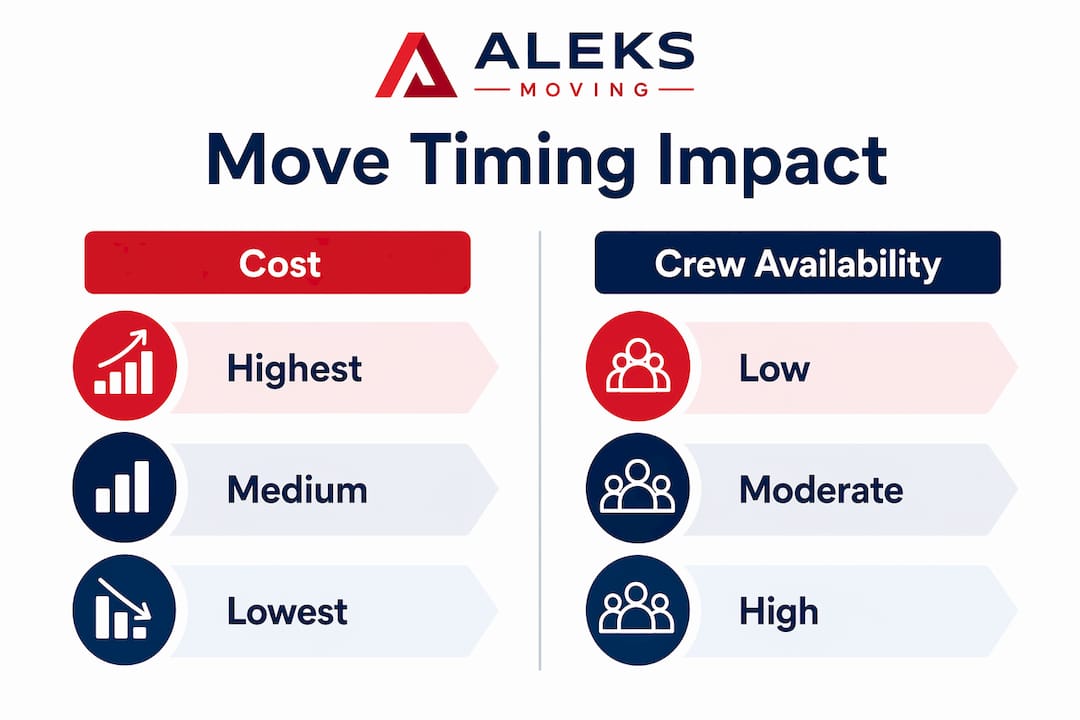
The table below shows how timing choices affect both cost and crew quality.
| Move timing | Relative cost | Crew availability |
|---|---|---|
| Weekend, month-end | Highest | Low |
| Weekday, month-end | Moderate | Moderate |
| Weekend, mid-month | Moderate | Moderate |
| Mid-week, mid-month | Lowest (up to 33% less) | High |
Beyond cost, flexible timing aligns moves with available truck capacity and transportation routes. This matters especially for long-distance relocations across Ontario, where scheduling conflicts can push delivery windows out by days. A client who locks in a fixed date during peak season may wait longer and pay more, while a client with a two or three-day window gets placed on the next available route.
Key benefits of flexible moving dates at a glance:
- Lower rates during off-peak windows (mid-month, mid-week)
- Better crew availability and more experienced teams on site
- Reduced risk of scheduling conflicts for long-distance routes
- Greater negotiating room with your moving company
- Less pressure on packing timelines when the move date has some give
Pro Tip: Book your preferred window as a range of two to three days rather than a single fixed date. This small change gives your moving company room to assign their best available crew and can reduce your quote noticeably.
Why is schedule flexibility critical for business relocations in Ontario?
Business relocations carry far higher stakes than household moves. Compressing the recommended 6 to 12-month planning window raises costs, increases operational downtime, and drives up employee attrition. Rushing a business move is one of the most expensive mistakes an Ontario company can make.

Phased relocations spread over 60–90 days reduce operational disruption significantly compared to single-day cutovers. A single-day move can cause 25–30% operational disruption. A phased approach lets departments move in sequence, keeping core functions running throughout the transition.
Flexible scheduling also protects against optimism bias. Booking logistics before finalising foundational decisions is a common planning error that leads to costly reversals. Keeping your timeline adaptable until key decisions are locked in prevents this trap. Experts call the opposite problem the “commitment trap,” where locking in dates prematurely forces a business to absorb avoidable costs when conditions change.
Talent retention is another reason flexibility matters. Only 24% of companies now offer fixed relocation benefits to all employees, down from 53%. That shift reflects what employees actually want: adaptable support that fits their lives, not a rigid package. When a business builds schedule flexibility into its relocation policy, employees feel respected and are more likely to follow through on the move.
Benefits of flexible scheduling for Ontario businesses:
- Avoids the cost and disruption of compressed planning timelines
- Supports phased moves that keep operations running
- Reduces the risk of optimism bias and premature commitment
- Aligns with employee expectations and supports talent retention
- Creates room to respond to market shifts or lease delays
Pro Tip: Treat IT infrastructure as your scheduling anchor. IT setup requires 30–90 working days of lead time. Plan your physical move date around IT readiness, not the other way around. This one adjustment prevents the most common cause of post-move productivity loss.
You can read more about the specific corporate moving challenges that Ontario decision-makers face when planning office relocations.
How to plan a flexible move: practical steps for individuals and businesses
Building flexibility into your relocation schedule starts with choosing the right planning window. For households, that means mapping your move against lease renewal dates, school calendars, and Ontario’s seasonal demand patterns. Summer months and the first and last days of each month are consistently the most congested and expensive periods to move.
A numbered approach works well here:
- Set a target window, not a fixed date. Choose a two to three-week range that avoids month-end and peak summer demand. This gives you room to respond to delays without penalty.
- Build a contingency buffer of at least five to seven days. Delays happen: closing dates shift, building elevators get booked, and weather disrupts schedules. A buffer absorbs these without derailing the whole move.
- Coordinate IT, utilities, and address changes in parallel. Do not wait for a confirmed move date to start these tasks. Run them alongside your physical planning so nothing becomes a bottleneck.
- Align your packing timeline with the window, not a single day. Starting your packing workflow two to three weeks out gives you room to adjust if the move date shifts by a few days.
- Choose a moving company that supports flexible date windows. Not all providers accommodate date changes without penalty. Confirm this before signing any agreement.
Remote workers face an additional scheduling consideration. Completing home-office setup at least 24–48 hours before the first workday prevents fatigue and productivity loss. Building that buffer into your move window is a simple step with a measurable payoff.
Pro Tip: If you are moving a family with school-age children, target the last two weeks of august or the first week of september. These windows avoid the mid-summer peak while still landing before the school year starts.
What are the advantages and challenges of flexible moving plans in Ontario?
Ontario’s housing market creates specific pressures on move timing. Competitive conditions in cities like Toronto, Ottawa, and Mississauga mean closing dates can shift at short notice. A flexible relocation schedule absorbs these changes without forcing a client into emergency logistics at premium rates.
Seasonal demand fluctuations are significant. Summer is the busiest period for Ontario movers, with demand peaking in june, july, and august. Firms that delay moves until conditions stabilise consistently achieve lower costs and better workforce integration. Waiting for a quieter window is not indecision. It is a deliberate cost-reduction strategy.
Ontario’s competitive labour market adds another layer. Employees who receive adaptable relocation support are more likely to accept and complete a move. True schedule flexibility goes beyond offering a menu of options. It means real adaptability that responds to individual circumstances.
Flexible plans do carry coordination challenges worth acknowledging:
- Supplier communication requires more active management when dates are not fixed
- Building access bookings in condominiums and apartment towers may need to be reserved in advance and updated if dates shift
- Businesses must keep internal stakeholders informed of any timeline changes to avoid confusion
The advantages outweigh these challenges in most Ontario scenarios. The key is treating flexibility as an active planning tool, not as an excuse to delay decisions. You can also explore storage options as a buffer strategy when move-in dates do not align perfectly with move-out dates.
Key takeaways
Schedule flexibility in relocation is the most reliable way to reduce costs, protect business operations, and support the people involved in an Ontario move.
| Point | Details |
|---|---|
| Mid-week timing saves money | Moving tuesday to thursday, mid-month, cuts costs by up to 33% compared to peak dates. |
| Phased business moves reduce disruption | Spreading a business move over 60–90 days prevents the 25–30% operational disruption of single-day cutovers. |
| Early planning windows protect outcomes | Compressing the 6 to 12-month planning window raises costs, downtime, and employee attrition. |
| Contingency buffers are non-negotiable | A five to seven-day buffer absorbs closing delays, elevator bookings, and weather without derailing the move. |
| Adaptive policies retain talent | Only 24% of companies still offer fixed relocation benefits, reflecting a clear shift toward flexible, employee-centred support. |
Scheduling flexibility: what I have learned after years of Ontario moves
After working with hundreds of Ontario clients, the pattern is clear. The movers who struggle most are the ones who treat their move date as fixed from day one. They book everything around a single date, and when one piece shifts, the whole plan falls apart.
The clients who have the smoothest moves are the ones who build in room to breathe. They pick a window, not a date. They start their packing and IT coordination early. They ask their moving company upfront whether date adjustments carry a penalty. These are not complicated steps. They are just habits that most people skip because they feel like they are adding time to the process.
The 2026 shift toward adaptive relocation policies is not a trend. It is a correction. Fixed schedules were always a source of unnecessary cost and stress. The industry is finally catching up to what experienced movers have known for years: flexibility is not a risk. Rigidity is.
If you are planning a move in Ontario this year, the single best thing you can do is resist the urge to lock everything in too early. Give yourself options. The savings and the smoother experience will follow.
— Ali
How Aleksmoving supports flexible scheduling for Ontario relocations
Aleksmoving has been helping Ontario households and businesses move for over 18 years, and adaptable scheduling is built into how we work. We understand that closing dates shift, leases overlap, and business timelines change. Our flat-rate pricing and no-hidden-fees approach means you get a clear quote whether your move falls on a tuesday in october or a saturday in june.

For individuals and businesses ready to plan a move that fits their actual timeline, our trusted moving services cover local and long-distance relocations across Ontario. We also support employee relocation for businesses managing staff transitions. Contact Aleksmoving today for a free upfront quote and let us build a schedule that works for you.
FAQ
What is schedule flexibility in relocation?
Schedule flexibility in relocation is the practice of choosing a move window rather than a fixed date, allowing adjustments based on cost, crew availability, and personal or business conditions.
How much can flexible moving dates save in Ontario?
Mid-week, mid-month moves cost up to 33% less than weekend or month-end moves. For most Ontario households, that translates to a meaningful reduction in total moving costs.
Why do businesses need a flexible relocation schedule?
Compressing the 6 to 12-month planning window increases costs, operational downtime, and employee attrition. Flexible scheduling gives businesses room to phase the move and respond to changing conditions.
What are the best days to move in Ontario?
Tuesday, Wednesday, and Thursday are the least requested move days. They offer better crew availability and lower rates compared to weekends and month-end dates.
How does schedule flexibility help with employee relocation?
Adaptive relocation support improves employee satisfaction and completion rates. With only 24% of companies still offering fixed relocation benefits, flexible scheduling has become the standard expectation for employees considering a company-supported move.