

TL;DR:
- Professional office movers act as logistics coordinators, ensuring detailed planning and safety.
- They manage risks with specialized protocols, phased moves, and secure handling of sensitive assets.
- Storage solutions help maintain business continuity by supporting flexible transition timelines.
Relocating an office is far more complex than most people expect. It is not simply a matter of hiring a van, packing a few boxes, and unlocking the door at the new location. Many Ontario business owners discover this the hard way, facing lost productivity, damaged equipment, and frustrated staff. Professional movers bring structure, accountability, and specialised expertise that no internal team can replicate. In this article, we walk through what office movers actually do, the core benefits they deliver, how they handle tricky scenarios, and how you can leverage their knowledge for a truly seamless transition.
Table of Contents
- Why movers matter: Beyond boxes and trucks
- Key phases of office transitions movers manage
- Managing risks: Specialised protocols and edge cases
- Ensuring business continuity: Movers and storage solutions
- Our take: What most move guides miss about office transitions
- Take the stress out of your office move: Next steps
- Frequently asked questions
Key Takeaways
| Point | Details |
|---|---|
| Move planning power | Professional movers offer tailored strategies and project management beyond simple transport. |
| Specialized expertise | Movers are equipped for complex needs like after-hours moves, phased transitions, and sensitive data handling. |
| Business continuity | Storage and overlap solutions from movers help keep business running smoothly during the switch. |
| Risk management | Engaging reputable movers can minimize disruption, reduce downtime, and protect valuable assets. |
Why movers matter: Beyond boxes and trucks
There is a persistent myth that professional movers simply carry furniture from one address to another. In reality, their role in an office context is far closer to that of a logistics coordinator. From the moment you engage them, they begin building a detailed plan tailored to your specific operation.
Here is what experienced office movers typically take responsibility for:
- Custom move planning: Movers assess your floor plan, map out where each item will land at the new space, and sequence the move to avoid bottlenecks.
- Inventory management: Every desk, cabinet, monitor, and piece of equipment is catalogued, labelled, and tracked. Nothing gets lost in transit.
- Special handling for sensitive assets: IT servers, medical devices, and confidential file boxes require specific packing materials, secure seals, and careful transport protocols.
- Logistics coordination: Movers coordinate logistics such as elevator bookings, arrange after-hours moves, and ensure sensitive files are protected throughout the process.
- Space mapping at the destination: Furniture and equipment are placed precisely as planned, so your team can start working immediately.
This level of co-ordination is what separates a stressful, drawn-out move from a clean, efficient one. You can explore the full range of moving services available for businesses of all sizes, and get a clearer picture of what professional mover duties actually look like in practice.
Professional movers are not just suppliers you hire on the day. They are strategic partners who help you protect your people, your assets, and your operational rhythm throughout the entire transition.
Pro Tip: Bring your movers into the planning conversation at least six to eight weeks before your move date. The earlier they understand your layout, your priorities, and your deadlines, the more precisely they can build a plan that fits your business.
Key phases of office transitions movers manage
Understanding where professional movers add the most value helps you allocate time and resources wisely. There are five main stages where their expertise becomes critical.
- Consultation: Movers visit your current office, assess the volume and nature of assets, discuss timelines, and identify risks. This is where smooth office move planning begins.
- Planning: A detailed move schedule is created, covering who does what, when, and in what sequence. Access times, parking permits, and elevator bookings are confirmed.
- Packing: Professional crews pack your office systematically, using colour-coded labels, protective wrapping, and anti-static materials for electronics.
- Moving day: Items are loaded, transported, and unloaded according to the plan. Movers also facilitate phased relocations and provide secure storage for any transition overlaps where both locations are active simultaneously.
- Post-move setup: Furniture is assembled, workstations are positioned, and the space is confirmed against the floor plan before your staff arrive.
| Move stage | DIY approach | Professional movers |
|---|---|---|
| Consultation | Ad hoc walkthrough | Structured site assessment |
| Planning | Basic checklist | Detailed logistics schedule |
| Packing | Mixed quality, inconsistent labels | Systematic, fully inventoried |
| Moving day | High risk of delays | Coordinated, time-bound execution |
| Post-move setup | Staff reassemble on arrival | Movers complete setup before staff arrive |
Pro Tip: Ask potential movers whether they offer post-move walkthroughs. A reliable company will return within 24 to 48 hours to address anything that was not set up correctly, saving you valuable staff time.
Managing risks: Specialised protocols and edge cases
Beyond routine relocations, businesses often face tricky scenarios. High-rise offices, secure medical facilities, and phased moves involving multiple floors or buildings all demand a different level of planning.
Here is how professional movers manage the most common risk categories:
- Sensitive data and confidential files: Sealed, numbered boxes with documented chain of custody reduce the risk of any breach during transport.
- Phased relocations: Rather than one disruptive move, movers handle after-hours, phased moves and secure storage to keep parts of your business operational throughout the process.
- IT equipment: Servers, switches, and workstations need anti-static wrapping, climate-controlled transport, and careful reinstallation. Learn more about IT equipment safety to understand what proper protocols look like.
- After-hours and weekend scheduling: Many Ontario businesses opt for weekend moving solutions to avoid disrupting regular operations entirely.
Did you know? A significant portion of commercial relocations in urban Ontario require after-hours or weekend scheduling simply because building management restricts freight elevator use during business hours. Planning for this early avoids last-minute cost increases.
| Risk type | Professional mover mitigation |
|---|---|
| Damaged IT equipment | Anti-static packing, climate-controlled vehicles |
| Lost or misplaced files | Numbered inventory with chain-of-custody records |
| Access delays | Pre-booked elevators, after-hours permits arranged |
| Operational disruption | Phased moves and off-hours scheduling |
| Asset theft or breach | Sealed containers, documented handover protocols |
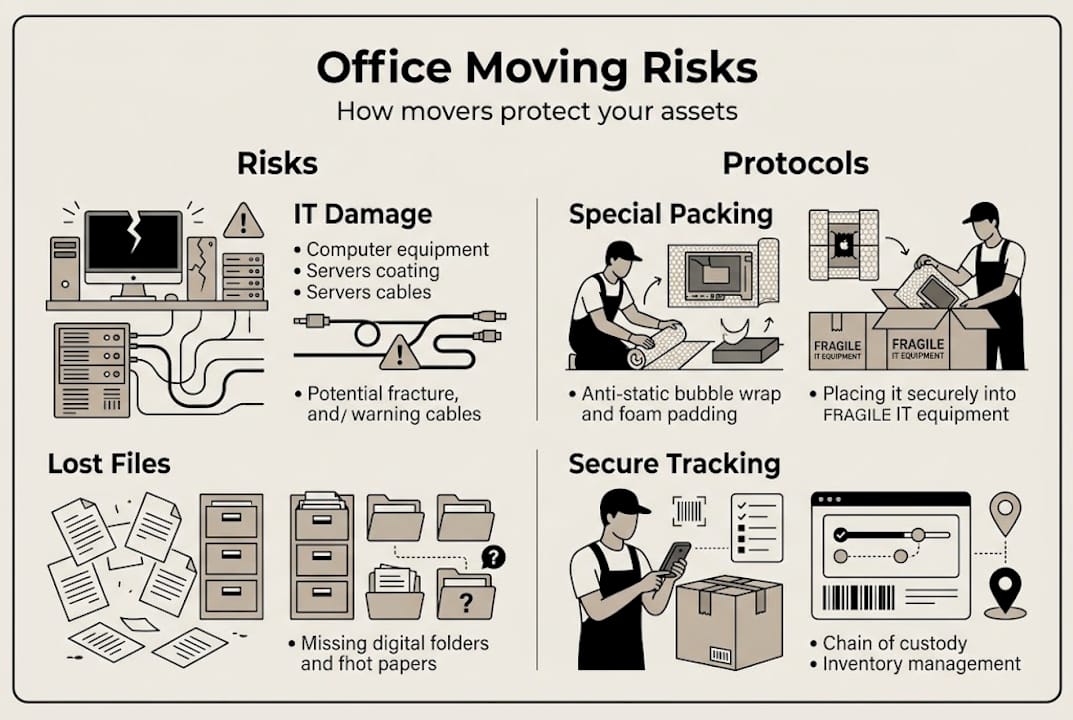
These protocols are not standard with every moving company. When evaluating providers, ask directly about their experience with complex office environments and the specific procedures they follow.
Ensuring business continuity: Movers and storage solutions
One of the most underestimated benefits of working with professional movers is their ability to keep your business running during the transition itself. This is where storage services become a genuine operational tool, not just a convenience.
Here is how storage bridges the gap during an office move:
- Short-term overlap storage: When your move-in date does not align perfectly with your move-out date, secure storage for transition overlaps keeps your assets safe and accessible without cluttering either location.
- Secure warehousing for IT and valuables: High-value equipment can be staged in a monitored facility rather than left in an unsecured interim space.
- Flexible retrieval: Items can be delivered in stages as your new office is made ready, allowing each department to set up at its own pace.
- Reduced downtime at both ends: Because equipment arrives only when the space is ready, staff are not waiting around for the right items to appear.
Exploring your business storage solutions early in the planning process gives you more flexibility on your move date. It also reduces pressure on your team if the new space requires finishing work or furniture installation before occupancy.
Pro Tip: Choose a moving company that has an established relationship with a secure storage facility or operates its own. This simplifies billing, reduces handling of your assets, and gives you a single point of accountability. Find out more about using storage during moves to see how this works in practice.
Businesses that plan storage into the relocation from the start consistently report smoother transitions and fewer last-minute crises. It is one of those decisions that pays for itself in avoided disruption.
Our take: What most move guides miss about office transitions
Most relocation guides focus heavily on checklists and timelines. What they rarely address is the dynamic between the client and the moving team. In our experience, the office moves that go smoothly are the ones where the business manager treats the moving company as a co-leader of the project, not simply a pair of hands on the day.
When you share your operational priorities, your most sensitive assets, and your downtime thresholds early, your movers can make decisions in the field that protect those priorities. When movers are kept at arm’s length and given minimal information, they can only execute the basics.
There are also hidden savings in this approach. A mover who understands your floor plan can identify efficiencies that reduce truck runs, cut hours, and lower your overall cost. Our ultimate guide to commercial moving explores this further, including how to structure your brief to get the most from your moving team. Treat your movers as project partners and you will likely spend less and disrupt your team far less than you expected.
Take the stress out of your office move: Next steps
Ready to put professional insights into action for your next office move? At Aleks Moving, we have been helping Ontario businesses relocate efficiently for over 18 years, with flat-rate pricing and no hidden fees.

Whether you are planning a single-floor move or a complex, phased relocation across multiple sites, we tailor our approach to your timeline and operational needs. Start with our guide to plan a smooth move, or explore our commercial moving guide for a complete overview of what to expect. When you are ready to take the next step, browse our full range of moving services and request a free upfront quote. The sooner you engage us, the more we can do to protect your business through every stage of the transition.
Frequently asked questions
What unique challenges do office movers solve that general movers may not?
Office movers specialise in after-hours and phased moves and handle sensitive file protocols, elevator bookings, and secure storage for transition overlaps that go well beyond standard residential moving experience.
Do most commercial moves require after-hours or weekend work?
Many office relocations are scheduled during off-hours or weekends because after-hours and weekend moves support zero-downtime goals by keeping regular business operations completely unaffected.
How do movers help with IT and equipment relocation?
Movers offer special handling for IT and sensitive files through specialised packing, detailed inventorying, and secure transport to ensure everything is safely operational at the new location.
What are the benefits of storage services during an office transition?
Storage solutions support phased relocations by bridging the gap between move-out and move-in dates, keeping your assets secure and accessible during any overlap period.
Recommended
- Role of movers in Ontario relocation: 30% faster, 40% less damage
- Tips For A Successful Commercial Move | Aleks Moving
- How to Plan a Smooth Office Move? | Aleks Moving
- What Do Professional Movers Do? | Aleks Moving
- How to communicate effectively with movers: key tips