Skip to content


TL;DR:
- Office relocation planning involves a structured process that minimizes operational disruptions and controls costs through thorough preparation. Key prerequisites include reviewing lease clauses, building a comprehensive budget with contingency funds, and assembling a cross-functional moving committee to coordinate tasks. Starting planning 6 to 12 months ahead, prioritizing internet orders, and conducting detailed IT and communication strategies ensure a successful move with minimal risks.
Office relocation planning is the structured, stepwise process of coordinating every operational, logistical, and technical element required to move a business from one location to another with minimal disruption. This guide to planning office relocations covers the full scope: lease review, budgeting, IT migration, team communication, and post-move optimisation. Done well, a commercial relocation protects productivity, controls costs, and sets your team up in a space that actually supports how you work. Done poorly, it costs far more than expected and stalls operations for weeks. The difference is almost always preparation.
What are the essential prerequisites before planning an office move?
The lease is the first document you read, not the last. Lease restoration and termination clauses are critical dependencies that shape your entire timeline and budget, not just your move date. Missing a restoration obligation, such as returning the space to its original condition, can add tens of thousands of dollars in unexpected costs after you have already left.
Once the lease is reviewed, build your budget in full categories. Early planning reduces costs by 20%, and the savings come from avoiding reactive decisions. Your budget should account for:
- Moving company fees
- IT infrastructure setup and cabling
- New or replacement furniture
- Temporary storage or swing space
- Productivity loss during transition
- A 15 to 20% contingency buffer above your baseline estimate
That contingency buffer is not optional. Overlap rent, surprise cabling costs, and last-minute equipment replacements are common, and they arrive without warning.
Assemble your moving committee before you do anything else. A cross-functional committee covering IT, HR, and Finance assigns clear accountability and prevents tasks from falling through the gaps. Each department head becomes a communication layer, which keeps the broader team informed without creating chaos.
Location scouting should factor in employee commute patterns, building infrastructure quality, and room for growth. Space planning tools help you model desk layouts and room configurations before signing a lease on the new space.
Pro Tip: Request a building survey from your internet service provider before signing the new lease. Whether the building is on-net or off-net determines how long internet activation will take, and that single detail can reshape your entire move timeline.
How to build a detailed office relocation timeline
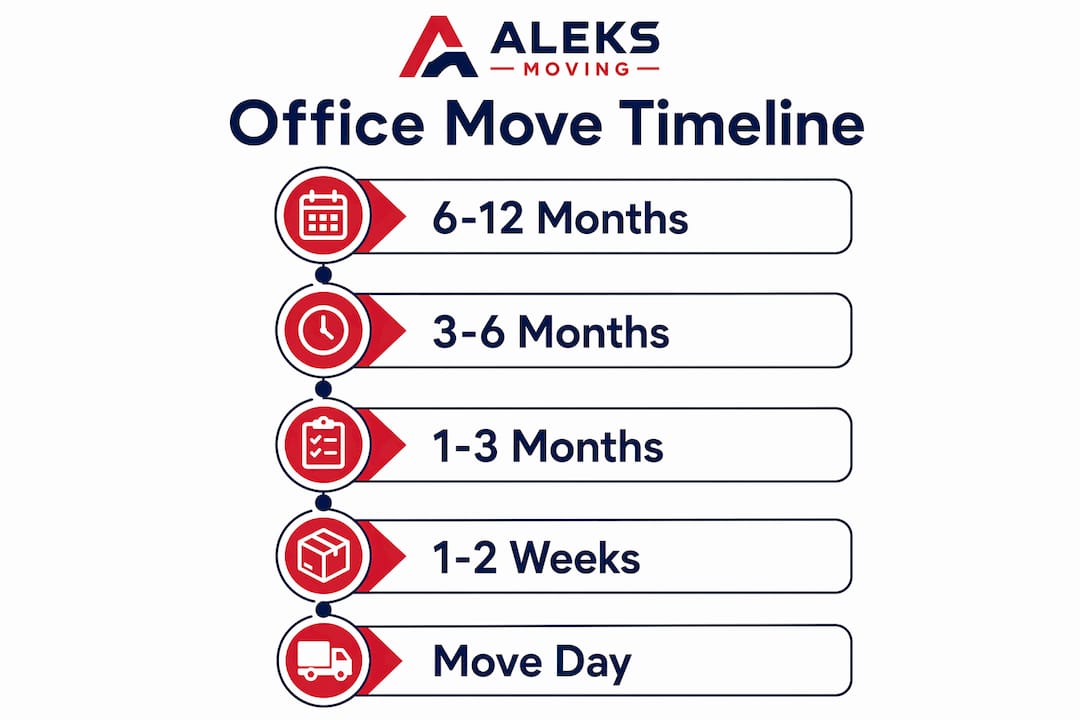
Office relocations should begin planning 6 to 12 months before the target move date. That lead time is not excessive. It reflects the real complexity of coordinating leases, IT infrastructure, vendors, and people simultaneously. The following phases give you a practical office relocation project plan to work from.
- 6 to 12 months out: Review the current lease, confirm termination obligations, set the full budget, form the moving committee, and begin location scouting. Finalise the new lease only after confirming infrastructure quality.
- 3 to 6 months out: Lock in the floor plan for the new space, order internet service immediately (more on this below), confirm furniture orders, and begin vendor notifications.
- 1 to 3 months out: Complete the IT asset inventory, conduct a Wi-Fi survey at the new location, label all equipment, and begin packing non-essential items by department.
- Final 2 weeks: Run a full technology dry run at the new space, confirm building access for move day, brief all staff with first-day logistics, and finalise the moving schedule with your professional movers.
- Move day: Execute the physical move in phases, prioritising IT infrastructure setup before workstations.
- 60 to 90 days post-move: Monitor space utilisation data, adjust layouts based on actual usage, and gather employee feedback on the new environment.
The single most time-sensitive task in this entire timeline is internet ordering. Internet activation lead times range from 30 to 90 days for buildings already on a provider’s network, and up to 120 days or more for off-net buildings. Get the activation date confirmed in writing and arrange a service overlap period so you are never without connectivity on move day.
| Phase | Key tasks | Lead time |
|---|---|---|
| 6 to 12 months | Lease review, budget, committee | Start immediately |
| 3 to 6 months | Floor plan, internet order, vendors | Order internet now |
| 1 to 3 months | IT inventory, Wi-Fi survey, labelling | 30 to 90 days |
| Final 2 weeks | Tech dry run, staff briefing, access | Confirm in writing |
| Post-move | Usage monitoring, layout adjustment | 60 to 90 days |
Pro Tip: Sync your workspace booking software, such as desk and room reservation tools, with the new floor plan before move day. Staff who arrive to find no working booking system on day one lose confidence in the move immediately.
Best practices for managing IT and equipment relocation
IT relocation is where the most expensive mistakes happen, and most of them are preventable. The office move checklist for IT should begin with a full asset audit, completed before a single cable is unplugged.
Here is what that audit and move process should include:
- Photograph every workstation, server rack, and peripheral before disconnecting anything. These photos are your reconnection reference.
- Label every cable, port, and device with matching identifiers. Skipping labelling creates hours of downtime reconnecting unidentified equipment at the new location.
- Back up all data to at least two locations, including an offsite or cloud backup, and verify that restores actually work before the move.
- Pack monitors upright, never flat. Use anti-static bags for circuit boards and sensitive components. Hard drives should travel in padded, shock-resistant cases.
- Disconnect equipment in reverse order of importance: workstations first, servers last.
Reconnection at the new space follows a strict sequence. Bring up networking first, then servers, then workstations, and run diagnostics and power-on tests several hours before staff arrive. Discovering a failed switch or misconfigured server at 8 a.m. on the first day back is far more disruptive than finding it the evening before.
Engage both professional movers experienced in commercial relocations and a qualified IT specialist for this phase. The physical transport and the technical reconnection are separate disciplines, and treating them as one is a common and costly error.
Pro Tip: Run a full technology dry run at the new space at least one week before move day. Test internet connectivity, VPN access, printers, and phone systems under real conditions. Issues found during a dry run cost an hour to fix. Issues found on move day cost a day.
How to plan communication and employee involvement
Clear, early, and frequent communication is the difference between a move that energises your team and one that unsettles them. Briefing department heads as communication layers improves message consistency and reduces the volume of individual questions directed at the moving committee.
Build a communication calendar that maps out every announcement from the initial move confirmation through to post-move feedback collection. Each communication should include what is changing, what employees need to do, and where to find more information. A shared FAQ document, updated regularly, handles the repetitive questions before they become noise.
For packing and logistics, a colour-coded labelling system by department or floor saves significant time on move day. Assign each department a colour, label every box and item clearly, and create a master inventory that tracks what is being moved, what is being disposed of, and what is being replaced. This catalogue also supports insurance claims if anything is damaged in transit.
Additional logistics to coordinate include:
- Notifying vendors, clients, and service providers of the new address and any service interruption windows
- Coordinating with both the old and new building landlords on access times, lift bookings, and loading dock availability
- Scheduling the physical move over a weekend or public holiday to reduce operational disruption
- Preparing contingency plans for delays, including temporary remote work arrangements if the new space is not ready on schedule
Involving employees in the process, even in small ways such as choosing their desk location or providing input on the new layout, increases buy-in and reduces resistance. The moving committee should include at least one representative from each major department to carry this involvement through the full process.
How to avoid the most common office relocation mistakes
The most frequent causes of relocation failure are predictable and avoidable. Late internet ordering, skipping lease restoration review, not running tech dry runs, and misaligned lease and move dates account for the majority of costly overruns and first-day failures.
- Late internet ordering leaves you without connectivity on move day even when everything else goes to plan. Order the moment the new lease is signed.
- Ignoring lease decommission clauses results in unexpected restoration costs that surface only after you have vacated. Read the full lease before planning anything.
- Skipping tech dry runs means the first real test of your IT setup happens with your entire team watching. That is not the time to discover a misconfigured server.
- Misaligned lease dates create overlap rent, where you are paying for two spaces simultaneously. Negotiate a handover date that aligns precisely with your move schedule.
- Delaying workspace software setup causes poor desk utilisation in the first weeks and frustrates staff who cannot find or book their workspace.
- Treating the move as a facilities project only leaves IT and HR without clear roles. Failure to treat the move as a cross-department project consistently leads to overlooked risks and budget overruns.
“The businesses that struggle most with office moves are the ones that start planning the logistics before they have finished reading the lease.”
Budget for problems before they happen. A 15 to 20% contingency buffer above your baseline estimate is the single most reliable way to absorb the unexpected without derailing the move. For larger or more complex relocations, a phased move approach, where departments relocate in stages rather than all at once, reduces risk and keeps at least part of the operation running throughout.
For a practical step-by-step breakdown tailored to Ontario businesses, the relocation planning guide from Aleksmoving covers the full workflow in detail.
Key takeaways
A successful office relocation requires early lease review, a phased timeline starting 6 to 12 months out, a cross-functional moving committee, and a 15 to 20% contingency budget to absorb the unexpected.
| Point | Details |
|---|---|
| Start with the lease | Review restoration and termination clauses before setting any timeline or budget. |
| Order internet early | Internet activation takes 30 to 120 days; order the moment the new lease is signed. |
| Build a full budget | Include IT, furniture, temporary space, and a 15 to 20% contingency buffer. |
| Sequence IT reconnection | Bring up networking first, then servers, then workstations, and test before staff arrive. |
| Communicate in layers | Brief department heads early and maintain a shared FAQ to reduce confusion. |
What I have learned from years of office relocations
After working through dozens of commercial moves across Ontario, the pattern I see most often is this: businesses underestimate the lease and overestimate how quickly IT can be sorted on the day. Those two assumptions cause more disruption than any other factor.
The lease review is not a formality. It is the document that tells you what you actually owe, when you can leave, and what condition you need to leave the space in. I have seen businesses budget carefully for the physical move and then receive a five-figure restoration bill they never anticipated. Reading the lease thoroughly at the start changes every downstream decision.
On the IT side, the instinct is to leave it until the move is close. The reality is that internet lead times alone can push your move date back by months if you order too late. My advice is to treat internet ordering as a lease-signing task, not a move-week task.
The moves that go well share one trait: the moving committee is formed early, roles are clear, and communication starts before most employees think it needs to. People adapt well to change when they feel informed. They resist it when they feel surprised.
Engaging professional movers with genuine commercial experience, rather than residential movers handling a commercial job, also makes a measurable difference. The handling of IT equipment, the coordination with building management, and the sequencing of a multi-floor move require a different level of planning than a residential relocation. For commercial move logistics, that experience shows on the day.
— Ali
Let Aleksmoving handle your next office relocation
Planning an office move is demanding, and the execution is where even well-prepared teams can run into trouble. Aleksmoving brings over 18 years of experience in professional commercial relocations across Ontario, with the expertise to handle everything from IT equipment transport to multi-floor office moves.

Our team works with your moving committee to coordinate logistics, protect your equipment, and keep your move on schedule. We offer flat-rate pricing with no hidden fees, so your budget stays intact from quote to completion. Whether you are relocating a small office or a large corporate space, our commercial moving services are built around your timeline and your needs. Contact Aleksmoving today for a free upfront quote and take the stress out of your next relocation.
FAQ
How far in advance should you start planning an office move?
Office relocations should begin planning 6 to 12 months before the target move date. This lead time allows for lease review, internet ordering, IT auditing, and team coordination without rushing critical decisions.
What should an office relocation budget include?
An office move budget should cover the moving company, IT infrastructure, furniture, temporary storage, and estimated productivity loss. Add a 15 to 20% contingency buffer above your baseline to account for overlap rent, unexpected cabling, and last-minute replacements.
Why is internet ordering so critical in office move planning?
Internet activation lead times range from 30 to 90 days for on-net buildings and up to 120 days or more for off-net locations. Ordering late is one of the most common causes of connectivity failure on move day, even when all other logistics are in order.
What is the correct sequence for reconnecting IT equipment after a move?
Reconnect networking infrastructure first, then servers, then individual workstations. Run diagnostics and power-on tests several hours before staff arrive to identify and resolve issues before the workday begins.
Who should be on an office moving committee?
A moving committee should include representatives from IT, HR, and Finance at minimum, with a designated lead for each department. This cross-functional structure ensures accountability across all areas of the relocation and keeps communication consistent throughout the process.