

TL;DR:
- Specialty office moving involves trained crews and purpose-built equipment to protect sensitive assets and minimize business downtime. Proper planning, early communication, and verifying carrier credentials are essential to avoid delays and costly mistakes during a complex relocation.
Specialty office moving is the professional relocation of office environments using trained crews, purpose-built equipment, and structured planning to protect sensitive assets and keep business downtime to a minimum. Unlike a standard residential or general commercial move, specialized office relocation treats every workstation, server rack, and modular furniture system as a business-critical asset. The process covers everything from IT infrastructure disconnection to building access coordination, and it requires a level of preparation that most general movers are not equipped to provide. For any organisation managing a complex office setup, understanding this distinction is the first step toward a move that does not cost you productivity.
What is specialty office moving and how does it differ from other moves?
Specialty office moving is defined as a category of commercial relocation focused specifically on minimizing business downtime while handling modular furniture, sensitive IT infrastructure, and strict building access requirements. That focus separates it clearly from both residential moving and general commercial moving.
Residential movers are trained to handle household goods. General commercial movers handle bulk freight and warehouse equipment. Specialty office movers, by contrast, are trained to disassemble and reassemble modular workstations, safely pack servers and network hardware, and coordinate move schedules around a business’s operating hours. The work typically happens after hours or on weekends to avoid disrupting staff.
The table below shows the core differences across the three categories.
| Category | Primary focus | Typical equipment | Crew training |
|---|---|---|---|
| Residential moving | Household goods | Standard dollies, blankets | General handling |
| General commercial moving | Bulk freight, warehouse items | Pallet jacks, forklifts | Freight logistics |
| Specialty office moving | IT systems, modular furniture, sensitive files | Server rack lifts, anti-static wrap, custom crates | Office-specific disassembly and IT coordination |
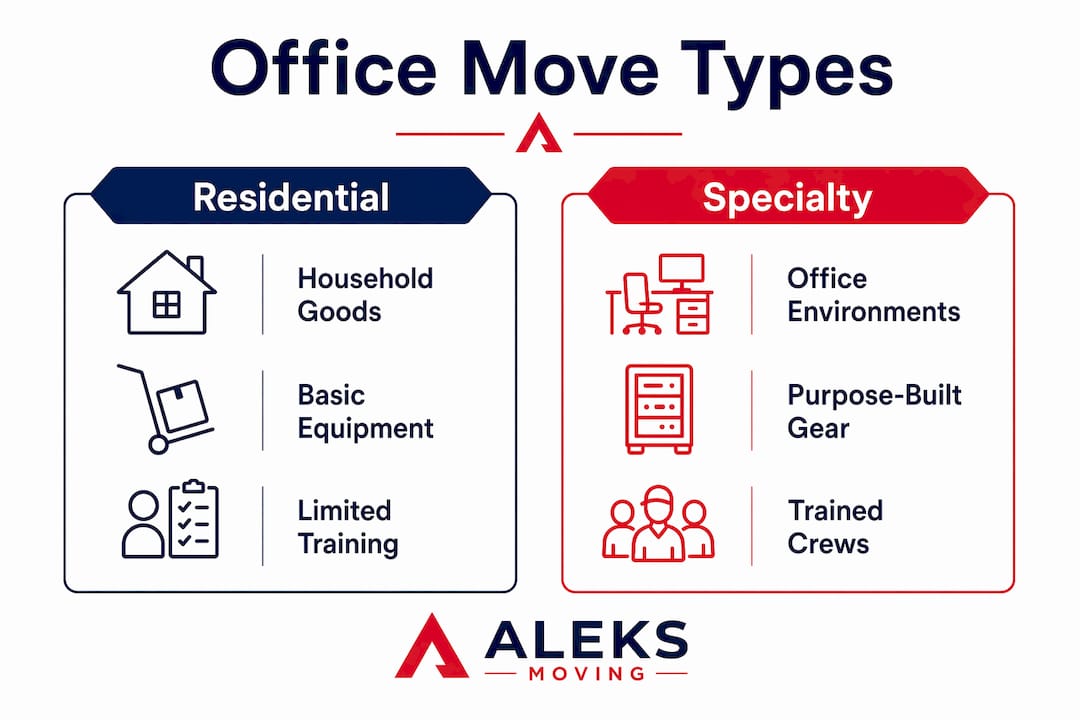
The distinction also extends to accountability. Direct carriers employ and supervise their own crews, which means consistent training and clear responsibility if something goes wrong. Brokers, by contrast, subcontract to whoever is available, which introduces unqualified crews and unpredictable outcomes. Verifying that your mover holds a valid carrier registration is a non-negotiable step before signing any contract.
Key characteristics of specialty office moving include:
- Scheduled access coordination with building management for freight elevators and loading docks
- Custom packing methods for electronics, monitors, and confidential documents
- Modular furniture disassembly and reassembly by trained technicians
- IT team collaboration to maintain data security and system integrity
- Certificate of Insurance (COI) submission to satisfy building requirements
How do you plan a specialty office move?
Planning an office move should begin 3–6 months before the move date, and up to 12 months in advance for large corporate relocations. That timeline allows enough room to set a realistic budget, assign a project lead, finalise floor plans, and coordinate with IT vendors.
A structured planning process follows these steps:
- Appoint a move coordinator. Assign one internal person to own the project. This person liaises between the moving company, IT, building management, and department heads.
- Audit your inventory. Document every piece of furniture, equipment, and IT hardware. Assign each item a destination location on the new floor plan before moving day.
- Confirm building logistics. Book freight elevator slots and loading dock times weeks in advance. Submit your mover’s COI to building management early, since COI approvals can take longer than expected and a missing certificate can halt the entire move.
- Coordinate with IT. Schedule IT disconnection, secure packing, and reconnection as a separate workstream. Confirm that internet, phone lines, and server access will be live at the new location before staff arrive.
- Set up utilities and services. Arrange electricity, internet, and security system activation at the new space before the move date.
- Label everything with colour codes. Assign a colour to each department or destination zone. Apply matching labels to every box, chair, and piece of equipment. This single step has the largest impact on how quickly staff can resume work after the move.
A full-service specialty mover provides end-to-end project management that covers packing, furniture disassembly and reassembly, IT equipment handling, secure transport, and post-move setup. Not all movers include every one of these services, so clarifying scope in writing before the contract is signed prevents costly gaps on moving day.
Pro Tip: Create a master spreadsheet that maps every item number to its destination room and workstation. Share it with your mover before the walk-through so the crew arrives on moving day already knowing where everything goes.

How do specialty movers handle IT infrastructure and sensitive materials?
IT equipment is the highest-risk category in any office relocation. Servers, network switches, and workstations are sensitive to static electricity, vibration, and temperature changes. Specialty movers use anti-static wrapping, server rack lifts, and custom crates to transport this equipment safely, and they coordinate directly with your IT team throughout the process.
The process for IT relocation follows a clear sequence. First, your internal IT team or a third-party vendor disconnects and labels all cables and hardware. The moving crew then packs each item using anti-static materials and loads it into climate-controlled transport containers. At the destination, the crew places each item in its mapped location before the IT team reconnects and tests every system. Work does not resume until systems are confirmed operational.
Confidential documents and sensitive files require a separate handling protocol. Specialty movers use locked, tamper-evident containers for physical records. Chain-of-custody documentation tracks every container from origin to destination. This matters for organisations in regulated industries such as finance, healthcare, and legal services, where mishandling records carries compliance consequences.
Key IT and sensitive materials handling practices include:
- Anti-static wrapping for all electronics and server components
- Server rack lifts to move heavy rack-mounted equipment without manual strain
- Custom crates for monitors, UPS units, and network hardware
- Locked transport containers for confidential files and physical records
- Post-move system verification before staff return to their workstations
Pro Tip: Ask your mover for a written IT handling protocol before the move. A reputable specialty mover will have a documented process for disconnection, packing, transport, and reconnection. If they cannot produce one, that is a clear warning sign.
What are the most common pitfalls in specialty office moving?
The most expensive mistakes in specialty office moving are preventable. They fall into a predictable set of categories that experienced movers see repeatedly.
“Failure to secure building management approval and COI in advance is the single most common cause of work stoppages on moving day. By the time the crew arrives, it is too late to fix a missing certificate.” — Hughes Marino, 2026
The most frequent pitfalls include:
- Hiring a broker instead of a direct carrier. Brokers subcontract to the lowest bidder, which means the crew that shows up may have no experience with modular furniture or IT systems. Always verify carrier registration through official government resources before signing.
- Skipping the labelling step. Inadequate labelling is the leading cause of extended downtime after a move. When items arrive without clear destination labels, staff spend hours locating equipment instead of working.
- Underestimating lead time. A 50-person office move requires at least 3 months of preparation. A 200-person corporate relocation needs closer to 12 months. Starting too late compresses every other step.
- Poor communication between stakeholders. The moving crew, IT team, building management, and department heads all need to operate from the same schedule. A single missed update can cascade into hours of delay.
- Ignoring freight elevator and dock scheduling. Building management regulations dictate when moves can happen and which access points are available. Failing to book these slots weeks in advance can force the crew to wait or reschedule entirely.
The role of logistics in office moves extends well beyond the physical transport of items. Coordinating access, insurance, and communication is just as demanding as the move itself.
Key takeaways
Specialty office moving requires trained crews, purpose-built equipment, and structured planning to protect IT infrastructure, modular furniture, and sensitive materials while keeping business downtime to a minimum.
| Point | Details |
|---|---|
| Start planning early | Begin 3–6 months out, or up to 12 months for large corporate moves. |
| Use a direct carrier | Verify carrier registration to avoid unqualified broker-assigned crews. |
| Label everything with colour codes | Colour-coded labelling is the fastest way to restore operations after a move. |
| Secure COI and building access early | Submit insurance certificates and book elevator slots weeks before moving day. |
| Coordinate IT as a separate workstream | Confirm all systems are operational before staff return to the new space. |
What I have learned from watching office moves go wrong
After years of working alongside businesses through commercial relocations, the pattern I see most often is this: organisations treat the move as a logistics problem when it is actually a project management problem. The physical transport of desks and servers is the easy part. The hard part is the six weeks before moving day, when approvals, schedules, and communication either come together or fall apart.
The businesses that move smoothly are the ones that assign a dedicated internal coordinator, hold weekly check-ins with their mover, and treat the floor plan as a living document that gets updated right up until moving day. The ones that struggle are the ones that hand the project to a facilities manager who is already running at full capacity and assume the mover will handle everything.
Choosing an experienced specialty mover with verified credentials matters enormously. A crew that has moved modular furniture systems before knows how to disassemble a Herman Miller workstation without stripping the hardware. A crew that has not will improvise, and that improvisation costs time and money. Do a pre-move walkthrough with your mover in person. Walk every room. Point out the fragile items. Ask specific questions about how they handle server racks. The quality of those answers tells you everything you need to know.
My strongest advice is to treat the office move as a business project with a budget, a timeline, milestones, and a named owner. That mindset alone will put you ahead of most organisations going through this process.
— Ali
Aleksmoving’s specialty office moving services for Ontario businesses
Aleksmoving brings over 18 years of experience to commercial relocations across Ontario, with a clear focus on protecting your equipment and keeping your team productive through the transition.
Our commercial relocation services cover the full scope of a specialty office move, from early planning and inventory mapping through to furniture reassembly and post-move setup. We handle modular workstations, IT infrastructure, and sensitive materials with trained crews and purpose-built equipment. Flat-rate pricing with no hidden fees means your budget stays predictable from the first quote to the final invoice. If you are planning an office move in Ontario and want a dependable partner from day one, contact Aleksmoving for a free upfront quotation.
FAQ
What is specialty office moving?
Specialty office moving is the professional relocation of office environments using trained crews and purpose-built equipment to protect IT infrastructure, modular furniture, and sensitive materials while minimising business downtime.
How far in advance should you plan an office move?
Office move planning should start 3–6 months before the move date, and up to 12 months in advance for large corporate relocations.
What is the difference between a broker and a direct carrier?
A direct carrier employs and supervises its own crew, ensuring consistent training and accountability. A broker subcontracts to third parties, which can result in unqualified crews and unpredictable outcomes.
Why is labelling so important in an office move?
Colour-coded labelling maps every item to its destination workstation before moving day, which is the most effective way to reduce setup time and restore operations quickly after the move.
What does a Certificate of Insurance (COI) have to do with an office move?
Most commercial buildings require movers to submit a COI before granting access. Without it, building management can stop the move entirely, resulting in costly delays and hourly overage charges.