Skip to content


To prepare appliances for moving, clean and dry each unit, drain all water lines, secure loose parts, measure your exit path, wrap exteriors with moving blankets, and call a licensed technician for any gas or hard-plumbed connections before moving day.
Here is your quick-reference checklist:
- Clean and dry every appliance completely to prevent mould during transit
- Defrost your fridge and freezer 24–48 hours before the move
- Drain water hoses on washers and dishwashers; close gas valves on stoves and dryers
- Secure shelves, drawers, and doors with straps (never tape directly to finished surfaces)
- Measure appliance dimensions and every doorway, hallway, and stairwell on the exit route
- Label all small parts in resealable bags and attach them to the appliance
- Hire a licensed technician for gas disconnections and a plumber for hard-plumbed water lines
Aleksmoving, Home Depot Canada, and North American Van Lines Canada all treat these steps as the baseline for a damage-free appliance move.
Key takeaways
Preparing appliances for moving safely comes down to timing, the right equipment, and knowing when a licensed professional is the only safe option.
| Point | Details |
|---|---|
| Defrost 24–48 hours early | Start the fridge and freezer defrost well before moving day to avoid a wet, heavy unit. |
| Gas lines need a licensed technician | Never disconnect or reconnect a gas stove, dryer, or BBQ line yourself; hire a certified professional. |
| Wait before plugging in the fridge | If transported on its side, wait at least as long as it was on its side (minimum 24 hours) before plugging in. |
| Measure the full exit path | Record appliance dimensions and every doorway, hallway, and stairwell width before moving day. |
| Aleksmoving handles the heavy work | Aleksmoving provides insured appliance moving across Ontario with flat-rate pricing and no hidden fees. |
Table of Contents
- What supplies do you need, and how do you measure before you start?
- General steps that apply to every appliance before you pack it
- Appliance-by-appliance preparation: what to do with each one
- What equipment do you need for safe appliance handling?
- When should you start, and how long do you wait after the move?
- What should you check after the move before turning appliances on?
- When should you hire professional movers or a licensed technician?
- What we see go wrong, and how to avoid it
- Aleksmoving makes appliance moves straightforward across Ontario
- Sources
What supplies do you need, and how do you measure before you start?
Getting the right materials together before you touch a single appliance saves you a last-minute run to the hardware store and prevents the frustrating discovery that your fridge won’t fit through the back door.
Supplies to gather or rent
Pick up or rent the following before moving day. Home Depot Canada carries most of these in-store and through its tool-rental programme:
- Appliance dolly with straps (essential for fridges, washers, and dryers)
- Moving blankets (at least four per large appliance)
- Ratchet straps (two or more per unit)
- Bubble wrap for glass shelves and fragile components
- Corrugated double-walled boxes in small and medium sizes for small appliances
- Painter’s tape for securing doors without damaging finishes
- Labelled resealable bags for screws, knobs, and small hardware
- Corner guards for protecting appliance edges and door frames
How to measure your exit route
Measure your appliance’s height, width, and depth first. Then walk the full exit path and record the narrowest point at each of these spots: doorway width and height, hallway width, stairwell width, any landing turns, elevator interior dimensions, and the truck loading opening. Add roughly 5 cm to your appliance measurement to account for the thickness of moving blankets on each side.
Whirlpool’s guidance on moving a refrigerator is clear: measure the unit and the entire exit path, and if the fridge won’t fit, remove the doors and keep the hardware in a labelled bag. The same logic applies to any large appliance.
Check for overhead obstructions too: light fixtures, handrails, and low ceilings on stairwells catch people off guard. If you are moving heavy kitchen appliances through a tight space, plan the tilt angle on the dolly before you lift.
Pro Tip: Before disconnecting anything, photograph every connection at the back of each appliance and take a close-up of the serial and model label. Those photos speed up reinstallation and support any insurance claim if damage occurs.
General steps that apply to every appliance before you pack it
Every appliance, large or small, goes through the same basic routine: unplug or shut off the power, clean and dry thoroughly, remove all loose parts, secure cords and doors, and label clearly. Following this order prevents the two most common problems: moisture damage during transit and lost hardware at the destination.
Here is a time-ordered checklist to keep you on track:
- Two weeks out: Locate owner manuals for each appliance. Note any manufacturer-specific moving instructions, particularly for fridges and washing machines.
- One week out: Use up perishable food. Begin cleaning interiors. Order or pick up packing supplies.
- 48 hours out: Start defrosting the fridge and freezer. Remove ice maker water lines. Run a cleaning cycle on the dishwasher and washing machine.
- 24 hours out: Finish defrosting. Dry all interior surfaces with towels. Remove and wrap glass shelves separately. Disconnect water lines from the washer and dishwasher.
- Moving day morning: Unplug all remaining appliances. Secure doors and cords. Load heaviest items first.
Gas connections and hard-plumbed water lines are not DIY tasks. A licensed technician must disconnect and reconnect gas appliances to avoid leaks and serious safety hazards — this applies to gas stoves, gas dryers, and gas BBQs.
Moisture is the hidden enemy of appliance moves. A washer drum that was not fully drained, or a fridge that was wiped but not dried, can develop mould or mildew within 24 hours in a sealed truck. Dry every surface, including drip pans and door gaskets, before wrapping.
Appliance-by-appliance preparation: what to do with each one
Fridge and freezer
Start defrosting well in advance before the move. Remove all food, pull out shelves and drawers, and wrap glass components in bubble wrap. Lay towels on the floor to catch meltwater, and never use metal tools to chip at ice. Anytime Removals recommends removing ice gently and letting it melt naturally.
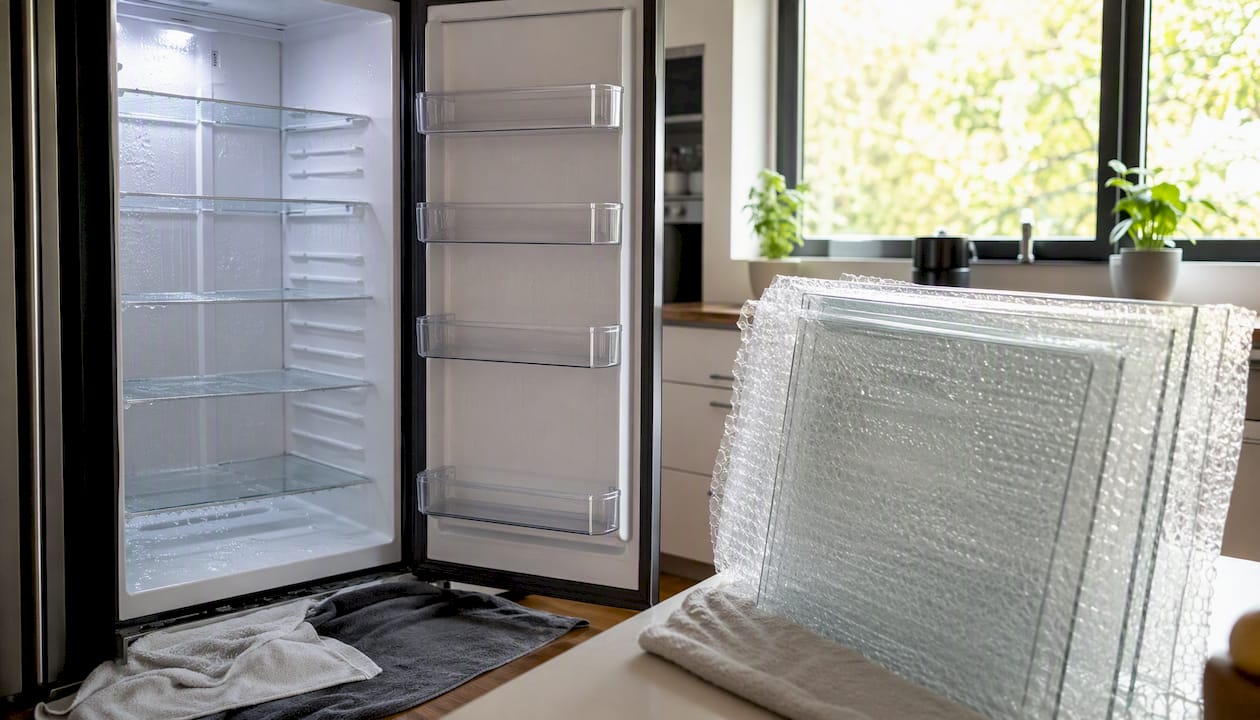
Once dry, secure the shelves inside or pack them separately. Wrap the exterior with moving blankets and use ratchet straps to hold the blankets in place. The Home Depot’s guidance specifically recommends strapping blankets around the unit rather than taping directly to the finish, which can pull off the surface coating. Use an appliance dolly for transport and keep the unit upright at all times if possible. For detailed dolly technique, see how to move a fridge with an appliance dolly.
Stove and oven
Remove all racks and clean out grease thoroughly. Grease left inside can shift and cause odours or fire risk. Secure knobs by removing them and packing in a labelled bag, or tape them gently with painter’s tape. For electric stoves, unplug and coil the cord. For gas stoves, call a licensed gas technician to disconnect the line. Do not attempt this yourself.
Dishwasher
Run a cleaning cycle, then disconnect the water supply and drain hose. If your dishwasher is hard-plumbed, a licensed plumber should handle the disconnection. Remove the dish racks and pack them separately. Secure the door with painter’s tape or a strap. For a full walkthrough on packing kitchen appliances, including dishwashers, Aleksmoving has a dedicated guide.
Washer and dryer
Drain the hoses completely and secure the washing machine drum using the transit bolts specified in your owner’s manual. If you no longer have the transit bolts, check the manufacturer’s website for the correct part number. Remove the lint trap from the dryer and disconnect the vent hose. For a gas dryer, a licensed technician must disconnect and cap the gas line before the unit moves.
Microwave and small appliances
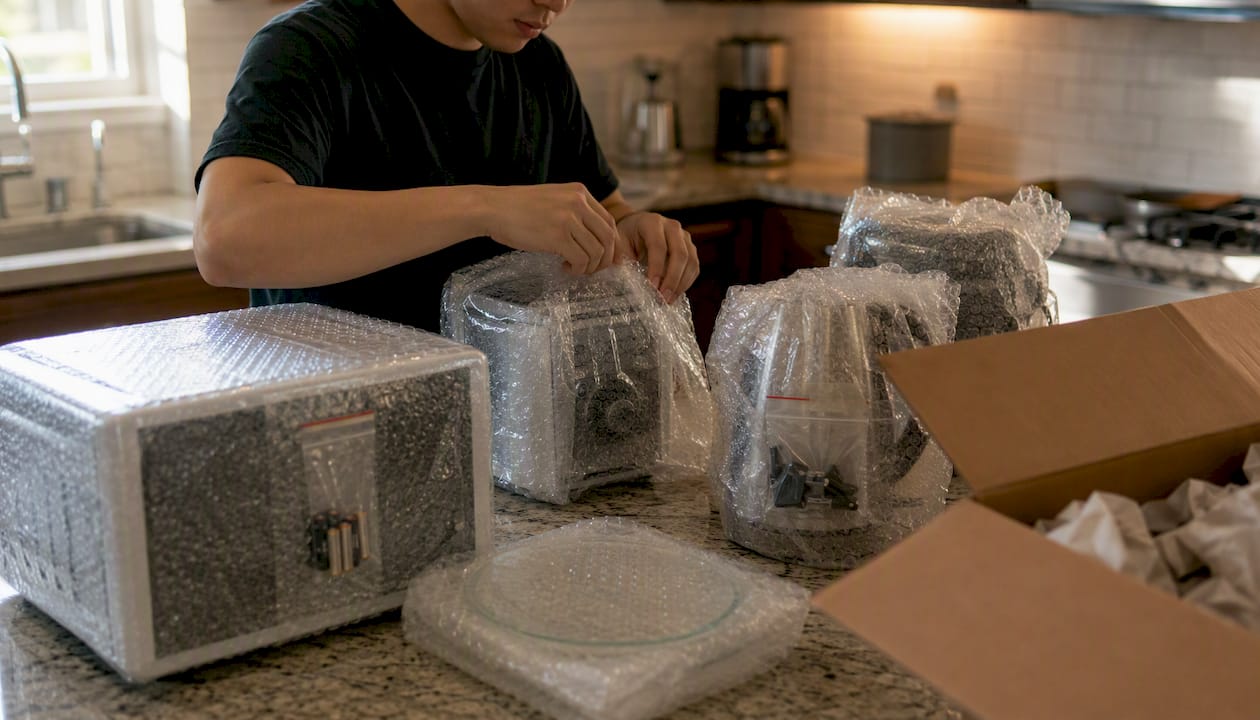
Small kitchen appliances should be cleaned, disassembled where possible, and wrapped individually. Remove the glass turntable from the microwave and wrap it separately in bubble wrap. Take out batteries from any appliance that has them. Use resealable bags for small parts and tape each bag to the appliance it belongs to. Pack each item in a snug box with crumpled packing paper filling any gaps to prevent shifting. Label every box with the appliance name and the destination room. For more detail, see how to pack small appliances for moving.
BBQ and gas grill
Close the cylinder valve fully. Remove the propane cylinder and transport it separately, upright, and in a ventilated space, following your provincial regulations for transporting fuel. Never place a propane cylinder inside an enclosed moving truck. At the destination, consider replacing the cylinder rather than transporting a partially used one, or arrange a certified tank transfer.
What equipment do you need for safe appliance handling?
Choosing the right gear prevents both injury and damage. Here is how the main options compare:
| Equipment | Best use | Key benefit |
|---|---|---|
| Appliance dolly with straps | Fridges, washers, dryers, stoves | Handles weight and tilt; straps keep unit secure |
| Standard hand truck | Smaller appliances, boxes | Lighter and more manoeuvrable in tight spaces |
| Moving blankets | All large appliances | Protects finish and cushions against wall contact |
| Ratchet straps | Securing units in the truck | Prevents shifting during transport |
| Corner guards | Door frames and appliance corners | Stops gouging on narrow exits |
| Ramp or skid board | Loading heavy units into the truck | Reduces strain and tipping risk |
Always use two or more people for any appliance over 45 kg. Lift with your legs, not your back, and keep the appliance’s centre of gravity over the dolly wheels. In the truck, place heavy appliances against the wall, strap them at two anchor points, and pad every contact surface. Leave space between units so they cannot knock against each other on the road.
Home Depot Canada’s tool-rental programme lets you rent appliance dollies and moving blankets by the day, which is practical if you only need them once. For professional-grade moving equipment guidance, Aleksmoving’s resource covers the full range of tools used on residential moves.
- Never lay a fridge on its side unless there is absolutely no alternative
- Keep washers and dryers upright to protect the drum bearings
- Pad the truck floor under heavy appliances to reduce vibration
When should you start, and how long do you wait after the move?
The timing of appliance preparation is as important as the steps themselves. Starting too late means a wet fridge on moving day; plugging in too soon after transport can damage a compressor.
Here is a simple countdown for the seven days before your move:
- 7 days out: Locate manuals, create an appliance inventory, and order supplies.
- 5 days out: Deep-clean interiors. Use up food in the fridge and freezer.
- 3 days out: Disconnect ice maker water lines. Confirm technician bookings for gas appliances.
- 2 days out: Begin defrosting the fridge and freezer. Lay towels to catch meltwater.
- 1 day out: Finish defrosting. Dry all surfaces. Drain washer and dishwasher hoses. Pack shelves and removable parts.
- Moving day: Unplug all appliances. Secure doors and cords. Load heaviest units first, against the truck wall.
- After the move: Let appliances settle before plugging in (see below).
How long to wait before plugging in
If your fridge was transported upright, most manufacturers allow plugging in after a few hours. If it was on its side at any point, GE Appliances recommends waiting at least as long as the unit was on its side, with a minimum of 24 hours, so the compressor oil can resettle. Manufacturer instructions vary, so always check your model’s manual for the exact guidance.
What should you check after the move before turning appliances on?
Before you plug anything in, do a quick visual inspection. Confirm the appliance is standing upright and level. Check for any visible leaks, dents, or damage to hoses and connections. Verify that the voltage and outlet type at the new home match the appliance’s requirements, particularly for electric stoves and dryers, which often need a 240V outlet.
For the fridge, follow the settling time above. For the washer and dryer, run a short empty cycle first and listen for unusual noises or vibration. If the washer vibrates heavily, check that the transit bolts have been removed and that all four feet are level on the floor. An unlevel washer wears out its drum bearings faster than almost any other cause.
If an appliance shows no power, check the circuit breaker before calling a technician. Unusual smells, especially a gas odour near a stove or dryer, mean you should not turn the unit on at all. Open windows, leave the space, and call a licensed gas technician immediately.
When should you hire professional movers or a licensed technician?
Some appliance tasks genuinely require a professional, and knowing which ones saves you from a costly mistake.
Call a licensed gas technician when:
- Disconnecting or reconnecting a gas stove, gas dryer, or gas BBQ line
- You smell gas at any point during preparation
- The gas shutoff valve is corroded or difficult to turn
Call a licensed plumber when:
- Your dishwasher or washing machine is hard-plumbed (no standard hose connection)
- Water supply lines are soldered or require specialized fittings
Hire professional appliance movers when:
- The appliance weighs more than two people can safely manage
- The exit route involves stairs, tight corners, or a narrow elevator
- You want warranty-backed handling and liability coverage for damage
Aleksmoving’s appliance moving service covers the full scope: appliance dollies and straps, moving blankets, coordination with licensed technicians, and insured transport across Ontario and Canada. With over 18 years of experience and flat-rate pricing with no hidden fees, the team handles the heavy lifting so you don’t have to. If you are unsure whether your move qualifies, do movers move appliances explains exactly what a professional crew covers.
Always keep your owner’s manual and follow the manufacturer’s moving instructions. Attempting gas or plumbing work without credentials can void your appliance warranty and, more seriously, create a safety hazard for your household.
What we see go wrong, and how to avoid it
The most common mistake we see on appliance moves is moving a fridge that still has food in it. Homeowners underestimate how long defrosting takes and end up with a wet, heavy unit on moving day. Start 48 hours out, not the night before.
Taping directly to stainless steel is the second most frequent error. Standard packing tape pulls the surface finish off stainless steel doors, leaving permanent marks. Use painter’s tape or, better yet, wrap with a moving blanket and strap the blanket in place.
The third one is forgetting to drain the washing machine hoses. A hose with residual water will leak in the truck, and that water can reach other boxes or appliances. Drain, then run a short spin cycle to pull out any remaining moisture before disconnecting.
One scenario we see regularly: a homeowner disconnects a dishwasher water line without shutting off the supply valve first. The result is water on the kitchen floor and a soaked cabinet. Always shut off the water supply at the valve under the sink before touching any hose.
Check your appliance warranties before you start. Some manufacturers require professional installation after a move to keep the warranty valid. A five-minute check of the warranty card or the manufacturer’s website can save you an expensive dispute later.
Aleksmoving makes appliance moves straightforward across Ontario
Moving appliances on your own is manageable for small units, but for fridges, gas stoves, washers, and dryers, the risk of injury or damage is real. Aleksmoving provides a dependable, fully equipped appliance moving service across Ontario and Canada, with flat-rate pricing and no hidden fees from the first quote.

The team arrives with appliance dollies, ratchet straps, and moving blankets, and can coordinate with licensed gas technicians and plumbers when your move involves gas lines or hard-plumbed connections. Every move is insured, and the flat-rate quote you receive upfront is the price you pay.
Request a free quote through the residential moving service page, reach the team by phone, WhatsApp, or the online contact form, and get a clear, no-surprise estimate for your appliance move. Over 18 years of experience across Ontario means the crew has handled every tight stairwell and narrow doorway you can imagine.
Sources
- How to move a refrigerator | Whirlpool
- How to move a refrigerator | The Home Depot
- How to pack kitchen appliances for moving | Moving by Design
- How to prepare your fridge-freezer for moving | Anytime Removals