
A moving truck that stops only for active loading in a legal spot usually needs no permit in Oakville. If the truck or a container occupies the street for longer, closes a lane, or needs traffic control, you need a Temporary Street Occupation permit from the Town’s Transportation and Engineering department. Standard temporary parking permits exclude commercial vehicles, so they won’t cover a moving truck.
TL;DR:
- Courtesy permits are free and cover up to 15 days per vehicle annually, with a maximum of five vehicles per address.
- Road closure applications must reach the Director at least 20 business days before the move, and the Town may require a traffic management plan.
- Eligible addresses can obtain paid parking permits for passenger vehicles at $6 per day or $55 for 30 days.
- Approved TSO permits are not transferable, require active insurance before work begins, and must remain on site throughout the permitted activity.
Table of Contents
- What permits exist in Oakville that affect moving trucks
- Active loading vs temporary street occupation: how to tell which you need
- When you do not need a permit (practical moving-day situations)
- How to apply for a TSO permit or a paid temporary on-street parking permit in Oakville
- Fees, timelines and enforcement to plan for
- How professional movers handle permits and traffic control
- Why most permit trouble comes from last-minute planning
- How we can help with your Oakville move and permit coordination
- FAQ
- Sources
What permits exist in Oakville that affect moving trucks
Two separate regimes apply to a move, and mixing them up is the most common way residents end up with a fine. The Town runs temporary on-street parking permits for passenger vehicles, and it issues a different permit when a truck or container takes up part of the roadway.
Here is how the pieces fit together:
- Courtesy temporary on-street parking permits: free, issued online for short-term needs, up to 15 days per vehicle per year and up to five vehicles per address. They are not available for commercial motor vehicles, trailers, or vehicles with attached trailers, according to the Town’s paid on-street permit page.
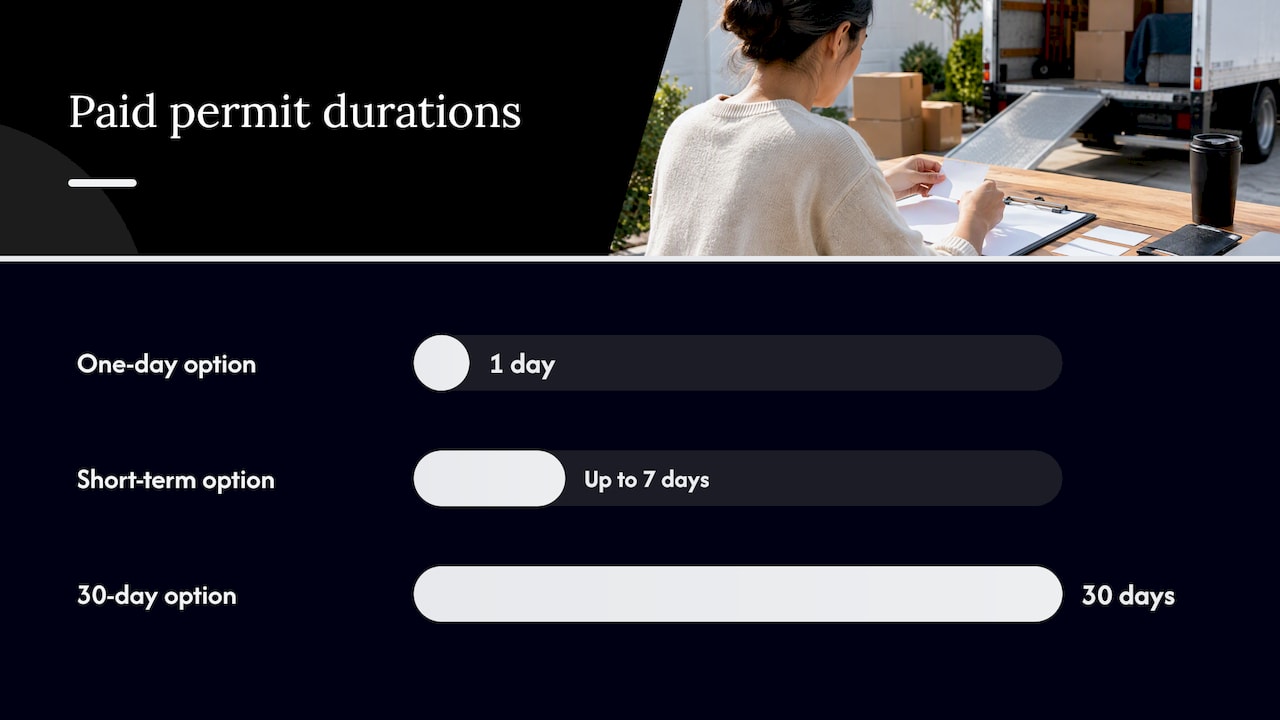
- Paid temporary on-street parking permits: available at eligible addresses shown on the Town’s paid parking map, such as areas south of Dundas Street. Durations run from one day to multiple days up to seven, or 30 days. Cost examples are $6 per day and $55 for 30 days.
- Temporary Street Occupation (TSO) permits: issued by Transportation and Engineering for any use of the municipal right-of-way that affects the roadway.
The Town also separates visitor parking from occupation by commercial equipment. Its temporary on-street parking procedure excludes commercial vehicles from the courtesy permits, and using the wrong permit is a frequent cause of unexpected fines on moving day.
A visitor permit is not a way to reserve curb space for a truck. If your plan involves a truck or container sitting on the street or boulevard, the TSO route is the one that applies. If your move is small and your driveway is clear, you may need none of these.
Active loading vs temporary street occupation: how to tell which you need
Oakville has no permanent on-street parking, and on-street time limits are enforced. The Town’s on-street parking rules let moving trucks stop while actively loading or unloading. “Active” is the key word. It doesn’t stretch to parking the truck all day for a multi-room move if it obstructs traffic or breaks safety rules.
A TSO permit is required when a truck or container must occupy the right-of-way longer than active loading, or when placement needs a road or lane closure. The Town’s TSO page sets this out.
Work through these checks in order:
- Can the truck fit in your driveway? A truck that sits entirely on private property generally needs no town permit.
- Will it stay parked on the street between loads? A brief stop to load directly to your door is active loading. A truck left standing for hours while the crew packs rooms is closer to occupation.
- Does the street allow traffic to pass? On a narrow street, a parked truck that blocks a lane can require traffic control, which triggers a TSO.
- Is a container going on the street or boulevard? Moving containers placed there are treated as temporary street occupations, with the same permitting process as large trucks.
- Is the vehicle oversized or overweight? That falls under the Town’s road corridor permits, needed when the vehicle and load exceed Highway Traffic Act limits.
Two examples show the difference. A townhouse with a wide driveway can load straight from the truck with no permit. A narrow-street home where the crew needs extended access, with the truck blocking part of the lane, is a TSO situation. Enforcement on the second scenario can mean a parking ticket or an order to move the truck mid-move.
Pro Tip: If you’re unsure which side of the line you’re on, ask Transportation and Engineering before moving day, not during it.
When you do not need a permit (practical moving-day situations)
Most Oakville moves never touch the permit system. If you plan well, yours may not either.
These situations generally stay permit-free:
- Short active loading in a lawful spot: a truck stopped only while the crew carries items to and from your door doesn’t need a TSO.
- Driveway use: keeping the truck or container fully within your private driveway is the simplest way to avoid town paperwork. Check that your truck fits within the zoning limits on residential lots, which cap a commercial vehicle in a driveway at 3000 kg gross weight, 6 metres in length and 2.3 metres in height under the parking and loading regulations.
- A smaller truck and a larger crew: measuring your load and sending more hands cuts the time the truck sits at the curb.
- Visitor permits for personal vehicles: these are fine for the crew’s cars or your helpers, but never for the moving truck itself.
If you do plan to park on a sign-restricted street, read the posted signs first. Overnight rules and time limits still apply. A paid on-street permit may help where your address is eligible, but only for the passenger vehicles it covers.
For help sequencing everything around the permit question, our Oakville moving checklist walks through the weeks before your move date. A partner-written house moving checklist for Canada also covers planning well ahead.
How to apply for a TSO permit or a paid temporary on-street parking permit in Oakville
Applications for a TSO go to the Town’s Transportation and Engineering department. The Director signs off on road closures, so those applications carry the longest lead times.
Follow these steps:
- Decide which permit you need. Use the checks above. A TSO is for truck or container occupation, while a paid permit is for eligible passenger vehicles.
- Confirm your address is eligible if you’re after a paid on-street permit, using the Town’s paid parking map.
- Gather your details (listed below).
- Submit the application to Transportation and Engineering, well before the move.
- Wait for approval and conditions. The Town may attach extra requirements.
- Keep the permit on site during the move.
Timing matters more than any other detail. Submit TSO applications well ahead, and contact the Town about the required lead time for road closure applications, per the TSO page. Practitioners suggest allowing ample time for any move needing a traffic management plan.
Have these items ready:
- Applicant name and contact information
- Property address
- Licence plate number(s)
- Vehicle dimensions
- Proof of insurance
- A traffic management plan, where required
- Written consent for use of adjacent properties, if applicable
Where an occupation significantly restricts roadway access, the Town may require a traffic management plan following the Ontario Traffic Manual, Book 7.
After approval, the conditions are firm. Permits are non-transferable, insurance must be in effect before work begins, and the permit must be on site during the activity. The Director may add conditions or require public notice. If you use metered parking spaces, additional fees apply.
Fees, timelines and enforcement to plan for
Cost depends on the permit type. Paid on-street parking permits are the cheapest option where your address qualifies. Occupations involving metered spaces add fees on top.
Plan around these points:
- Paid on-street permit costs: $6 per day or $55 for 30 days, only in eligible areas such as south of Dundas Street.
- Courtesy permit limits: free, up to 15 days per vehicle per year, up to five vehicles per address, and never for commercial vehicles.
- Paid permit durations: one day, multiple days up to seven, or 30 days.
- Approval timelines: build in buffer time, since road closures take the longest.
- Enforcement: violations fall under the Town’s consolidated traffic and parking by-laws, which set administrative penalties and offence amounts.
Road closures must reach the Director at least 20 business days before the proposed date. (Town of Oakville) That is the fixed point to plan from if your move closes a lane or a road.
Penalty amounts are set out in the Traffic Control By-law and the Parking APS By-law, whose Schedule “A” lists administrative penalties for parking without a permit or valid payment. Check those schedules for the current amounts before you rely on a figure from anywhere else.
How professional movers handle permits and traffic control
A good mover takes the permit question off your plate before it becomes a problem. At our company, our crews assess whether a TSO is likely needed from the address, street width and truck size, and we can advise on the traffic management plan the Ontario Traffic Manual, Book 7 asks for where it applies.
Here is what we do on a permit-sensitive move:
- We check the street layout and driveway access before booking a truck size.
- We plan crew timing and truck placement so the move stays within permit conditions.
- We verify insurance coverage so it’s in place before work begins.
- We coordinate arrival windows so the truck isn’t idling on the street longer than necessary.
If you’re comparing movers, ask each of them the same four things: who files the permits, who pays the town fees, can they show proof of insurance, and what arrival window will they commit to. Clear answers up front save you from surprises on the day. You can read more about our parking coordination on our moving truck parking page.
Pro Tip: Ask your mover to put the permit responsibilities in writing, including who is on site with the permit during the move.
Why most permit trouble comes from last-minute planning
Permit problems on moving day almost never come from the rules themselves. They come from timing. The three mistakes we see most often are assuming a visitor permit covers a moving truck, leaving the truck on a narrow street for the whole move, and starting the permit conversation a few days out when a lane closure needs weeks.
My view is that residents underestimate how much a single early phone call to the Town, or to a mover who knows Oakville’s streets, can save. The rules are not complicated, but the lead times are unforgiving. If your street is tight or your move is large, treat the permit as step one, not an afterthought. Start the conversation as soon as you have a move date.
— Ali
How we can help with your Oakville move and permit coordination
A permit-sensitive move goes smoother when one team handles the logistics. We offer local moving, residential moving, and Oakville-based support through our Oakville moving company page, with pricing details available when you request a quote.
What we can take on for you:
- Assessing whether your move needs a TSO permit
- Supporting permit paperwork and coordinating traffic management
- Verifying insurance and keeping the move within permit conditions
- Packing, storage and bin rental to cut down loading time
To get a quote, have your move date, both addresses, estimated truck or container size, and whether you have driveway access ready. Contact us through our local moving page and we’ll take it from there.
FAQ
Do I need a permit for a moving truck in Oakville?
Not for short active loading in a legal spot. If the truck or a container occupies the street longer, or needs a lane or road closure, you need a Temporary Street Occupation permit from Transportation and Engineering, as set out on the Town’s TSO page.
Can I use a temporary parking permit for my moving truck?
No. Commercial vehicles are excluded from the courtesy temporary on-street parking permits, so they won’t cover a moving truck. A TSO permit is the route for a truck that must stay on the street.
Do I need a permit to park on my street in Oakville?
Oakville has no permanent on-street parking, and on-street time limits are enforced. Where an address is eligible, a paid on-street permit allows longer parking, with cost examples of $6 per day or $55 for 30 days, per the paid permit page.
How far ahead should I apply for a TSO permit?
Apply well ahead, and allow 20 business days when a road closure is involved. Practitioners suggest about three weeks for a move that needs a traffic management plan.