Skip to content


The fastest way to avoid business disruption is an after-hours or weekend move paired with a staged IT cutover and one project coordinator. Start by contacting your landlord and your internet provider now, since freight elevator bookings and leased-line orders both run on lead times that can stretch past 60 to 90 working days, and most buildings require a Certificate of Insurance before movers can touch the freight elevator.
TL;DR:
- Order business internet immediately after lease signing: provisioning commonly takes 4 to 8 weeks, while leased lines may require 60 to 90 working days.
- Confirm building access and freight elevator rules early, and arrange a Certificate of Insurance naming the building as additional insured before movers arrive.
- Test the new network while the old site stays live, then move a pilot group before staff switch after wireless, VPN, phones, and badges pass.
- Compare overtime, security, and landlord fees with the cost of daytime downtime; small offices with light IT may be better served by phased weekday moves.
Table of Contents
- Timeline and lead times: what to order and when
- Building rules, landlord requirements and insurance to sort before after-hours access
- IT and telecom: parallel builds, cloud migration, and verification checks for zero-downtime
- Move-night runbook: an hour-by-hour template and staged cutover checklist
- Staffing, vendor coordination and communications plan for after-hours moves
- Packing, inventory and asset tagging best practices to speed reassembly
- Safety, compliance and rollback options if something goes wrong
- How Aleks Moving helps with after-hours office relocations
- When an after-hours move is the right call, and when it isn’t
- How Aleks Moving can help you plan your after-hours move
- FAQ
- Sources
- Authoritative tenant manuals and IT move resources
Timeline and lead times: what to order and when
A simple office move with light IT needs can run on roughly an eight-week timeline. A move with servers, phone systems or multiple departments needs 12 to 16 weeks or more to plan properly, mostly because telecom and building approvals move slower than the packing itself.
Order internet and cabling the day your new lease is signed. Business-grade circuits commonly take 4 to 8 weeks to provision, and traditional leased lines can take far longer.
- Book your freight elevator and building access windows as soon as a move date is set.
- Order your new circuit or leased line immediately after signing the lease.
- Confirm cabling and workstation setup at least four weeks before move night.
- Reserve movers and specialty crews once the IT cutover plan is locked.
Our office move planning steps for managers walks through how to sequence these bookings against your actual move date.
Building rules, landlord requirements and insurance to sort before after-hours access
Office landlords generally restrict moves to evenings, overnight windows or weekends, and many will not grant freight elevator access without proof of insurance on file. The 16 York tenant manual is typical of commercial buildings in requiring both after-hours scheduling and a Certificate of Insurance before movers set foot on-site, and most buildings also charge for security staff or after-hours HVAC and lighting.
- Confirm your after-hours access window and freight elevator booking directly with building management.
- Arrange a Certificate of Insurance naming the building as additional insured, which our COI guide for movers explains in plain terms.
- Budget for security guard or elevator operator fees, which buildings often bill separately.
- Confirm floor and wall protection requirements in writing with your moving crew.
Pro Tip: Ask your landlord for their tenant move-out checklist a full month early. It usually lists every fee and form you’d otherwise discover on move night.
IT and telecom: parallel builds, cloud migration, and verification checks for zero-downtime
Treat your move the way an IT team treats a risky system change: write a runbook, name an owner and set pass or fail checks before anyone touches a cable. The OpsMatters guide to office relocation frames this directly, noting that treating a move as a high-risk IT change, complete with rollback and verification criteria, materially cuts post-move outages.
Build the new office’s network and core infrastructure in parallel with the old one still running. Where possible, migrate email, files and line-of-business apps to cloud services before move weekend, which reduces physical hardware risk and can remove the need to move servers at all. Our IT equipment relocation guide covers the hardware side in more depth.
A laptop that can reach VPN, the internal wiki and a video bridge, with a badge that opens the server room, is the kind of testable checkpoint that belongs in your runbook rather than a vague “network’s up” note.
- Confirm Wi-Fi reaches every desk zone, not just the areas nearest the access point.
- Test VPN, phone lines and badge access as separate pass or fail checks.
- Verify printers, copiers and the postage meter reconnect to the new network.
- Keep the old circuit live until every check above passes.
Move-night runbook: an hour-by-hour template and staged cutover checklist
A written runbook turns move night from guesswork into a sequence anyone on the team can follow. Build yours around a staged cutover: infrastructure first, then a small pilot group as a canary, then everyone else.
- 6:00 PM: coordinator confirms building access, security and freight elevator with the landlord contact.
- 7:00 PM: movers begin relocating furniture, packed equipment and labelled boxes.
- 9:00 PM: IT team activates core network gear and confirms internet circuit is live.
- 11:00 PM: pilot group workstations go online and run verification checks.
- 1:00 AM: full staff equipment connects once the pilot group passes every check.
- 6:00 AM: coordinator signs off the site as operational or triggers rollback.
A pilot week using a volunteer group in production is an inexpensive way to catch problems that a site survey alone would miss, such as Wi-Fi dead zones or permission errors.
- Rollback trigger: VPN or phone verification fails after two attempts.
- Rollback trigger: freight elevator or building access is lost mid-move.
- Sign-off criteria: every department’s pilot desk passes network, phone and badge checks.
Staffing, vendor coordination and communications plan for after-hours moves
One project coordinator should own the whole night, with a simple vendor matrix underneath them: internet provider, movers, cabling contractor, landlord contact, security and copier or phone vendor, each with a named point of contact and a phone number.
- Give the coordinator authority to call a rollback without needing sign-off from leadership mid-move.
- Keep an emergency contact sheet on-site covering the landlord, building security and every vendor.
- Protect your on-call IT team’s sleep schedule by rotating shifts rather than running one person all night.
- Plan a day-one hypercare window, with IT or vendor support physically on-site for the first morning.
Our office relocation planning guide covers how to structure these roles before move week arrives.
Packing, inventory and asset tagging best practices to speed reassembly
Fast reassembly starts with a map, not a truck. Match every employee to a desk number and every piece of equipment to a port before boxes get taped shut, and keep a simple inventory with photos of cable setups behind monitors and docking stations.
- Label monitors, docks and peripherals with the desk number they’re returning to.
- Tag servers and networking gear separately, since these get reconnected first.
- Photograph cable arrangements before disconnecting anything.
- Keep a single spreadsheet tracking box number, contents and destination desk.
Pro Tip: A coloured sticker system by department speeds up placement far faster than written labels alone when movers are unpacking under time pressure.
Our guide to planning a smooth office move has more detail on packing sequencing.
Safety, compliance and rollback options if something goes wrong
Floor and wall protection, padded freight elevators and on-site security are standard requirements in most commercial buildings, and tenant manuals like the one for Simcoe Place list them as routine checklist items rather than extras.
- Keep your old lease overlapping by a few days if your budget allows, as a full rollback option.
- Keep the old internet circuit active until the new site passes every verification check.
- Have a 4G or 5G fallback router on hand in case the new circuit is delayed.
- Confirm your mover’s insurance and your own COI cover after-hours work specifically.
How Aleks Moving helps with after-hours office relocations
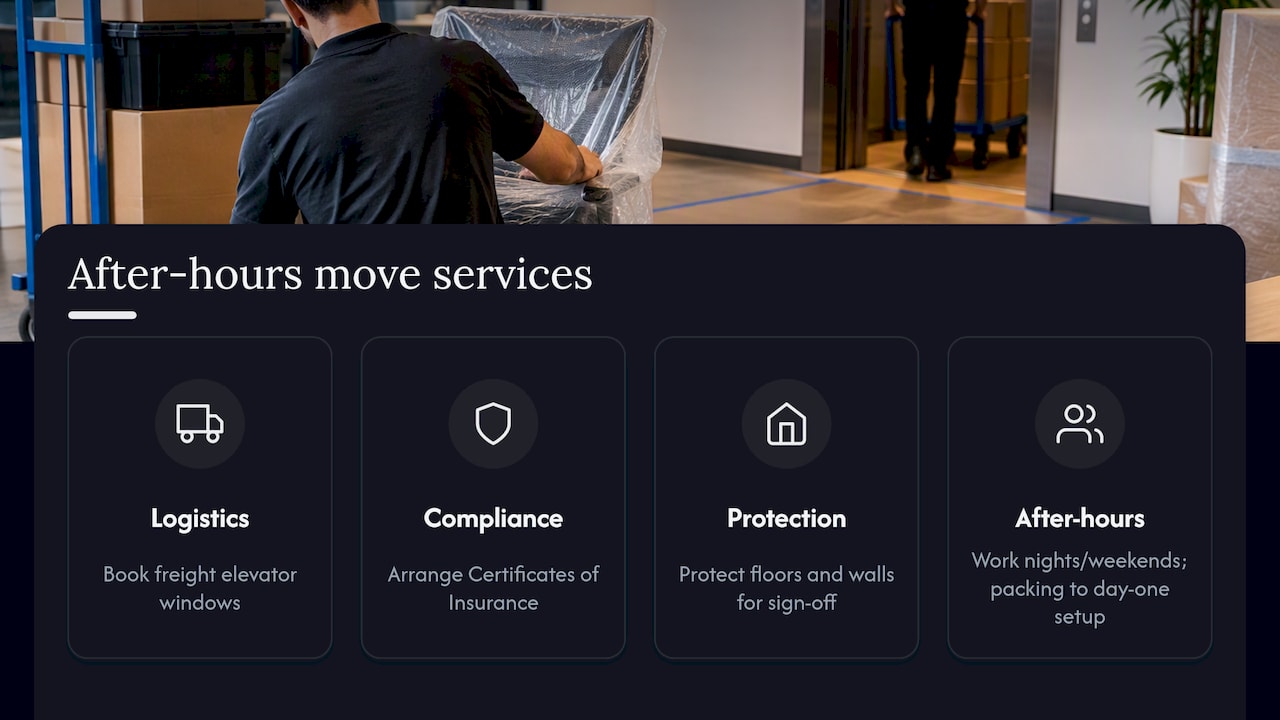
We have extensive experience handling the physical side of moves, including sorting freight elevator bookings, arranging Certificates of Insurance, and protecting floors and walls so building management signs off without delay. Our crews work the after-hours and weekend windows that commercial leases require, and our commercial moving service covers everything from packing to day-one setup support.
When an after-hours move is the right call, and when it isn’t
Overtime premiums for after-hours crews, security staff and landlord fees are only worth paying when daytime downtime would cost more than the premium itself. A small office with light IT needs often does better with a phased weekday move, spread over a few evenings rather than one high-pressure overnight push. Start by costing both options before booking a date.
— Ali
How Aleks Moving can help you plan your after-hours move
We know after-hours moves come with more moving parts than a standard relocation, so our team works directly with landlords, freight elevator schedules and Certificates of Insurance to keep move night on track. Before requesting a quote, have these ready:

- Your preferred move date and after-hours access window.
- Floor access details, including freight elevator and loading dock restrictions.
- Whether your building requires a Certificate of Insurance.
- An estimated desk and workstation count.
Our pricing is transparent, with no hidden fees once the quote is set. Reach out through our commercial moving page to get started, or check our bin rental options if you need temporary storage during a staged clearout.
FAQ
What is an after-hours office move?
An after-hours office move takes place outside standard business hours, typically evenings, overnight or weekends, so staff experience little or no disruption to their workday. Buildings often require this scheduling as a condition of access, alongside a Certificate of Insurance and freight elevator booking.
How far in advance should we book an after-hours office move?
Simple moves run on roughly an eight-week timeline, while moves involving significant IT infrastructure need 12 to 16 weeks or more. Internet and leased-line orders should go in as soon as your new lease is signed, since provisioning can take 4 to 8 weeks or longer.
Do we need a Certificate of Insurance for an office move?
Most commercial buildings require a Certificate of Insurance naming the building as additional insured before movers can access freight elevators, as outlined in tenant manuals like 16 York’s. Your moving company or insurance provider can typically issue this document within a few business days.
What is a staged IT cutover and why does it matter?
A staged cutover means building and testing the new office’s network while the old office stays live, then moving a small pilot group first as a canary test before the full team switches over. This approach, outlined in guidance on treating relocations as IT change projects, catches problems before they affect everyone.
Can Aleks Moving handle the freight elevator and insurance paperwork?
Yes, our commercial moving team coordinates freight elevator bookings, floor protection and Certificate of Insurance requirements directly with building management as part of an after-hours office move. Details on what we handle are available on our commercial moving service page.
Sources
- 16 York tenant manual (Cadillac Fairview)
- Minimise downtime during office relocation (Cloudswitched)
- Office relocation as an ops project (OpsMatters)
Authoritative tenant manuals and IT move resources
These sources back the timelines, building rules and IT guidance covered above, including tenant manual requirements for freight elevators and insurance, and technical guidance on parallel infrastructure and move runbooks.