Skip to content


Plan on 3 to 5 hours for a studio or one-bedroom move, 5 to 8 hours for a three-bedroom home, and a full day or more for anything larger, assuming boxes are packed and access is straightforward. The quick-reference table below breaks this down by home size and crew, and a simple formula further down lets you adjust those numbers for stairs, elevators, or that piano nobody wants to lift.
TL;DR:
- Move times can extend significantly when stairs, elevators, or specialty items like pianos and fragile art are involved beyond the typical time estimates.
- Adding more movers can reduce total move duration mainly for larger homes, but the cost-benefit depends on move size and specific challenges like tight elevator windows.
- Proper preparation, such as sealing boxes, disassembling furniture, and reserving parking or elevator access, can save 30 to 90 minutes on moving day.
- Long-distance moves extend from a single day to multiple days due to driving, staging, and crew changes, often requiring more than just several hours.
- Contractors typically bill from the time the truck arrives at the old address until it departs the new one, so clarifying scope and readiness impacts the final cost.
Table of Contents
- Average moving time by home size: a quick-reference table
- What factors commonly add time to a move?
- Does adding more movers actually save time?
- How long does packing take compared to moving day?
- How do you calculate your own move-time estimate?
- What steps actually shorten move day?
- How does a long-distance move change the timeline?
- How do movers measure billed time?
- What movers notice most on move day
- Get a straight answer on your move time with Aleks Moving
- Sources
- FAQ
Average moving time by home size: a quick-reference table
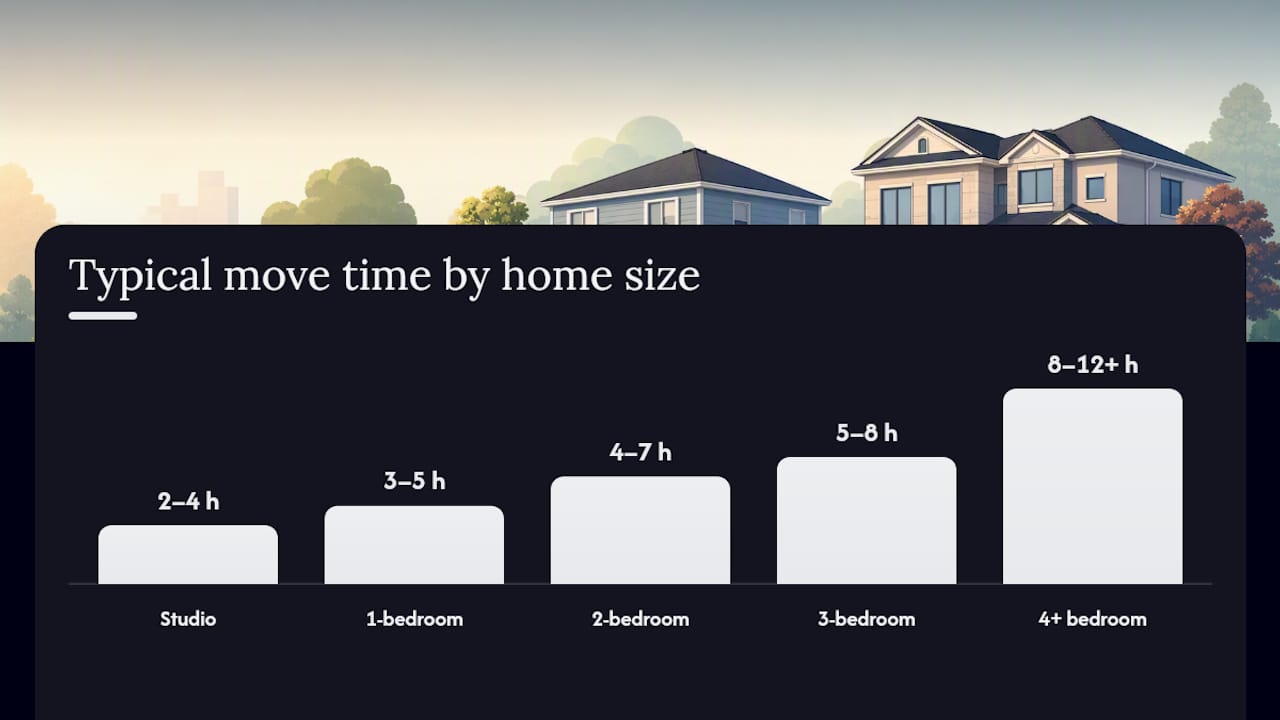
Every mover measures things slightly differently, but the patterns across the industry are consistent enough to plan around. Aggregated data from All My Sons Moving & Storage puts the average one-bedroom local move at about 3.92 hours and a two-bedroom at roughly 5.09 hours, numbers that line up closely with what Two Men and Van and the Moving Muscle blog report from their own move data.
| Home size | Typical time range | Recommended crew size |
|---|---|---|
| Studio | 2–4 hours | 2 movers |
| 1-bedroom | 3–5 hours | 2 movers |
| 2-bedroom | 4–7 hours | 2–3 movers |
| 3-bedroom | 5–8 hours | 3–4 movers |
| 4+ bedroom | 8–12+ hours | 4–5 movers |
These ranges assume boxes are sealed and labelled before the crew arrives, that there’s clear access to both the pickup and drop-off (a driveway or an elevator that doesn’t require a reservation window), and that there are no oversized specialty items like pianos, safes, or large art pieces. Add any one of those complications and the low end of the range disappears fast.
We built this table from industry-sourced averages rather than a single company’s numbers, because move times vary enough between crews, cities, and seasons that no single dataset tells the whole story. Treat it as a planning baseline, then adjust using the factors in the next section.
What factors commonly add time to a move?
The table above assumes a best-case scenario. Real moves rarely hit that mark exactly, and the gap almost always comes down to a short list of predictable culprits.
- Parking and loading permits: if the truck can’t park within a reasonable carry distance, every trip to the truck takes longer, sometimes by 20 to 30 minutes per hour of work.
- Elevator booking windows: buildings with regulated move windows or required elevator reservations are among the most common bottlenecks, and an uncoordinated window can double an expected move time.
- Stairs and long carries: each flight of stairs adds a real time penalty per trip, especially with heavier furniture, and that penalty multiplies across dozens of trips.
- Specialty and fragile items: pianos, glass tabletops, and artwork require careful wrapping and slower handling, which our guide to handling specialty items in Ontario covers in more detail.
- Packing readiness: unsealed boxes, loose items, and last-minute sorting are the single most common cause of delay that movers report, turning a straightforward job into a scramble.
Apartment moves with elevator restrictions or narrow hallways often take longer than a similarly sized house move with driveway access, even when the inventory is nearly identical, according to Two Men and Van’s breakdown of timelines by access type.
Does adding more movers actually save time?
Adding crew members shortens total hours on site, but only up to a point, and the payoff depends on how much inventory you’re moving.
- Two movers handle a studio or one-bedroom efficiently; a third or fourth mover mostly helps with larger, heavier loads rather than small apartments.
- For a three-bedroom or larger home, a bigger crew often finishes in a fraction of the time a two-person team would need, because more hands can load and carry simultaneously instead of queuing at the truck.
- Extra movers pay off most clearly when you’re working against a tight elevator booking window, a lease closing deadline, or a home packed with bulky furniture.
- A typical crew splits roles naturally: one driver/lead who manages the truck and sequencing, and two or more loaders who handle carrying and wrapping.
For time-sensitive moves, paying for one more mover is often cheaper than paying overtime rates on a smaller crew, according to Moving Muscle’s analysis of crew efficiency.
Pro Tip: Ask your mover for two quotes, one at your default crew size and one with an extra person, so you can compare the cost-per-hour trade-off directly instead of guessing.
How long does packing take compared to moving day?
Move-day hours and packing hours are two completely different budgets, and conflating them is where a lot of moving stress comes from.
- DIY packing typically stretches across seven weeks to two months for a full household, according to ConsumerAffairs’ research, especially once you factor in sourcing boxes, sorting belongings, and packing around a work schedule.
- Full-service packing compresses that same job into a few days to about a week, since a trained crew can pack an entire kitchen in the time it takes a homeowner to wrap a dozen mugs. Our packing workflow guide walks through what that process actually looks like.
- Unpacking almost always takes longer than people expect, often weeks rather than days, so prioritize unpacking the kitchen and bedrooms first and let garage boxes wait.
If you’re packing yourself, our guide to packing fragile items can shave real time off move day by reducing how much re-wrapping the crew needs to do on site.
How do you calculate your own move-time estimate?
You don’t need a mover on site to get a reasonably accurate number. Add up these four components:
- Base time from the table above, matched to your home size.
- Stairs or elevator penalty: add roughly 15 to 30 minutes per flight of stairs, or extra time if the elevator needs a booked window.
- Specialty items: add 30 to 90 minutes for each oversized or fragile piece, such as a piano, large mirror, or antique cabinet.
- Readiness buffer: add an hour if you know some boxes won’t be sealed by the time the crew arrives.
For example, a two-bedroom apartment on the third floor with no elevator, plus a piano, might run 4 to 7 hours base, plus 30 to 60 minutes for stairs, plus 60 to 90 minutes for the piano, landing somewhere around 6 to 9 hours total. If your estimate feels uncertain, ask for an in-home or virtual walkthrough rather than guessing over the phone.
What steps actually shorten move day?
A handful of small actions consistently shave real time off a move, and none of them require hiring anyone extra.
- Seal every box completely and label it by room, not by contents.
- Disassemble beds, large shelving, and table legs before the crew arrives.
- Reserve parking and elevator windows in advance, especially in condo buildings.
- Have basic tools out and accessible for reassembly at the new place.
- Clear a direct walking path between the door and the truck.
Combined, these steps commonly shave 30 to 90 minutes off a move that would otherwise involve waiting on decisions or improvised disassembly.
Pro Tip: Assign one person as the point of contact for access and decisions on move day. Crews lose real time when they have to track someone down to ask where a box goes or whether a door needs propping open.
How does a long-distance move change the timeline?
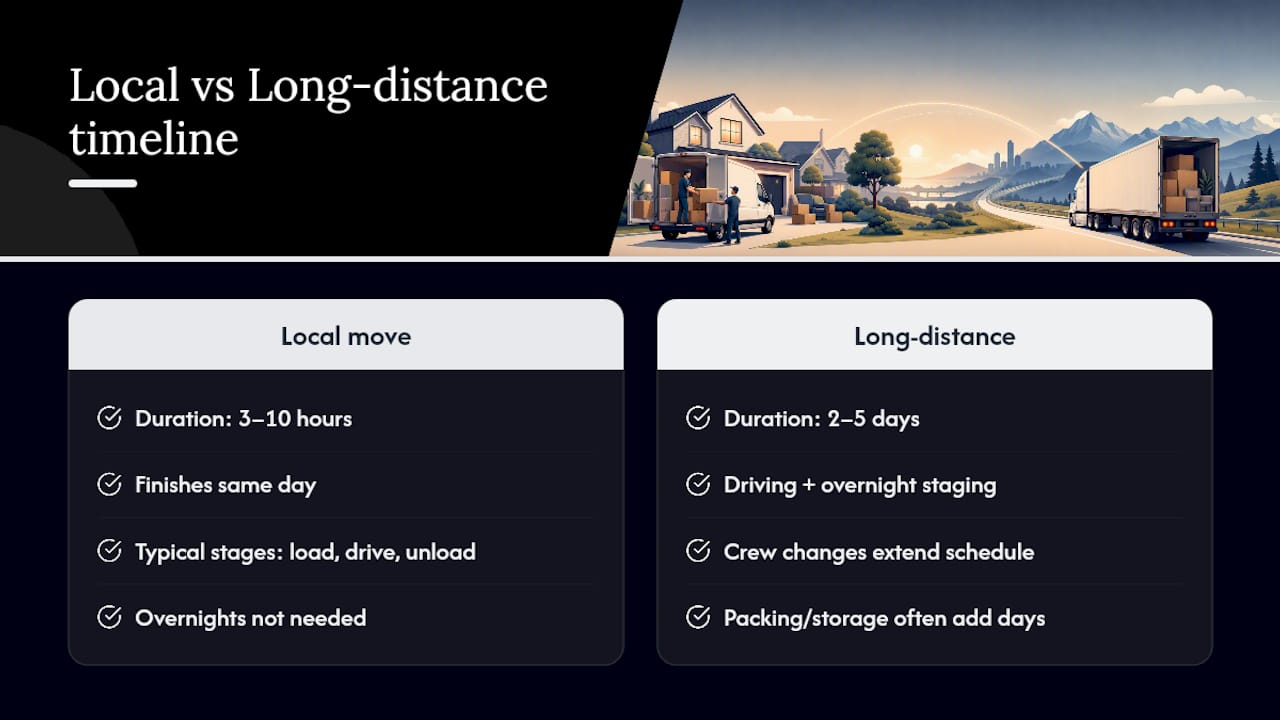
A local move usually wraps in a single day, somewhere in the 3 to 10 hour range depending on home size, based on the ranges in the quick-reference table above. A long-distance relocation is a different animal entirely.
Driving time, overnight staging, and crew changes routinely stretch a long-distance move to 2 to 5 days, even for a modest-sized home. Add professional packing services or short-term storage into the mix, and you’re often adding days to the timeline, not just hours, particularly if there’s a gap between move-out and move-in dates. If your relocation involves a job change, note that many employers only give about a month to relocate, which makes early planning worth the effort rather than a nice-to-have.
How do movers measure billed time?
Most movers bill from the moment the truck arrives at your old address to the moment it leaves your new one, sometimes called portal-to-portal or door-to-door time. That window typically does not include tasks like full unpacking, deep cleaning, or extended sorting, which is why a quote that looks tight on paper can still leave you working past dinner.
Confirm the scope in writing before move day. Ask specifically whether packing, unpacking, and disposal of packing materials are included or billed separately, so there are no surprises on the invoice.
What movers notice most on move day
The biggest swing factor isn’t crew size or truck size. It’s whether the home is actually ready when the truck pulls up. Half-packed kitchens and undone bed frames cost more real time than almost anything else we see, and the fix is always the same: pack early, label clearly, and clear the path before the crew knocks.
With more than 18 years moving households and offices across Ontario, our takeaway is simple: readiness beats speed. A prepared two-person crew often outpaces a rushed four-person crew working around unfinished boxes.
— Ali
Get a straight answer on your move time with Aleks Moving
You’ve seen the ranges, the formula, and the checklist. If you’d rather skip the guesswork and get a number specific to your home, that’s exactly what a proper in-home or virtual estimate is for.

Flat-rate quotes with no hidden fees mean the hours estimated up front are the hours billed for, not a number that grows once the truck is loaded. Crews can handle everything from a studio apartment to a full house, with packing, unpacking, and storage options available if your timeline needs more flexibility than a single day allows. If stairs, an elevator window, or a piano are part of your move, mention them during the quote to have the estimate built around it instead of facing surprises on move day.
Request a free estimate through our professional moving services page and get a realistic time and cost figure before you commit to a date.
Sources
- How Long Does It Take to Move? (2026)
- Moving Time Averages | All My Sons Moving & Storage
- How Long Does It Take to Move: Timeline Calculation and Time Saving Tips | Moving Muscle Blog
FAQ
What is the average hourly rate for movers in Ontario?
Hourly rates vary by crew size and company, and aren’t tied to a single fixed number industry-wide. Request a flat-rate quote up front so you know the total cost regardless of how many hours the move actually takes.
What is the most expensive day to move?
Weekends and the end or beginning of the month tend to be the busiest and priciest booking windows, since that’s when leases typically turn over. Booking a weekday move mid-month usually gives you more scheduling flexibility and better rates.
How much should you tip on a $500 move?
Adjust based on job difficulty, such as extra stairs or fragile items handled carefully.
How much does it cost to pay for one mover for three hours?
Costs depend on the company’s rate structure and any minimum-hour policies, which vary enough that there’s no universal figure to quote. Ask for a flat-rate quote that states the total cost for a three-hour job rather than relying on an hourly estimate alone.