Skip to content


In Canada, expect an all-in 7-day bin rental to typically cost from the mid-hundreds for a 10 to 20-yard bin, with larger 30 to 40-yard containers generally costing more, often reaching into the higher hundreds. Pick your size by project scale: a small cleanout or bathroom gut usually fits a 10 to 14-yard bin, a full kitchen or basement renovation calls for 16 to 20 yards, and a home addition or major demolition needs 30 to 40 yards.
Most quotes already bundle the essentials, so the sticker price is close to the real price.
- Delivery and pickup within a normal service radius
- A standard 7-day rental window
- A set weight allowance, typically 1 to 4 tons, depending on bin size
Quick rule of thumb: if you can picture the debris filling a pickup truck bed twice over, you likely need a 14-yard bin. Filling it three or four times over pushes you into 20-yard territory.
TL;DR:
- Regional differences heavily influence prices, with landfill disposal fees and permit requirements causing quotes to vary by $50 to $150 even for the same bin size.
- Overages in weight or rental period can significantly increase costs, making it crucial to confirm included tonnage and schedule pickup promptly to avoid extra charges.
- Separating heavy materials like concrete or shingles from general debris can help reduce surcharges, and choosing the right bin size prevents overpaying or overage fees.
- Flat-rate quotes from providers like Aleksmoving ensure upfront clarity on costs, including delivery, pickup, rental period, and tonnage, avoiding hidden fees.
Table of Contents
- What does bin rental cost by size in Canada?
- Why do bin rental prices vary so much?
- What extra fees should you watch for?
- How do you pick the right bin size?
- How much do bin rentals cost in different Canadian cities?
- Aleksmoving’s approach to flat-rate bin rentals in Canada
- Are disposal and tipping fees included in your quote?
- Is a bin rental cheaper than junk removal?
- How can you lower your bin rental cost?
- What payment methods and deposits are standard?
- Where the standard bin rental advice falls short
- How do you book a flat-rate bin rental quote?
- Key Takeaways
- Sources
What does bin rental cost by size in Canada?
Prices swing more by region and hauler than most homeowners expect, but the size of the bin is still the biggest lever on your quote. Across Canadian pricing pages, a small 6-yard bin starts at a moderate price point while a 10-yard unit starts somewhat higher and a 14-yard bin above that, according to Flat Rate Bin’s published rates. Larger units climb from there, though the jump from 20 to 40 yards is rarely a straight multiple. Hauling logistics, tipping fees, and how far the truck has to travel all shift the final number.
A quote at the low end of a range usually means a shorter haul distance, lighter expected material, and lower local tipping fees. Here’s what a typical bundled quote should already include:
- Drop-off and pickup scheduling within your chosen window
- The standard rental period (almost always 7 days)
- A stated tonnage allowance before overage fees kick in
- Basic placement on your driveway or private property
Two quotes for the same size bin can differ by $100 or more simply because one hauler’s landfill is 15 minutes away and the other’s is 40. Seasonal demand matters too. Spring and early summer, when renovation season peaks across Ontario and the Prairies, tends to push prices toward the higher end of these ranges.
Why do bin rental prices vary so much?
The price on your invoice is really four separate costs stacked together, and each one moves independently.
Local landfill and tipping fees are the biggest hidden driver. According to DumpsterComparison’s 2026 fee breakdown, these disposal charges are baked into the base rate before you even see a number, and they vary by municipality far more than most renters realize. A hauler working near a regional landfill with lower per-ton fees can simply charge less, all else being equal.
Distance affects the delivery and pickup side of the equation. If your address sits well outside a company’s normal service zone, expect a trip surcharge added to the base rate.
Material type changes everything downstream:
- Clean fill, wood, and household junk are the cheapest to dump
- Roofing shingles and asphalt often carry a per-ton surcharge because they’re heavier and go to specific disposal streams
- Mixed construction debris (drywall, insulation, wiring) usually falls between the two
Access constraints add one more variable. If the bin has to sit on a public street or boulevard, many municipalities require a placement permit, and that fee is separate from the rental itself.
Pro Tip: Ask upfront whether your quote already includes any municipal permit fee for street placement. Some haulers handle the paperwork for you; others expect you to apply and pay the city directly, which can take a few business days.
What extra fees should you watch for?
Overage and misuse fees are where a reasonable-looking quote turns into a surprise invoice. DumpsterComparison’s aggregated data reports that overage charges generally fall within a moderate to substantial per-ton fee beyond included allowances, and overfilling past the bin’s rim (the “fill line”) often triggers a flat penalty on top of that.
Here’s how to keep your final bill close to your original quote:
- Get the included tonnage in writing. A verbal “it should be fine” isn’t a number you can hold anyone to.
- Separate heavy materials before they go in. Concrete, dirt, and shingles often need their own bin or a dedicated heavy-materials rate; mixing them into a general debris bin is the fastest way to blow past your weight allowance.
- Watch for restricted-item fees. Appliances with refrigerants, tires, mattresses, and anything flagged hazardous usually carry a separate charge or outright rejection at the landfill.
- Schedule pickup promptly. Extension fees for keeping a bin beyond the standard rental period commonly vary by several dollars up to around twenty per extra day, based on rates listed by Ontario-area providers.
- Ask about dry-run fees. If the truck arrives and can’t access the drop point (blocked driveway, low wires, soft ground), some haulers still bill a trip charge.
How do you pick the right bin size?
Guessing on size is the single most common way renters overpay, either by renting too big or by hitting overage fees on a bin that was too small from the start.
- Walk the space and count bulky items separately from loose debris. A couch, mattress, and old washer eat volume fast without adding much weight.
- Estimate renovation debris by room: a single bathroom gut typically fills 2 to 4 cubic yards; a full kitchen tear-out often hits 10 to 15.
- Flag dense materials (concrete, tile, dirt, shingles) separately. These fill a bin’s weight allowance long before they fill its visual space.
- Match your project to a size: basement demo and garage cleanouts usually land in the 10 to 16-yard range; kitchen renovations need 16 to 20 yards; full home renovations or new builds call for 30 to 40 yards.
Before you call for a quote, have these bin rental logistics details ready:
- Your delivery address and whether the bin sits on a driveway or the street
- The type and rough volume of materials
- Preferred delivery and pickup dates
- Any access issues (low overhang, narrow laneway, shared driveway)
Pro Tip: If you’re between two sizes, size up. An extra $50 to $100 for the next size is almost always cheaper than a $40 to $100-per-ton overage fee on a bin you overfilled. For renovation-specific sizing help, see Aleksmoving’s guide to choosing the right dumpster size.
How much do bin rentals cost in different Canadian cities?
Local pricing tells the real story better than any national average. In Edmonton, Save On Bins lists a 12-yard bin at $335 plus GST and a 20-yard bin at $425 plus GST, both on a 7-day base with daily fees after that. In Winnipeg, flat-rate operators publish similar city-specific spreads with per-ton dump charges layered on top for heavier loads, per Mr. Garbage’s Winnipeg pricing.
The spread between cities comes down to two things: local landfill tipping fees and whether the municipality requires a permit for street placement. Both can shift a quote by $50 to $150 without the bin size changing at all.
- Always compare at least three local quotes for the same bin size and rental window.
- Confirm whether GST or other taxes are shown separately or are already rolled in.
- Ask each hauler what tonnage is included before comparing sticker prices
Aleksmoving’s approach to flat-rate bin rentals in Canada
Aleksmoving has spent over 18 years handling moves, packing, and cleanouts across Ontario, and bin rental quotes follow the same flat-rate promise that runs through every service line: one number, agreed upfront, with no surprise add-ons after delivery.
A flat-rate quote only works if it actually includes what a renter needs: delivery, pickup, the standard rental period, and a stated weight allowance spelled out before the bin ever arrives on-site.
A typical Aleksmoving bin rental quote bundles:
- Delivery and pickup scheduled around your timeline
- The standard rental period, with extension terms confirmed in advance
- A clear, stated tonnage allowance so there’s no guessing about overage risk
To get an accurate all-in number, Aleksmoving asks for your address, expected material type, preferred dates, and whether the bin will sit on your driveway or require street placement. You can reach the team by phone, through the contact form, or by WhatsApp.
Are disposal and tipping fees included in your quote?
This is the single biggest source of confusion when comparing two bin rental quotes side by side, because haulers handle it differently.
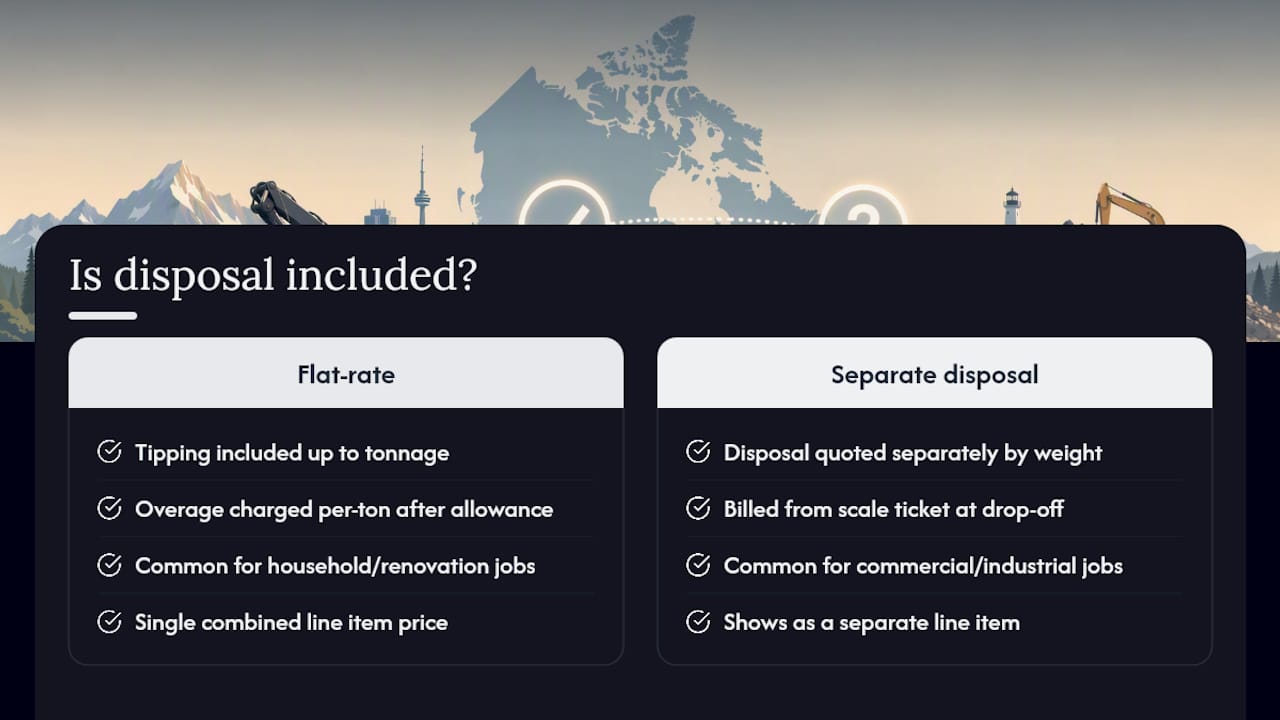
Most Canadian flat-rate quotes for standard household or renovation debris already fold tipping fees into the base price, up to your stated tonnage allowance. That’s the model behind most of the size-based ranges above. Once you go over that included weight, though, the per-ton overage charge you’re billed is essentially the hauler passing along the landfill’s tipping fee directly to you, often with a small markup for handling.
Some haulers, particularly for commercial or industrial jobs, quote disposal separately from the rental fee itself. In that setup, you’ll see a base delivery and rental charge, then a second line item calculated by actual weight at drop-off. This structure is more common for construction sites generating unpredictable debris volumes, where a flat included-tonnage model doesn’t reflect the real risk.
Either way, the question to ask before booking is simple: is disposal already inside my quoted price, or will I be billed separately based on the scale ticket? If a hauler can’t answer that clearly, treat the quote as incomplete rather than final. A vague answer here is often the first sign of fees showing up later that were never mentioned upfront.
Is a bin rental cheaper than junk removal?
It depends entirely on how much debris you’re generating and how much labour you’re willing to do yourself.
A bin rental puts the physical work on you. You load it yourself, on your own schedule, over several days. That’s exactly why it tends to cost less per cubic yard for medium to large jobs. A 14 to 20-yard bin at $450 to $680 for a week gives you far more capacity than most junk removal packages at a similar price point.
Junk removal services, by contrast, send a crew that does the loading and hauling in a single visit, usually priced by volume (how much of their truck your items fill) rather than by a flat rental period. That convenience carries a premium, and it tends to make more financial sense for smaller jobs. Clearing out a single room or a handful of bulky items, where renting a bin for a full week doesn’t make sense, is where junk removal usually wins on cost and time.
For anything at renovation scale, a demolition project, or ongoing debris over several days, a rented bin is generally the more economical route since you’re paying once for a week of access rather than per pickup. The trade-off is simple: bins save money if you have the time and physical ability to load them; junk removal saves time if your budget allows the premium.
How can you lower your bin rental cost?
A few practical adjustments can shave real money off a bin rental quote, and none of them require negotiating with the hauler.
Right-sizing the bin is the single biggest lever. Renting a 20-yard bin because you’re not sure, when a 14-yard would have covered the job, means paying for capacity you never use. Walk through the size-estimation steps above before you call.
Separating material types helps almost as much. Clean loads (wood, drywall, general household debris) dump more cheaply than mixed loads contaminated with shingles, concrete, or hazardous items. If your project generates both, ask whether a second, smaller bin for heavy material costs less overall than one bin hit with a mixed-load surcharge.
Booking during shoulder seasons, fall and winter rather than the spring renovation rush, often gets you better availability and occasionally a better rate, since demand on haulers eases outside peak months.
Finally, timing your pickup tightly against your actual project timeline avoids extension fees entirely. A bin sitting empty in your driveway for three extra days at $5 to $20 per day adds up fast for no benefit. And always ask for the included tonnage in writing before booking. It’s the cheapest insurance against an overage bill you didn’t see coming.
What payment methods and deposits are standard?
Most Canadian bin rental companies keep payment straightforward, though the details differ enough between operators that it’s worth confirming before delivery day.
Credit card is the most common method, both because it’s fast to process over the phone and because it gives the hauler a way to charge overage or extension fees after the fact without chasing you down. Debit and e-transfer are widely accepted as well, particularly for smaller residential operators.
A deposit or full prepayment before delivery is standard practice across most of the industry. Some haulers charge the full flat rate upfront once you confirm your delivery window; others take a partial deposit and bill the balance, plus any overage, at pickup. Either way, expect to pay before or at delivery rather than after the job is done.
If your quote includes a stated tonnage allowance, ask whether the overage rate will simply be charged to the same card on file or whether you’ll receive a separate invoice. Getting this in writing before delivery avoids any confusion about how and when an overage charge actually gets collected.
Where the standard bin rental advice falls short
Most guides to bin rental costs stop at listing price ranges by size, which is useful but incomplete. The real risk to a Canadian renter’s budget isn’t the base rental rate. It’s the gap between what a quote implies and what it actually includes.
The conventional advice, get three quotes and pick the cheapest, misses the point when quotes aren’t measuring the same thing. A $380 quote with 1 ton included and a $420 quote with 3 tons included aren’t comparable numbers; the second one is very likely cheaper for anyone doing a real renovation. Readers should prioritize matching included tonnage and rental length before comparing sticker prices at all.
What’s overrated is chasing the absolute lowest advertised rate. What’s underrated is asking pointed questions about overage rates, permit responsibility, and pickup flexibility before booking anything. A hauler that answers those questions clearly, in writing, before you pay a deposit, is a better bet than one with a slightly lower number and no specifics. That’s the judgment this whole pricing landscape supports: transparency beats the lowest bid almost every time.
— Ali
How do you book a flat-rate bin rental quote?
Aleksmoving prices bin rentals the same way it prices every move: one flat number, confirmed before the truck shows up, with delivery, pickup, the rental period, and your tonnage allowance all spelled out in advance. That’s the difference that matters most after reading through the fee traps above, no per-ton surprise, no vague “included weight,” no guessing whether a permit fee is on you or on the hauler.
If you’re planning a renovation cleanout, a demolition, or a larger residential job anywhere Aleksmoving serves across Ontario, request a quote through the Aleksmoving contact page with your address, expected material type, and preferred dates ready to go. You’ll get a straight answer on price and inclusions before you commit to anything, and if your project also involves packing, storage, or a full move, Aleksmoving’s storage options can be quoted alongside the bin rental in the same call.
Key Takeaways
Bin rental cost in Canada depends less on the bin size alone and more on whether your quote clearly states included tonnage, rental length, and disposal fees upfront.
| Point | Details |
|---|---|
| Budget by size | Expect $350–$480 for 10 to 20-yard bins and $520–$800 for 30 to 40-yard bins over a standard 7-day rental. |
| Confirm what’s included | Delivery, pickup, the rental period, and a stated tonnage allowance should already be in the base price. |
| Watch overage fees | Extra tonnage typically runs $40–$100 per ton, and extension days cost $5–$20 each. |
| Separate heavy materials | Concrete, shingles, and mixed debris often trigger surcharges that clean loads avoid. |
| Choose Aleksmoving for transparency | Aleksmoving’s flat-rate bin rental quotes confirm tonnage and terms upfront, backed by 18+ years serving Ontario. |
Sources
- Garbage Bin Rental Prices, Dumpster Sizes
- Bin Rental Rates – Edmonton
- How Much Does It Cost to Rent a Dumpster in 2026? (DumpsterComparison)