Skip to content


Book a dedicated elevator slot at least 7 days before moving day, confirm it with concierge or your property manager 48 to 72 hours before arrival, and bring proof of the reservation for your movers. That’s the whole plan in one sentence. Most condo moves that go sideways in Canada do so because someone skipped one of those three steps, not because the building was unreasonable.
Here’s the action plan we give clients before every condo move:
- Contact your concierge, superintendent, or property management office to find out their elevator reservation process.
- Book your slot at least 7 days ahead (some Canadian buildings ask for 14 to 30 days).
- Confirm your reservation in writing and reconfirm 48 to 72 hours before moving day.
- Ask about padding, protection requirements, and whether a refundable deposit applies.
- Share the confirmed time slot with your moving company before booking their truck.
Most Ontario condo boards require sign-off from the owner or property manager, not just the tenant, and many buildings block Sunday moves entirely.
Key Takeaways
Booking a condo elevator early, confirming it twice, and documenting its condition before and after the move prevents most fines, delays, and deposit disputes.
| Point | Details |
|---|---|
| Book at least 7 days ahead | Confirm your elevator slot early, since many buildings work first-come, first-served with limited weekend availability. |
| Reconfirm 48 to 72 hours out | Call concierge and share your movers’ contact number shortly before the move to catch scheduling errors. |
| Expect fees and deposits | Budget for a non-refundable move-in fee plus a refundable security deposit tied to post-move inspection. |
| Pad the elevator properly | Confirm who installs protection, since skipping it is a common cause of deposit deductions. |
| Document before and after | Photograph the elevator’s condition pre-move and attend the post-move inspection to protect your deposit. |
Table of Contents
- When should you book your condo elevator for moving day?
- How does condo elevator booking actually work?
- What time slots and rules apply to condo elevators?
- What fees and deposits should you budget for?
- How do you protect the elevator and hallways on move day?
- How do you arrange parking and truck access for the move?
- How do you coordinate with movers and building staff?
- What if you can’t get a booking or the elevator fails?
- How do post-move inspections and deposit claims work?
- What mistakes cause fines, delays, or lost deposits?
- Your printable checklist and sample booking message
- What movers actually see on condo move day
- What’s the one thing to get right on condo move day?
- Frequently asked questions about condo elevator booking
- Sources
When should you book your condo elevator for moving day?
Seven days is the floor, not the target. Most Canadian property managers ask for a minimum of 7 days’ notice before they’ll confirm a booking form, but buildings in busy downtown towers often prefer 14 to 30 days, especially for weekend slots.
Weekday mornings and early afternoons tend to have the least competition for elevator time. Weekends fill up fast because that’s when most people move, and buildings with only one freight elevator serving 300-plus units can be booked solid two or three weekends out.
Watch for these predictable pinch points:
- The last weekend of the month, when leases turn over across the building.
- The first weekend of the month, for the same reason in reverse.
- Long weekends and any week with a scheduled building event, AGM, or fire inspection.
- December and early September, when moving volume spikes across most Canadian cities.
Pro Tip: If your move date is flexible, ask the concierge which weekday has the fewest existing bookings. A Tuesday or Wednesday slot is often available with just a few days’ notice, even when every Saturday for a month is gone.
How does condo elevator booking actually work?
Most buildings use one of three systems: a concierge-managed paper or email form, a property management portal, or a dedicated online scheduling tool that syncs with Google or Apple calendars. Some larger buildings run amenity booking software where residents log in, pick a date and time, and receive an automated confirmation by email, similar to how you’d book a party room.
Whichever system your building uses, expect to submit the same core information:
- Preferred move date and backup date.
- Requested time slot (morning or afternoon block).
- Unit number and resident name.
- Moving company name and contact number.
- Confirmation of insurance or liability coverage, if required.
- Payment for the booking fee and refundable deposit, if applicable.
Owners and tenants aren’t always treated the same. Some boards let tenants submit the form directly; others require the unit owner or a property manager to sign off first, particularly for larger freight elevator reservations. If you’re renting, check this before your moving date approaches. Our condo moving tips for renters cover exactly who needs to authorize what in a typical Ontario lease.
What time slots and rules apply to condo elevators?
Expect two standard formats: a 2-hour window or a 4-hour window, and most buildings publish a fixed daily schedule rather than open availability. A common pattern is a morning block from 9:00 AM to 1:00 PM and an afternoon block from 1:00 PM to 5:00 PM, with moves permitted Monday through Saturday and Sundays off-limits.
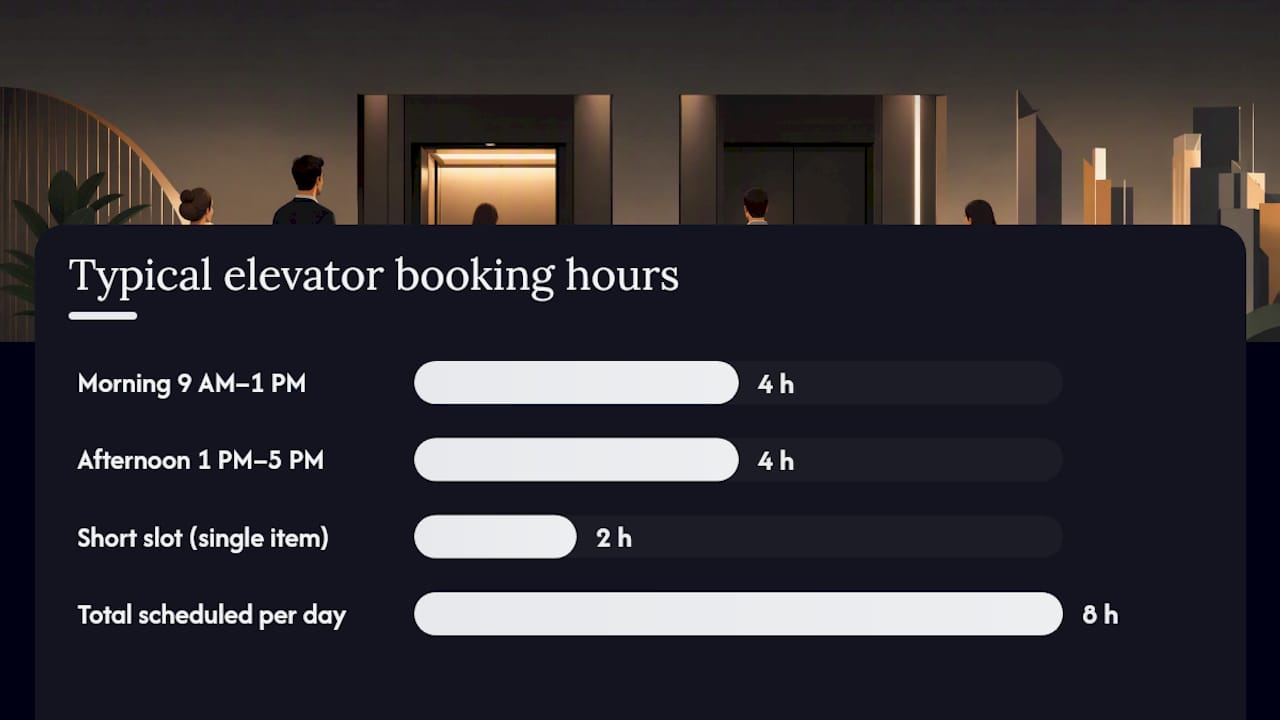
Some properties split the offering further. One Durham condo corporation offers a full 4-hour exclusive slot with padding and loading dock access for full move-ins or move-outs, alongside a shorter, non-exclusive slot for single large items like a couch or mattress that doesn’t need the whole elevator locked down.
Rules you’ll see repeated across buildings:
- No moving on the passenger elevator, even for “just one quick trip.”
- One confirmed move per elevator per time block, booked first-come, first-served.
- Some buildings cap total elevator use per suite at 2 hours, no exceptions.
- Freight elevator access may require a key fob or code issued only for your booked window.
What fees and deposits should you budget for?
Plan for two separate charges: a non-refundable booking or move-in fee, and a refundable security deposit. Freight elevator reservations commonly involve both a refundable deposit and a separate move-in fee, with the deposit held against cleaning costs or damage to the elevator, doors, or hallway walls. Local coverage of condo moves in cities like Ottawa confirms these charges vary widely by building, so always verify the exact amounts with your property manager rather than assuming a number from a different building applies to yours.
Keep these in mind while budgeting:
- Booking fees are typically due at the time you submit your reservation, not on move day.
- Deposits are usually returned within a set number of business days after a clean post-move inspection.
- Some buildings require proof of mover liability insurance before they’ll confirm any freight elevator slot.
- Damage found during inspection, including scuffed walls or a dented elevator door, can be deducted directly from your deposit.
Ask for the fee schedule in writing when you request your booking form. A verbal quote from concierge isn’t the same as the number that ends up on your invoice.
How do you protect the elevator and hallways on move day?

Buildings almost universally require some form of padding before a freight elevator can be used for a move, and getting this wrong is one of the fastest ways to lose your deposit. Standard protection includes quilted elevator pads along the walls, corner guards in hallways, floor runners near entry points, and door straps that hold the elevator open without triggering the safety sensors repeatedly.
Who installs it depends on the building. Some property staff pad the elevator themselves before your slot begins; in other buildings, it’s the mover’s job, and failing to do it properly can trigger a deposit deduction even if no actual damage occurred.
- Confirm in advance whether concierge, maintenance staff, or your moving crew is responsible for padding.
- Ask whether the building supplies pads or whether your movers need to bring their own.
- Photograph the elevator interior before loading begins, whether or not staff are documenting it themselves.
Pro Tip: Experienced movers stage the truck load in reverse order of what needs to go on the elevator first, and they’ll often run the elevator in “independent service” or “fireman’s mode” if the building allows it, which holds the doors and skips other floor calls entirely. That one setting alone can cut a four-hour move down by 30 to 45 minutes.
How do you arrange parking and truck access for the move?
A confirmed elevator slot means nothing if the truck can’t get near the door. Most Canadian cities require a temporary no-parking or loading zone permit for moving trucks parked on city streets, and applications typically need to go in several business days before your date, longer during summer when permit offices are busier.
Before the truck arrives, make sure you have:
- A named building contact who can meet the truck and unlock loading doors or the freight entrance.
- A clear, obstacle-free route mapped from the curb to the elevator, including any doors that need to be propped.
- Temporary signage or cones if your city permits allow them, to hold the space until the truck arrives.
Give your moving company the exact arrival window, the truck’s approximate length, and a backup plan if street parking is restricted that day, such as a nearby loading dock or an alternate entrance.
How do you coordinate with movers and building staff?
Treat the days leading up to your move like a countdown with fixed checkpoints, not a single booking you can forget about until the day arrives. Reconfirming a reservation 48 to 72 hours before moving day is standard advice from building staff and movers alike, and it catches the rare cases where a booking calendar glitched or got double-assigned.
A reliable timeline looks like this:
- At booking: Get written confirmation with date, time slot, and any conditions attached.
- 7 days out: Check that your movers have the exact time slot and building address on file.
- 48 to 72 hours out: Call concierge to reconfirm, and share the mover’s direct phone number.
- Move-day morning: Movers check in with the front desk or concierge on arrival, not after they’ve already started unloading.
Give both sides the same information: access codes, the elevator mode instructions, and a single point of contact who can solve problems in real time. Our guide on expert tips for condo moves walks through this handoff in more detail.
What if you can’t get a booking or the elevator fails?
Sometimes the calendar is full or the freight elevator goes down mechanically the morning of your move. Neither situation has to derail the whole day if you plan a fallback.
- Ask about a staggered move: smaller loads carried up manually via stairwell for a walk-up unit, or split across two shorter bookings on different days.
- Check whether a passenger elevator can be used temporarily under staff supervision for a handful of lighter items, if the building allows it in an emergency.
- If the freight elevator fails mechanically, contact the property manager, concierge, and building engineer immediately, and loop in your moving company so they can adjust the crew’s schedule.
Document everything: the time the failure was reported, who you spoke with, and any costs incurred from the delay (extra mover hours, a rescheduled truck rental). That paper trail matters if you later need to dispute a charge or claim against a missed booking.
How do post-move inspections and deposit claims work?
Most buildings inspect the elevator and adjacent hallways before your booking starts and again once you’re done, comparing the two. Ask to be present for both, or at minimum request photos from staff, since a resident who skips inspection can still be billed if damage turns up later on the unit’s account.
Deposit refunds typically process within a set number of business days once the post-move inspection comes back clean, though exact timelines vary by property manager. If a charge shows up that you dispute, request the inspection photos and any incident report in writing before paying it. Keep your own photos, the original booking confirmation, and any email correspondence with concierge as your evidence file.
What mistakes cause fines, delays, or lost deposits?
The same handful of errors show up again and again in condo moves across Canada:
- Trying to squeeze boxes onto the passenger elevator instead of the booked freight elevator.
- Assuming padding isn’t necessary for a “quick” move and skipping it entirely.
- Tenants booking directly when the building actually requires owner or property manager authorization.
- Booking only two or three days out, then discovering every slot that week is taken.
- Failing to reconfirm with concierge and movers 48 hours ahead, leading to a no-show or mixed-up time.
- Skipping the post-move inspection and getting billed for damage you didn’t cause.
Being a considerate neighbour during the move also matters more than people expect. Our guide to moving day etiquette covers the small courtesies, like not blocking hallways during someone else’s booked slot, that keep buildings willing to work with you next time.
Your printable checklist and sample booking message
Copy this into your phone or print it out for moving day.
30+ days out: Ask concierge or property management for the elevator booking process and form.
7 days out: Submit your booking request with preferred date, time slot, and mover contact info.
48 to 72 hours out: Reconfirm with concierge and share the confirmed slot with your movers.
Move-day morning: Bring printed confirmation, photograph the elevator, and check in with the front desk.
A sample message you can adapt:
- Greet the property manager or concierge by name and state your unit number.
- Request the elevator for [date] between [start time] and [end time] for a full move [in/out].
- Confirm your mover’s company name and direct contact number.
- Ask about the booking fee, refundable deposit amount, and any insurance documents required.
- Ask whether padding is provided by the building or needs to be arranged by your movers.
Adjust the wording to match how your building actually communicates, whether that’s a portal ticket, an email, or a form dropped off at the front desk.
What movers actually see on condo move day
After years of running condo moves across Ontario, a few patterns hold true no matter the building. A one-bedroom unit on a mid-rise floor typically takes 3 to 4 hours door to truck when the elevator is booked and padded ahead of time; the same move can stretch past 6 hours when the crew is waiting on an unpadded elevator or an unclear booking window.
What actually speeds things up:
- Movers load the truck in the reverse order items need to come off, so nothing sits idle in the hallway waiting for elevator space.
- Someone from the building meeting the crew at the loading entrance saves 15 to 20 minutes right at the start, every time.
- Using a freight elevator’s independent or service mode, where the building allows it, keeps the doors from cycling to other floors mid-move.
We built these habits into how Aleks Moving plans every condo relocation, because a smooth elevator handover is often the single biggest factor separating a four-hour move from an eight-hour one.
Ready to hand off the logistics? Our team handles the elevator coordination, protective padding, and timing calls directly with your building, so you’re not the one on the phone with concierge the morning of your move. Get a flat-rate quote through our residential moving services page and we’ll build the timeline around your building’s actual booking rules.
What’s the one thing to get right on condo move day?
If you take away one lesson from this guide, confirm your booking early and do the pre-move inspection yourself. Every delay, fine, and lost deposit I’ve seen traced back to skipping one of those two steps, not to a difficult building. Use the sample message and checklist above, and you’ll walk into moving day with nothing left to guess at.
Frequently asked questions about condo elevator booking
How far in advance should I book a condo elevator for moving day?
Book at least 7 days ahead as a minimum. Buildings in busy downtown towers often prefer 14 to 30 days, especially for weekend or month-end slots.
Can tenants book the elevator directly, or does the owner need to do it?
It depends on the building. Some allow tenants to submit the form directly, while others require the unit owner or property manager to authorize the booking first.
Are Sunday moves allowed in condo buildings?
Many buildings prohibit Sunday moves entirely and restrict elevator reservations to Monday through Saturday within set daily time blocks.
What happens if the elevator breaks down on my scheduled move day?
Contact the property manager, concierge, and building engineer immediately, loop in your moving company, and document the failure and any resulting delay costs in writing.
Do I get my deposit back after the move?
Yes, typically within a set number of business days after a clean post-move inspection, provided no damage or excess cleaning charges apply.
Sources
- Elevator booking notice for residents (Young Condos)
- Elevator bookings | Durham Condominium Corporation #122
- Freight elevator reservation & move-in fees (Place One Condominium)
- Book elevator appointment (Mondofi resident help centre)