Skip to content


TL;DR:
- Successful corporate relocations require a comprehensive 12-month planning process focusing on talent retention, vendor transition, and financial compliance. Effective communication, staggered move waves, and early tax and budget planning significantly reduce risks and disruptions. Leadership engagement and dedicated support for employees are critical to preserving culture, knowledge, and operational continuity during the move.
Corporate moving challenges are defined as the combined risks to talent retention, operational continuity, vendor relationships, and regulatory compliance that arise when a company changes its physical location. These are not simply logistical problems. Poorly managed relocations result in 30 to 40% headcount loss, while well-managed ones preserve 80 to 85% of staff. That gap represents the difference between a company that emerges stronger and one that spends the next two years rebuilding. Business relocation issues span people, processes, finances, and physical assets simultaneously, which is exactly why so many companies underestimate them. A 12-month planning timeline is the recognised standard for mid-size moves, and anything shorter increases both attrition and vendor failures.
What are the primary corporate moving challenges for retaining talent?
Talent retention is the single most consequential challenge in any corporate relocation. When employees face longer commutes, disrupted routines, or genuine uncertainty about their futures, many simply leave. Companies that announce a move without ready talent packages accelerate attrition before the first box is packed. The damage is not just headcount. It is institutional knowledge, client relationships, and billing continuity that disappear with those people.
The causes of attrition during moves are predictable and preventable:
- Commute changes that add 30 to 60 minutes per day are among the top reasons employees decline to follow a company to a new location.
- Poor communication creates rumours that spread faster than facts, causing high performers to start interviewing elsewhere.
- Inadequate relocation packages signal to employees that the company does not value their sacrifice.
- Uncertainty about role changes tied to the new location drives anxiety among mid-level managers and specialists.
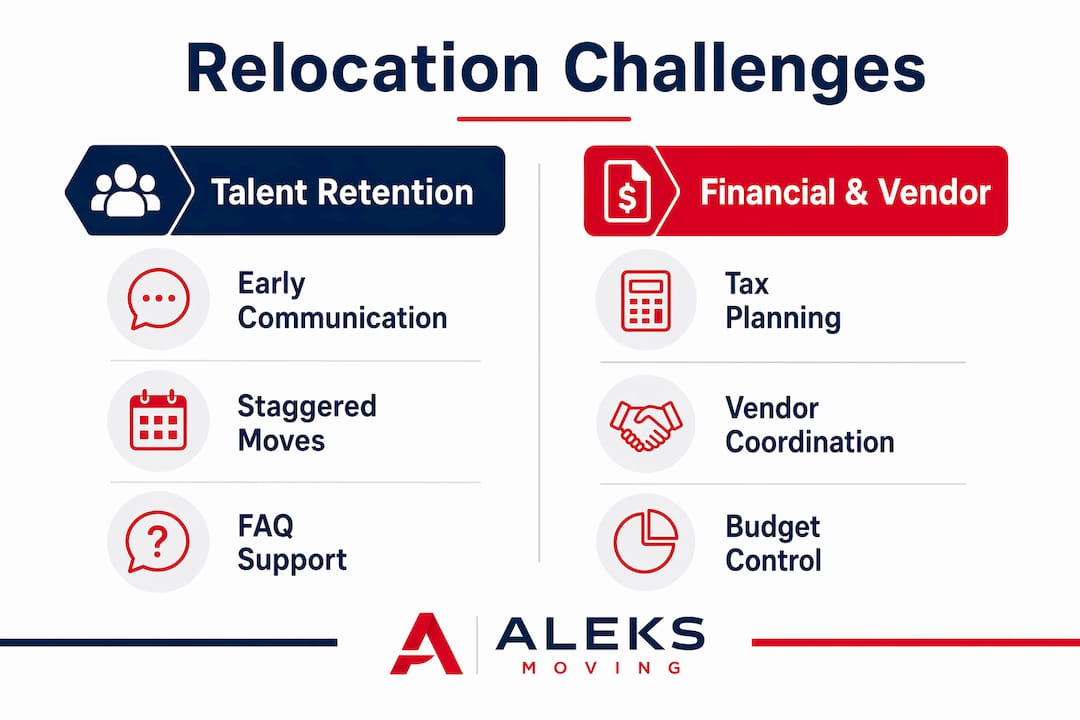
Early announcements with clear FAQs reduce employee anxiety and measurably improve morale during moves. This means communicating the why, the timeline, and the support available before employees hear anything through informal channels. Real-person relocation support, such as a dedicated coordinator who helps employees find housing and schools, outperforms a generic lump-sum allowance every time. Generic allowances feel transactional. Personal support feels like the company actually cares.
Staggering employee moves into multiple waves reduces operational disruption by 25 to 30%. This approach also reduces pressure on the local housing market at the destination, which matters in cities like Toronto or Ottawa where rental inventory is tight. Spreading relocations over 60 to 90 days gives HR teams time to address individual concerns rather than processing everyone as a batch.
Pro Tip: Build a dedicated internal FAQ page for the move and update it weekly. Employees who feel informed are far less likely to begin a job search.
How do logistical and vendor transitions complicate office moves?
The physical move is the part most companies plan for. The vendor transition is the part most companies forget. Re-establishing vendor relationships in a new metro takes 9 to 18 months and adds transitional costs that rarely appear in the original budget. This is not just about finding a new office cleaning service. It includes IT support contracts, facilities maintenance, catering, courier networks, and specialised suppliers that took years to vet and negotiate.
Here is the sequence that causes the most damage in office moving logistics:
- Compressed planning phases. When leadership decides to move in under nine months, vendor sourcing gets rushed. Rushed vendor sourcing means paying premium rates or accepting lower service quality.
- IT infrastructure gaps. Network cabling, server room buildouts, and phone system migrations each require lead times of weeks. Underestimating these creates move-day failures that cost thousands per hour in lost productivity.
- Asset auditing failures. Companies that skip a pre-move asset audit arrive at the new location with equipment that no longer fits, furniture that does not match the floor plan, and hardware that should have been decommissioned.
- Lease overlap costs. Holding two leases simultaneously is expensive. Without a precise move timeline, overlap periods stretch from weeks into months.
- Staging and sequencing errors. Moving all departments at once creates chaos. A staged approach, department by department, keeps at least part of the business fully operational throughout.
Professional movers with commercial relocation experience add genuine value here. They coordinate the physical staging, protect sensitive equipment, and work within the operational windows that minimise downtime. An experienced commercial mover is not a commodity. They are a risk management tool. You can read more about planning office move logistics to understand how sequencing decisions affect outcomes.
What financial and regulatory challenges arise during corporate relocations?
Financial surprises are the third major category of corporate move difficulties, and they are the ones that tend to surface after the move is complete. A local effective tax rate change as small as 3% can cost mid-sized firms millions over five years. That figure assumes no change in revenue. It is purely the cost of moving to a jurisdiction with different tax treatment.
| Financial risk | What it means in practice |
|---|---|
| Tax nexus changes | Moving to a new province or municipality can create new payroll tax, sales tax, and corporate tax obligations immediately. |
| Lease overlap costs | Holding two premises simultaneously is common and can add 10 to 20% to total move costs. |
| Budget overruns | Most moves exceed initial estimates without a contingency buffer built into the plan. |
| Compliance penalties | Delayed filing of Form 8822-B and equivalent Canadian business address updates triggers penalties that persist well beyond the move date. |
| Employment law changes | Moving staff across provincial lines changes minimum wage, termination notice, and benefits obligations. |
Integrating tax planning early avoids costly surprises and optimises after-tax earnings during the relocation period. This means engaging a tax adviser before signing the new lease, not after. The new location’s municipal tax incentives, provincial grants, and business licence requirements all affect the true cost of the move.
Adding a 15 to 20% contingency buffer to relocation budgets is the standard recommendation from relocation specialists. Most companies budget for the known costs and ignore the unknown ones. The unknown ones include emergency IT repairs, temporary storage overruns, and the productivity loss from employees who are distracted during the transition period.
Pro Tip: Assign a single finance team member as the relocation budget owner. Distributed budget ownership is the fastest way to lose track of spending across departments.
How to plan and manage a corporate relocation effectively
The most important reframe for any corporate decision-maker is this: a company relocation is a cross-functional change programme, not a facilities project. Leadership must treat relocations as they would a major organisational transformation, with a steering committee, a project manager, and clear accountability across HR, Finance, IT, and Operations.
A 12-month planning framework for a mid-size corporate move looks like this:
- Months 12 to 9 (strategic planning phase): Confirm the new location, engage tax advisers, begin lease negotiations, and appoint a relocation project manager.
- Months 9 to 6 (employee decisions phase): Announce the move with full communication materials, launch individual relocation support programmes, and begin identifying roles that may change.
- Months 6 to 3 (vendor and logistics phase): Begin vendor sourcing at the new location, conduct a full asset audit, engage a commercial moving company, and finalise IT infrastructure plans.
- Months 3 to 0 (move execution phase): Execute staggered department moves, maintain a live issue log, and keep a dedicated helpline open for employee concerns.
The comparison below shows the difference between a rushed move and a planned one:
| Factor | Rushed move (under 9 months) | Planned move (12 months) |
|---|---|---|
| Staff retention | 60 to 70% | 80 to 85% |
| Vendor readiness | Gaps lasting 12 to 18 months | Gaps of 3 to 6 months |
| Budget accuracy | Overruns of 20 to 35% | Overruns of 5 to 15% |
| Operational downtime | Days to weeks | Hours to days |
Pre-move asset auditing deserves specific attention. Companies that catalogue every piece of equipment, furniture, and technology before the move arrive at the new location with a clear picture of what they own, what they need, and what they can leave behind. This single step prevents the most common move-day surprises. For a detailed look at office relocation planning milestones, the timeline above translates directly into a workable project plan.
Pro Tip: Treat your vendor transition as a parallel workstream to your employee transition. Both take longer than expected, and both need dedicated ownership from day one.
Key takeaways
Successful corporate relocations depend on treating talent retention, vendor transitions, and financial compliance as equally critical workstreams, each requiring dedicated ownership and a minimum 12-month planning horizon.
| Point | Details |
|---|---|
| Talent retention is the top risk | Poorly managed moves lose 30 to 40% of staff; early communication and personal support close that gap significantly. |
| Vendor gaps last longer than expected | Re-establishing supplier relationships takes 9 to 18 months; begin sourcing at the new location six months before the move. |
| Tax planning must start early | A 3% effective tax rate change can cost millions over five years; engage a tax adviser before signing the new lease. |
| Budget for the unknown | A 15 to 20% contingency buffer is the standard recommendation to cover overruns, lease overlaps, and productivity losses. |
| Treat it as a change programme | Cross-functional steering, staggered move waves, and real-person employee support define the difference between a smooth move and a damaging one. |
What I have learned from watching corporate moves succeed and fail
After years of working alongside companies navigating relocations across Ontario, the pattern I see most often is not one catastrophic mistake. It is the accumulation of overlooked small details that compound into a serious operational setback. Leadership approves the move, signs the lease, and then assumes the project manager will handle everything. That assumption is where things start to go wrong.
The companies that come out of a relocation stronger are the ones where the CEO or COO treats the move as their personal responsibility, not a delegated task. They show up to employee town halls. They ask the IT lead about cabling timelines. They personally review the vendor sourcing list. That level of engagement signals to the entire organisation that this move matters and that the company is prepared.
The other thing I have observed is that culture travels with people, not with furniture. When a company loses 30% of its staff during a move, it does not just lose headcount. It loses the informal networks, the institutional memory, and the cultural norms that took years to build. No onboarding programme replaces that. The cost is real and it is long-lasting. Investing in genuine relocation support for employees is not a soft benefit. It is a hard financial decision with a measurable return.
My honest advice to any decision-maker reading this: do not let the budget conversation happen before the people conversation. The cost of losing your best people far exceeds the cost of a well-funded relocation programme.
— Ali
How Aleksmoving helps companies manage their relocation with confidence
Aleksmoving has supported mid-size corporate relocations across Ontario for over 18 years, and we understand that the physical move is only one part of a much larger challenge. Our commercial relocation services are built around minimising downtime, protecting your assets, and working within the operational windows that keep your business running. We coordinate staging, sequencing, and IT-sensitive equipment moves with the same care we bring to every client.
If you are planning an office move and want a dependable partner who understands the full scope of corporate relocation in Ontario, we are ready to help. Contact Aleksmoving for a free, no-obligation quote and find out how our flat-rate pricing and experienced team can take the pressure off your relocation project.
FAQ
What are the biggest challenges in a corporate relocation?
The three primary challenges are talent retention, vendor transition gaps, and financial compliance. Poorly managed moves lose 30 to 40% of staff, vendor relationships take 9 to 18 months to re-establish, and tax nexus changes can cost millions if not planned for in advance.
How long should a corporate move take to plan?
A realistic planning timeline for a mid-size corporate move is 12 months. Moves planned in under nine months face significantly higher rates of staff attrition, vendor failures, and budget overruns.
How do you reduce employee attrition during an office relocation?
Announce the move early, provide clear and regularly updated communication, and offer real-person relocation support rather than a generic allowance. Staggering employee moves over 60 to 90 days also reduces disruption by 25 to 30%.
What financial risks do companies overlook when relocating?
The most commonly overlooked risks are tax nexus changes, lease overlap costs, and compliance penalties from delayed business address filings. Adding a 15 to 20% contingency buffer to the relocation budget is the standard way to protect against these overruns.
When should tax planning begin for a corporate move?
Tax planning should begin before the new lease is signed. A local effective tax rate change of just 3% can cost a mid-sized firm millions over five years, making early tax adviser engagement one of the highest-return decisions in the entire relocation process.