Skip to content


A local move in Toronto typically runs from a few hundred dollars for a studio up to a few thousand for a three-bedroom home, before HST, depending on size and services. Most Toronto crews bill hourly, and a two‑mover truck team commonly falls in the $130 to $160 per hour range for 2026, with three or four movers priced up from there.
Here’s the budgeting rule we use with our own clients: hours multiplied by the crew rate, plus a truck fee, plus applicable taxes. This formula covers most local quotes.
- Studio or bachelor: typically a few hundred dollars
- One-bedroom apartment: often in the lower to mid-thousands
- Two-bedroom home: moderately higher cost
- Three-bedroom house: higher range reflecting larger size
Pro Tip: Ask every mover whether their hourly rate is “portal to portal” (billed from the truck leaving the depot) or “door to door.” That one detail alone can add 30 to 60 minutes of billed time you didn’t budget for.
Key Takeaways
| Point | Details |
|---|---|
| Use the core formula | Multiply hours by crew rate, add the truck fee, then apply 13% HST for a realistic total. |
| Expect $130 to $160 per hour | Two-mover Toronto crews with a truck typically fall in this 2026 hourly range. |
| Budget by home size | Studios run $400–$700, one-beds $600–$1,100, two-beds $900–$1,600, three-beds $1,300–$2,400. |
| Watch for overtime, not add-ons | The most common surprise charge is underestimated hours running past the quote, not a hidden fee. |
| Compare three written quotes | Aleks Moving provides itemised, flat-fee quotes covering crew, truck, HST, and valuation with no hidden charges. |
Table of Contents
- How much do movers cost in Toronto: hourly vs. flat-rate pricing
- Sample cost calculations for every home size (with HST)
- How many movers and what truck size you actually need
- What actually drives your final moving bill up
- How to actually lower your Toronto moving bill
- Getting a written quote you can actually compare
- Taxes, insurance, and permits that change your total
- 2026 Toronto rate benchmarks worth knowing
- Why these numbers match what we see every day
- Get a transparent quote for your Toronto move
- Where these Toronto moving cost figures come from
- Sources
How much do movers cost in Toronto: hourly vs. flat-rate pricing
Local moves in Toronto are almost always billed hourly. Flat or per-kilometre rates show up mainly for long-distance relocations, where a set distance makes hourly billing impractical. If your move stays within the GTA, expect an hourly rate.
A standard hourly quote bundles the crew, the truck, and basic protective gear like blankets and straps. On top of that base rate, most companies add a few separate charges:
- A one-time truck or fuel fee, often $50 to $150 depending on the company
- Travel time from the depot to your home, billed at the same hourly rate in most Ontario contracts
- A minimum-hours policy, usually two to three hours even for small jobs
Picture two quotes side by side. Quote A: 3 hours at $150/hour, $75 truck fee, subtotal $525, plus HST. Quote B: a flat $600 for a studio move with two movers, no separate truck fee listed. Neither is wrong, but only one lets you see where your money goes.
- Ask for the hourly rate and the minimum hours upfront.
- Confirm whether travel time counts toward your billed hours.
- Get the truck fee written as a separate line, not buried in the rate.
Pro Tip: If a quote doesn’t specify portal-to-portal or door-to-door billing, that’s the first question to ask before you sign anything.
Sample cost calculations for every home size (with HST)
These worked examples use the $130 to $160 hourly benchmark for a two-mover crew and truck, plus Ontario’s 13% HST. Actual totals shift with stairs, distance to the truck, and how much you’ve packed yourself.
| Move size | Crew | Estimated hours | Subtotal (before tax) | Total with tax |
|---|---|---|---|---|
| Studio | 2 movers | few hours | typical range | typical range |
| 1-bedroom | 2 movers | few hours | typical range | typical range |
| 2-bedroom | 3 movers | moderate hours | moderate range | moderate range |
| 3-bedroom | 3–4 movers | several hours | higher range | higher range |
Here’s how a one-bedroom apartment adds up in practice:
- Two movers at $150/hour for 3.5 hours = $525
- Add a $75 truck fee = $600 subtotal
- Apply 13% HST = $78
- Total: $678
That lines up closely with HomeStars’ homeowner-reported average of roughly $583 for a one-bedroom move, with reports climbing toward $1,100 for units with tricky access.
Full-service packing changes the math significantly. Add a packing crew and materials, and the total bill can rise 20 to 40% above the labour-only figures shown here.
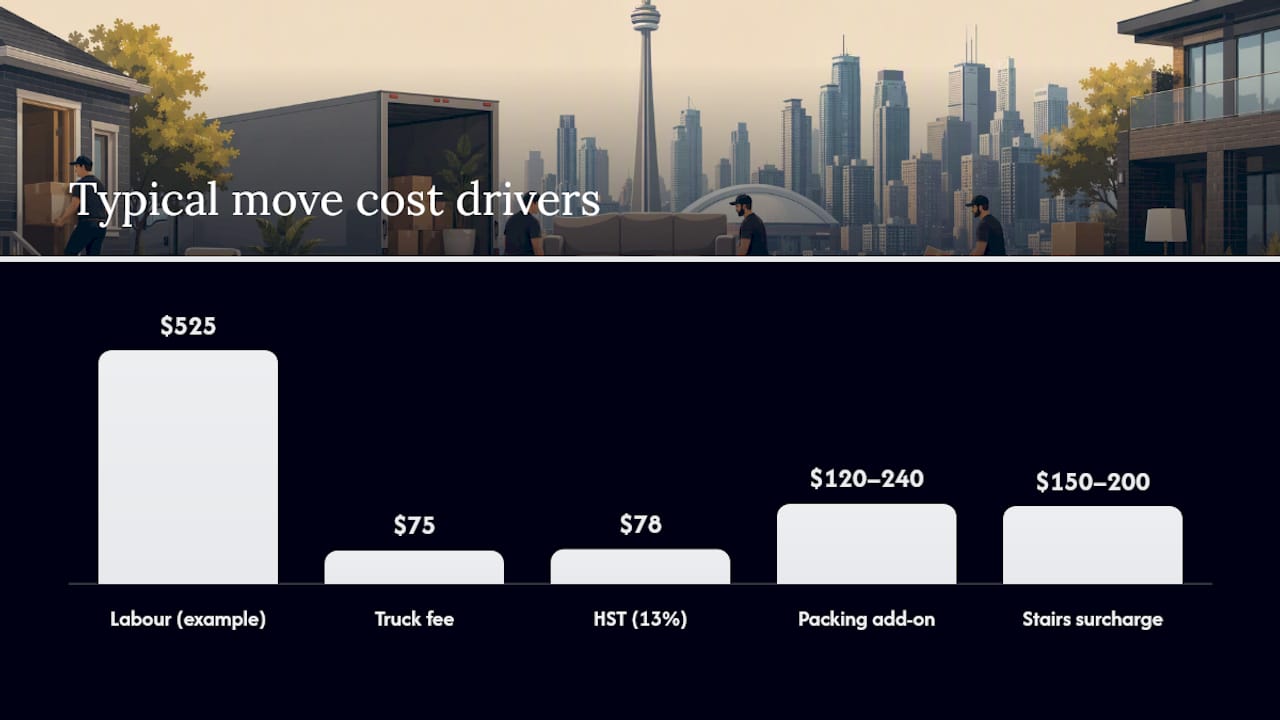
Pro Tip: Stairs and elevators are the biggest hidden variable in these calculations. A third-floor walk-up with no elevator can add a full hour to a one-bedroom move, which is often $150 to $200 you didn’t plan for.
How many movers and what truck size you actually need
Crew size drives both your hourly rate and how fast the job gets done, so matching it to your home size matters more than most people expect.
- Two movers work well for studios and one-bedrooms with modest furniture.
- Three movers suit most two-bedroom homes and any move with a couch, mattress, and multiple large boxes.
- Four movers make sense for three-bedroom houses, homes with stairs, or moves you need finished in a single afternoon.
| Crew size | Typical move size | Expected hours |
|---|---|---|
| 2 movers | Studio, 1‑bedroom | 3–4 hrs |
| 3 movers | 2‑bedroom | 4–5 hrs |
| 4 movers | 3‑bedroom+ | 6–8 hrs |
Adding a fourth mover to a small studio rarely saves money since there isn’t enough furniture to keep everyone moving. The math flips for larger homes, where an extra pair of hands cuts total billed hours enough to offset the higher rate.
Pro Tip: If your quote seems light on crew for your home size, ask directly how many hours they expect. A two-person crew quoting three hours for a three-bedroom house is a red flag, not a bargain.
What actually drives your final moving bill up
Base hourly rates rarely tell the whole story. The details that add real time and money include:
- Stairs, especially walk-ups above the second floor
- Long carries from your unit to the truck, common in condo buildings with distant loading docks
- Elevator wait times, which homeowner reports flag as a common condo-move surprise
- Large or heavy items like pianos, safes, or appliances needing disassembly and reassembly
- Packing services, which raise the total but save hours on move day
On the administrative side, watch for overtime charges past the estimated hours, fuel surcharges, cancellation fees for late notice, and parking permit costs in dense downtown neighbourhoods.
The single most common surprise fee is unbudgeted overtime from underestimated hours, not a mystery add-on. Ask your mover to walk through their time estimate line by line before booking, and confirm what happens if the job runs long.
How to actually lower your Toronto moving bill
Small scheduling and prep choices shrink your bill more than most people realize, because every hour saved on the clock is an hour you don’t pay for.
- Book mid-week and mid-month; end-of-month and summer weekends carry a 10 to 25% premium while off-peak slots run 10 to 15% cheaper.
- Pack boxes yourself and disassemble small furniture (bed frames, shelving) before the crew arrives.
- Declutter first. Fewer boxes means fewer trips and fewer billed hours.
- Have everything staged near the door so movers aren’t waiting on you.
For very small moves, a container or hybrid drop-off service can undercut a full-service crew. For anything beyond a studio’s worth of belongings, a local neighbourhood-focused crew usually works out cheaper once you factor in your own time and rental trucks.
Pro Tip: Being fully packed and ready when the truck arrives can shave 30 to 60 minutes off your bill, which on a $150/hour crew is real money saved for zero extra cost.
Getting a written quote you can actually compare
A proper written quote spells out the hourly rate, crew size, truck fee, travel-time policy, HST, and valuation or insurance options, all as separate line items rather than one bundled number.
Before you sign with anyone, ask these twelve questions:
- What’s your hourly rate, and does it change with crew size?
- Is there a minimum number of hours?
- Do you bill travel time, and at what rate?
- Is the truck fee separate or included?
- Is HST included in the quoted number?
- What valuation or insurance options do you offer?
- What’s your overtime policy if the move runs long?
- Is there a deposit, and is it refundable?
- What’s your cancellation policy and fee?
- How do you handle damage claims?
- Are you Canadian Association of Movers (CAM) affiliated?
- Can I see recent reviews or BBB standing?
- Request at least three written, itemised quotes before deciding.
- Compare them side by side using the same categories, not just the bottom-line total.
Pro Tip: Save every quote as a PDF or screenshot with a timestamp. Verbal estimates that later “increase” are the most common source of moving-day disputes.
Taxes, insurance, and permits that change your total
Ontario applies 13% HST to moving services, so a $600 subtotal becomes $678 after tax ($600 × 1.13). Build that multiplier into every estimate you compare.
Most movers offer basic valuation coverage included in the rate, with optional full-value protection for a small additional fee, which is different from third-party insurance. Ask which one applies to your goods specifically.
- In dense downtown Toronto neighbourhoods, you may need a parking permit or a loading zone reservation for the truck.
- Condo buildings often require an elevator booking, and missing that window can trigger delays or fines.
Pro Tip: Call your building management a week ahead to confirm elevator and loading dock rules. It’s free, and it prevents the single most avoidable overtime charge.
2026 Toronto rate benchmarks worth knowing
Toronto crews generally price at or above the province-wide range, sitting toward the top of the $130 to $160 hourly benchmark most Ontario movers use for 2026. Community-reported totals for small local moves in the city cluster in the $890 to $1,300 range, which tracks closely with the sample calculations above.
- Higher demand during peak season pushes Toronto rates up faster than in smaller Ontario cities.
- Downtown parking scarcity adds time and permit costs that rural or suburban moves rarely face.
- Local labour costs run higher in the GTA than in much of the province.
Pro Tip: When a quote comes in well below $130/hour for a two-person Toronto crew, ask what’s excluded. It’s often travel time, fuel, or minimum hours stacked on separately.
Why these numbers match what we see every day
We’ve spent over 18 years quoting moves across the GTA, and these benchmarks track closely with what we tell clients on the phone every week. A one-bedroom apartment with a flight of stairs, a two-bedroom condo needing an elevator booking, a three-bedroom house across town: the hours and fees follow the same patterns outlined here. When you’re ready for numbers specific to your home, request a written quote and we’ll break down every line before you commit to anything.
Get a transparent quote for your Toronto move
Aleks Moving is the flat, itemised alternative to guessing your way through vague hourly estimates. We handle local moves, packing and unpacking, bin rentals, short and long-term storage, and specialty handling for antiques and artwork, all across Ontario and beyond.

Every quote we provide breaks out the crew rate, truck fee, and HST as separate lines, so you see exactly what you’re paying for before moving day, not after. No hidden overtime surprises, no vague “estimated” totals that balloon once the truck shows up.
Reach us by phone, through our contact form, or over WhatsApp, whichever is easiest. If you want a number specific to your home size and building access, request your free residential moving quote today and we’ll walk you through the math before you book anything.
Where these Toronto moving cost figures come from
- EasyTools: 2026 Ontario hourly benchmarks and HST calculation guidance.
- Van Blanc: Ontario minimum-hours policy and packing cost premiums.
- HomeStars: Toronto homeowner-reported price averages and variance by home size.
- BlogTO: Local context on Toronto moving service options.
Sources
- Easytools
- How Much Do Movers Cost in Ontario? 2026 Guide | Van Blanc
- Moving Cost Guide For Toronto – HomeStars
- The best movers in Toronto | BlogTO