Skip to content


Book your movers first, then follow this checklist backward from moving day: 8 weeks out for planning, 6 for confirming details, 4 for utilities and paperwork, 2 for final prep, and 1 for the essentials box and last confirmations. If you’re moving into a condo, add elevator and parking permit bookings the moment you have a possession date.
Start these now, in order:
- Book at least three moving quotes this week.
- Start a decluttering pass, room by room.
- If you’re in a condo, call the building manager about elevator booking rules.
- Check Mississauga for any parking or move permits your street or building requires.
Save or print Aleksmoving’s Mississauga checklist now so you have it on hand for the next eight weeks.
Key Takeaways
Booking movers early and following a week-by-week timeline, from the 8-week planning stage through moving day, is what keeps a Mississauga move on schedule and on budget.
| Point | Details |
|---|---|
| Get three quotes minimum | Compare at least three written estimates before booking to avoid overpaying or missing red flags. |
| Book condo elevators early | Reserve elevator time and building permits weeks ahead, since properties often require advance notice. |
| Follow the 8/6/4/2/1 timeline | Work backward from moving day through utilities, packing, and final confirmations at each stage. |
| Avoid peak-period surprises | Book earlier for summer, month-end, and long-weekend moves when demand and rates climb. |
| Aleksmoving handles local logistics | Aleksmoving offers flat-rate local moves, packing, and storage with 18+ years of Mississauga experience. |
Table of Contents
- How does a condo move differ from a house move in Mississauga?
- What is the week-by-week moving timeline for Mississauga?
- What’s the smartest way to pack for a Mississauga move?
- What paperwork and utility changes need to happen before you move?
- What should you do on moving day itself?
- What Mississauga-specific tasks shouldn’t you miss?
- How do you choose a reliable mover in Mississauga?
- What usually goes wrong, and how do you avoid it?
- Where can you get a printable checklist and inventory template?
- What separates a smooth move from a stressful one?
- If you want help: how Aleksmoving simplifies a Mississauga move
- Sources
How does a condo move differ from a house move in Mississauga?
A house move gives you a driveway, your own timeline, and no one else’s schedule to work around. A condo move in Mississauga almost always means booking a freight elevator, working inside a fixed time window, and following building rules your movers didn’t write. Loading docks, visitor parking limits, and certificate-of-insurance requirements for the building are common in Mississauga’s downtown towers near Square One, where a growing share of new households land.
Condo buildings commonly require an elevator reservation, a specific move window (often a few hours on a weekday), and sometimes a building-issued parking or loading permit. Miss the booking cutoff and your move date might not budge, even if your mover is ready.
Before your move date is locked in, confirm with your building:
- Elevator booking lead time (some require two to four weeks’ notice).
- Required certificate of insurance from your moving company.
- Maximum move window length and after-hours restrictions.
- Loading dock or visitor parking rules for the moving truck.
Pro Tip: Call your condo’s property management office before you book movers, not after. Elevator slots fill fast on weekends, and a mover who already knows your building’s rules will save you an hour of back-and-forth on move day.
What is the week-by-week moving timeline for Mississauga?
Working backward from moving day keeps you from discovering a missing permit with three days left. Here’s the plan.
1. Eight weeks out. Build a room-by-room inventory and start decluttering anything you won’t take. Research movers and request at least three quotes, since local guides recommend comparing multiple estimates before committing, and hourly rates for Mississauga movers typically run $120–$180 depending on crew size and services. Note whether your move falls in a peak window: summer, month end, or a long weekend all see higher demand and tighter availability.
2. Six weeks out. Confirm your mover in writing and start packing anything you won’t need in the next month and a half: off-season clothes, spare linens, books. Order boxes, tape, and wrap now rather than mid-pack. If you’re in a condo, this is when you apply for elevator bookings or building move permits, since some properties require several weeks’ notice.
3. Four weeks out. Lock in your utility transfer and internet installation dates so there’s no gap in service. Notify schools, employers, and any subscription services of your new address. Keep packing room by room, and if your street requires a temporary parking reservation for the moving truck, apply through mississauga.ca now.
4. Two weeks out. Confirm arrival time windows with your mover in writing. Label every box by room and contents. Start building your essentials kit. Defrost your freezer at least 24 hours before moving day, since movers generally won’t transport a fridge or freezer with ice buildup. Ask your mover about valuation coverage or moving insurance and get your estimate in writing as binding, not just an approximate quote.
5. One week out. Reconfirm elevator and parking permits with both your building and your mover. Pack your essentials box last. Walk through each room and photograph electronics and valuables before they’re boxed, useful for insurance if anything goes missing in transit.
6. Moving day. Do a final walkthrough of every room, closet, and cupboard. Take meter readings for hydro and gas if you’re responsible for the transition. Sign off on the mover’s inventory list before the truck leaves. Keep jewellery, documents, and prescriptions with you rather than on the truck. Hand over keys only after confirming everything is loaded and the space is clear.
A few things trip people up every time: hazardous materials like propane tanks, paint, and cleaning chemicals typically can’t go on the truck at all, and most movers flag this in their contract, not verbally on move day. Freezer defrost timing is another one, since a partially thawed freezer can delay loading by an hour while everyone waits around with towels.
What’s the smartest way to pack for a Mississauga move?
Buy your supplies before you need them, not the week you’re drowning in loose items. For an average two- to three-bedroom home, plan on roughly 15 to 20 small boxes, 15 medium boxes, 8 to 10 large boxes, two to three wardrobe boxes, a roll of packing tape per five boxes, bubble wrap for anything fragile, and a few mattress covers.
Work room by room, and pack in this order of priority:
- Fragile and decorative items first, wrapped individually.
- Electronics with cables labelled and photographed before disconnecting.
- Paperwork and documents into one dedicated box, sealed and clearly marked.
- Everyday essentials into a bag you’ll carry yourself, not load onto the truck.
Label every box with its destination room, a one-line contents summary, and whether it’s fragile. Colour-coding by room with sticky dots speeds up unloading enormously, since your movers can place boxes correctly without asking you every five minutes. Aleksmoving’s Ontario packing guide and room-by-room checklist both walk through this in more detail if you want a printable reference.
Pro Tip: Mirrors, framed artwork, and flat-screen TVs need flat storage, not stacking. Use mirror boxes or heavy cardboard on both sides, and never lay a TV screen-down on a hard surface. See Aleksmoving’s fragile-item guide for wrapping techniques that actually hold up in transit.
What paperwork and utility changes need to happen before you move?
Utility gaps are one of the most avoidable moving-day headaches, and they’re entirely a timing problem. Schedule your hydro, gas, and water transfers at least three to four weeks ahead, since some providers need lead time to process a same-day cutover. Internet and cable installations often book out further than people expect, especially in newer condo towers, so call as soon as you have a possession date.
Handle your address changes in roughly this order:
- Canada Post mail forwarding, set up at least two weeks before your move.
- Driver’s licence and vehicle registration address updates.
- Bank, credit card, and insurance provider notifications.
- Health card address update and school registration transfers.
- Any subscription services or memberships tied to your old address.
Review your homeowner or renter’s insurance policy before the move, and ask your mover directly about valuation coverage or moving insurance, since standard mover liability is often minimal unless you’ve purchased additional coverage. If your new neighbourhood relies on GO Transit or MiWay for your commute, mississauga.ca lists local service providers and permit guidance worth bookmarking before your move date arrives.
What should you do on moving day itself?
Pack an essentials box the night before, not the morning of. It should hold important documents, phone chargers, medications, a few snacks, toilet paper, and a basic toolkit for reassembling furniture at the new place.
Before the truck leaves your old address:
- Walk every room and closet one final time.
- Photograph each empty room for your records.
- Take hydro and gas meter readings if applicable.
- Confirm the mover’s written inventory matches what’s loaded.
- Unplug and secure any appliances left behind for the next occupant.
Confirm your parking spot, elevator access, and building contact person the morning of the move, not the week before, since schedules occasionally shift. If your building requires a visible permit for the loading zone, have it printed and displayed before the truck arrives.
Pro Tip: Stay present while the crew loads and unloads. If something arrives damaged or a box goes missing, note it on the mover’s paperwork immediately, not after they’ve left. A same-day note is far easier to act on than a claim filed a week later. Carrolls Moving’s walkthrough guide covers what to verify in more depth if you want a second reference.
What Mississauga-specific tasks shouldn’t you miss?
Municipal and building-level details are where out-of-town movers usually stumble, and where local knowledge saves real time. mississauga.ca is the place to check for street parking permits, temporary no-parking zones for moving trucks, and any move-related bylaws for your address. Processing times vary, so apply as soon as you have a confirmed date rather than the week before.
Condo buildings typically set standard move windows (often weekday mornings or early afternoons), require elevator bookings, and sometimes expect a post-move inspection of hallways and elevators for damage. For bulky items and packing materials you’re leaving behind, the city’s waste and recycling programs handle much of it, and several donation centres across Mississauga accept furniture and household goods in good condition.
| Timing window | What to expect |
|---|---|
| Summer months | Highest demand, book 4+ weeks ahead |
| Month end | Tight availability, confirm early |
| Long weekends | Limited crew availability, plan around it |
| Off-peak weekdays | Easier booking, sometimes better rates |
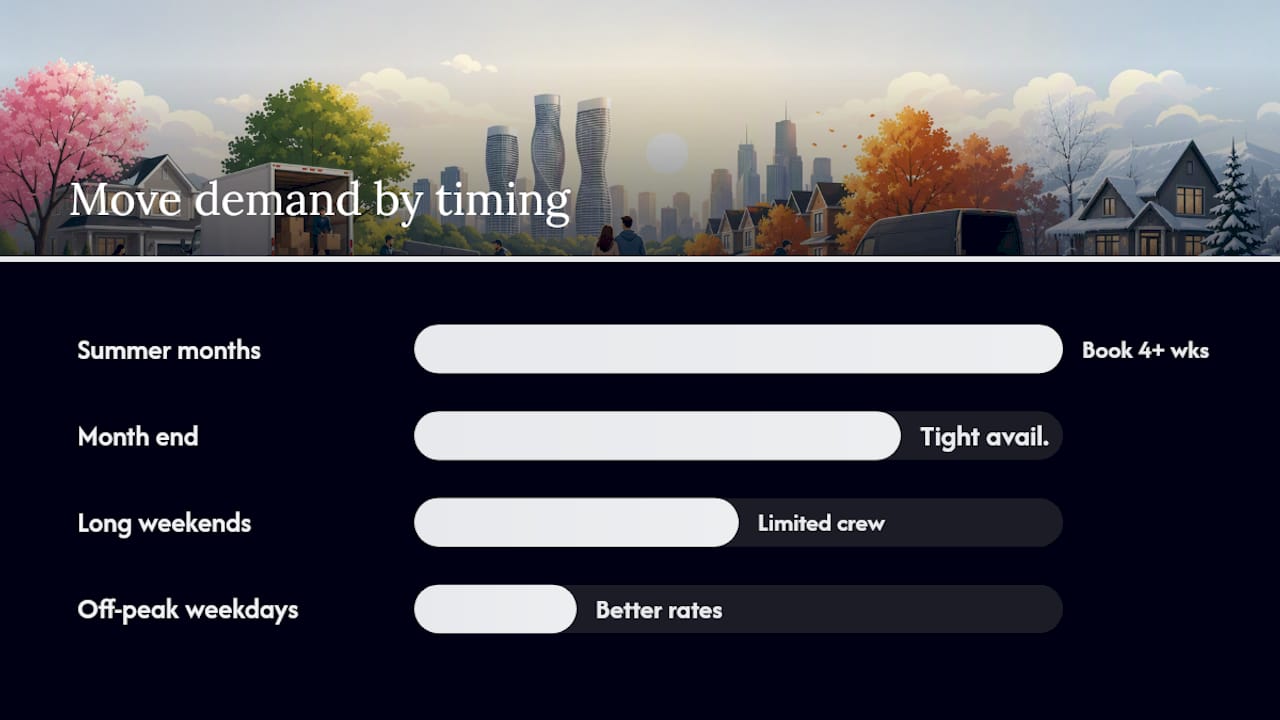
Pro Tip: If you have any flexibility, avoid moving on the last weekend of the month, when demand across Mississauga spikes hardest. A mid-week move two or three days earlier often costs less and comes with a wider choice of crews.
How do you choose a reliable mover in Mississauga?
Ask for proof of licensing and insurance before anything else, and get a written estimate that states whether it’s binding or non-binding. A binding estimate locks your price regardless of small changes; a non-binding one can shift once the crew sees your actual load.
During the quote call, ask directly:
- Is packing included, or billed separately?
- What’s the arrival window, and what happens if the crew runs late?
- Are there extra fees for stairs, long carries, or bulky items?
- What’s the process for filing a claim if something’s damaged?
Watch for red flags: no written estimate, a large upfront deposit demanded before any work is done, or vague answers about valuation coverage. Book 2 to 4 weeks ahead in off-peak periods, and earlier still if your date falls in summer or near a long weekend. Aleksmoving’s guide to hiring a mover breaks these questions down in more detail.
What usually goes wrong, and how do you avoid it?
Most moving-day stress traces back to the same handful of mistakes, and nearly all of them are avoidable with a bit of buffer time. Underestimating how many boxes you’ll actually need is the most common one; people consistently pack more than they expect once closets and cupboards get emptied out.
Here’s what tends to go sideways, and the fix:
- Elevator double-booking in condos. Confirm your slot in writing with the building the week before, not just verbally.
- Blocked driveway or loading zone on move day. Check for scheduled street work or events near your address through the city’s events calendar beforehand.
- Damaged or missing small items. Photograph valuables before the crew arrives, and keep an itemized list handy.
- Last-minute mover cancellations. Confirm your booking by phone 48 hours ahead, especially during peak season.
Pro Tip: Build in a one-hour buffer on both ends of your move day. Traffic on the QEW or 403 during a weekday move can easily eat into your elevator window if you’ve cut the timing too close.
Where can you get a printable checklist and inventory template?
A one-page printable version of this timeline keeps everything in one place instead of scattered across sticky notes. Track your inventory with four simple fields: room, box number, contents summary, and estimated value, which also helps if you need to file an insurance claim.
For supplies, budget roughly $80 to $150 for a full set of boxes, tape, and wrap for a typical two- to three-bedroom home, sourced from moving supply stores, hardware retailers, or directly through your moving company.
| Item | Approximate quantity | Notes |
|---|---|---|
| Small boxes | 15–20 | Books, kitchenware |
| Medium boxes | 15 | Clothing, toys |
| Large boxes | 8–10 | Linens, light items |
| Wardrobe boxes | 2–3 | Hanging clothes |
| Packing tape | 1 roll per 5 boxes | Reinforce bottoms |
Download Aleksmoving’s full Mississauga moving checklist for a printable version you can keep on the fridge through the whole process.
What separates a smooth move from a stressful one?
The households who move without drama tend to do three things the same way every time: they get three written quotes before booking, they start decluttering weeks before they touch a single box, and they confirm every permit or elevator slot in writing rather than trusting a verbal agreement. None of that is complicated, but skipping any one of them is usually what turns a Tuesday move into a Tuesday disaster.
One recent Mississauga condo move came down to a single phone call. The building required 48 hours’ notice for elevator bookings, and the resident hadn’t checked until the week of the move. A quick call to property management on a Monday secured the last open slot for Thursday, the only day that week with availability.
If you want help: how Aleksmoving simplifies a Mississauga move
Aleksmoving is the alternative to piecing your move together yourself across multiple bookings, permit calls, and packing runs. We handle local Mississauga moves, packing, and storage under one flat-rate quote, so there’s no separate bill for the truck, the crew, and the boxes. With more than 18 years in the business, our crews already know which downtown condo towers require elevator bookings, which streets need a parking permit, and how to time a load around peak traffic on the 403 or QEW.

If your move is coming up in the next few weeks, especially during a summer or month-end window, the smart move is to lock in your date now rather than wait for availability to tighten. Request a free quote through our moving services page and get a flat-rate estimate with no hidden fees, or check our storage options if you need a short-term buffer between move dates.
Sources
- Mississauga
- The Ultimate Mississauga Moving Guide: What You Need to Know | Tag in Time
- Moving to Mississauga: What to Expect | HOMEH