Skip to content


Toronto does not offer a general permit that lets you reserve curb space for moving day. Moving trucks can stop at the curb only while actively loading or unloading, and the City’s parking regulations make no special exception for moves. If your situation goes beyond a quick in-and-out, check the City’s temporary permit pages or contact Right of Way Management before move day.
TL;DR:
- Temporary curb permits are available through eTPP up to two weeks ahead, but only qualifying family vehicles and certain vans meet the size and weight limits.
- Street Occupation Permits cover moving containers, bins, or lane use; some applications and payments must be handled in person, with fees charged by day.
- Oversized vehicle permits require a route plan, vehicle dimensions, and proof of insurance, and processing typically takes 7 to 10 business days.
- Temporary parking permits generally cannot be refunded or changed after purchase, so confirm your move dates carefully before paying for coverage.
- Some Street Occupation Permits cost $73.89 plus HST per day, while an oversized single trip permit costs $66.41 plus HST outside construction hubs.
Table of Contents
- When do you actually need a permit?
- The City permit types that matter for moves
- How to apply for a moving truck permit in Toronto
- Costs and processing times for Toronto moving permits
- Day-of move rules and how to handle curbspace without a permit
- Requesting a loading zone or longer-term curb change
- How Aleks Moving reduces permit and curbspace risk
- Planning early beats scrambling on move day
- Get help planning your move with Aleks Moving
- FAQ
- Sources
When do you actually need a permit?
Most straightforward moves do not need any paperwork at all. The City treats “active loading” differently from parking: your truck can stop briefly while your crew is physically moving boxes in or out, but once the truck sits unattended, it’s subject to the same parking regulations as any other vehicle, including fire hydrant setbacks and no-stopping zones.
A small apartment move with a short carry usually falls under this normal loading allowance. A move that blocks a full lane, uses a moving container left on the street overnight, or involves hoisting furniture through a window typically crosses into permit territory.
Ask yourself:
- Will the truck be left unattended for more than a few minutes at a time?
- Does the job need a container, bin, or equipment parked on the street overnight?
- Will your crew need to occupy more than one parking space or part of a lane?
If you answered yes to any of these, a permit is worth looking into.
The City permit types that matter for moves
Three permit types cover most moving scenarios in Toronto.
- Temporary On-Street Permit Parking lets you reserve 24-hour, 48-hour, or weekly parking in designated permit areas, and the City’s temporary permit page notes these can be bought up to two weeks ahead through City channels. Vehicle eligibility matters here: the permit terms limit coverage to passenger vehicles and some vans or panel trucks under 5.2 metres and 3,000 kilograms, provided they’re registered as family vehicles.
- Street Occupation Permit applies when you need to place a moving container, disposal bin, or otherwise occupy part of the right-of-way. The Street Occupation Permit page confirms some of these must be applied for and paid in person.
- Single-Trip/Oversize Permits come into play when your vehicle and load exceed standard dimension or weight thresholds, with oversize load rules setting route and timing controls plus insurance requirements.
How to apply for a moving truck permit in Toronto
Which office you deal with depends on which permit you need.
- For a temporary on-street permit, apply through the City’s eTPP system: enter your address, vehicle information, and the date range you need, then print or save your confirmation to display in the vehicle.
- For a Street Occupation Permit, contact the relevant construction permits office directly. Many of these applications and their fees are handled in person, and you’ll need details about the location, duration, and purpose of the occupation.
- For a single-trip or oversize permit, apply through Right of Way Management with your route plan, vehicle dimensions, and proof of insurance ready, since oversize load permits typically require 7 to 10 business days for processing.
Before you start, gather your address and move dates, vehicle registration and dimensions, and insurance documentation if a container or oversized vehicle is involved.
Pro Tip: Apply for temporary on-street permits at least two weeks ahead and for street occupation or oversize permits 5 to 10 business days out, since these offices process requests on business-day timelines, not calendar days.
Costs and processing times for Toronto moving permits
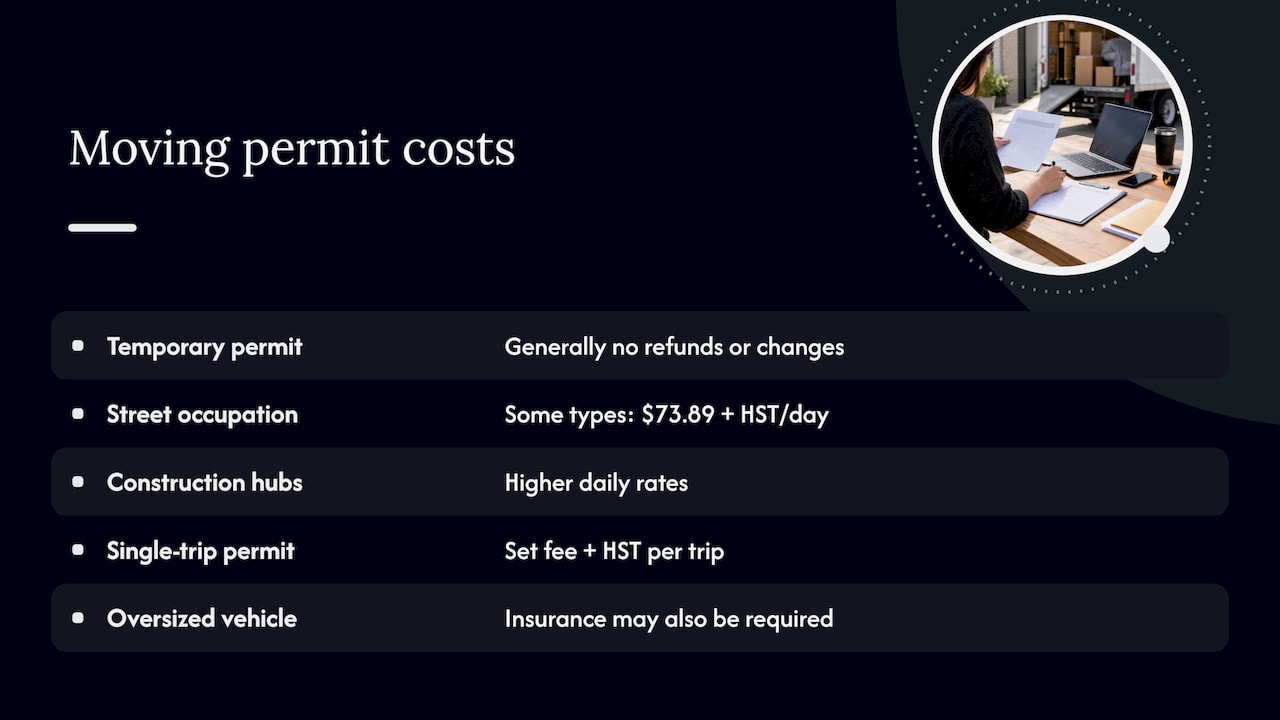
Temporary on-street permits follow strict purchase and modification rules: once bought for a given date range, they generally can’t be refunded or changed, so confirm your move date before paying, according to the temporary permit page.
Street Occupation Permits carry daily fees, with some permit types charging $73.89 plus HST per day, and higher rates inside designated construction hubs. That daily structure matters if your move stretches across a weekend.
Oversize or single-trip permits add their own line item: not-in-construction-hub single-trip permits run a set fee plus HST per trip, on top of any insurance your oversized vehicle requires. When budgeting a move that needs a container or an oversized truck, build both the daily occupation fee and the insurance cost into your plan early.
Day-of move rules and how to handle curbspace without a permit
On move day, the line between legal and ticketed comes down to activity. A truck with crew members actively carrying items counts as loading. A truck sitting empty while everyone’s inside packing boxes looks, to a parking officer, like an unpermitted parked vehicle.
A short pre-move walk of your street tells you a lot: where the nearest legal loading zone sits, whether a side street offers easier access, or whether a building loading dock solves the problem entirely. Scheduling your move for a weekday mid-morning instead of a weekend afternoon often means less competition for curb space.
- Keep at least one crew member moving items continuously so the truck stays in active-loading status.
- Scope out nearby legal parking or loading zones before the truck arrives.
- Stage boxes and furniture near the door in advance to cut down on trips.
- Give building management or neighbours a heads-up if your truck will be parked for an extended window.
Pro Tip: A longer carry from a legal parking spot is almost always cheaper than a parking ticket from stopping in a no-stopping zone.
Our moving truck parking guide covers more of these tactics in detail for moves across different Canadian cities.
Requesting a loading zone or longer-term curb change
If your street regularly causes headaches for deliveries or moves, you can ask the City to investigate a new or modified loading zone rather than relying on permits every time.
- Submit a service request describing the location and the problem you’re trying to solve.
- The City checks eligibility, including whether the spot sits on a City road and at least 9 metres from an intersection, per the loading zones page.
- Some changes need City Council approval, which extends the timeline well beyond a single move.
For a one-time move, a Street Occupation Permit is almost always the faster, more practical route than waiting on a zone change.
How Aleks Moving reduces permit and curbspace risk
We have experience coordinating residential and commercial moves in Ontario, and curbspace planning is part of how we keep a move on schedule. Before your moving day, our team can walk the street, flag whether your building or block needs a Street Occupation Permit or a temporary on-street permit, and plan around active-loading windows so your crew stays compliant without idle time at the curb.
We price our residential moving and commercial moving jobs at a flat rate with no hidden fees, so permit coordination doesn’t turn into a surprise line item. If your move involves bins or containers that might trigger a Street Occupation Permit, our bin rental service team can talk through the logistics with you ahead of time.
Planning early beats scrambling on move day
Toronto’s permit system rewards people who plan ahead and penalizes people who assume they can sort out curbspace on the fly. The single highest-impact thing you can do is check your permit needs the moment you book a moving date, not the week before.
A short site survey, whether you do it yourself or your mover does it for you, solves more curbspace problems than any amount of improvising on the day.
— Ali
Get help planning your move with Aleks Moving
Permit rules add one more thing to track on an already busy moving day, and we’d rather you spend that energy on packing than parking enforcement. Our team handles the on-the-ground part: assessing your street, flagging when a Street Occupation Permit or temporary on-street permit applies, and building a loading plan around it.
Whether you’re moving a house, an office, or need storage between leases, we quote every job at a flat rate with no hidden fees. Request a free quote for your residential move and we’ll work the curbspace planning into your booking from the start.
FAQ
How much does a street permit cost in Toronto?
Costs depend on the permit type: a Street Occupation Permit runs $73.89 plus HST per day for some permit types, with higher rates inside construction hubs. A single-trip oversize permit costs $66.41 plus HST per trip outside construction hubs.
Can you park a commercial vehicle in your driveway in Toronto?
Driveway parking rules depend on your vehicle’s size and classification rather than the move itself, and this falls outside the on-street permit system covered on the City’s parking regulations page. If you’re unsure whether your moving truck qualifies, confirm with the City directly before move day.
How do I get a right of way permit for a move in Toronto?
For container placement or lane occupation, apply for a Street Occupation Permit, which the City’s permit page notes often requires an in-person application and payment. For oversized vehicles, apply for a single-trip permit through Right of Way Management with your route and insurance details ready.
What’s the difference between loading and parking a moving truck?
Loading means your crew is actively moving items in or out of the truck, which the City allows without a permit under its parking regulations. Once the truck sits unattended, it’s treated as a parked vehicle and subject to normal enforcement, including no-stopping zones and fire hydrant setbacks.
Does Aleks Moving help with permit planning?
Yes, our team can assess your street ahead of your move and flag whether a Street Occupation Permit or temporary on-street permit applies to your situation. We build that planning into our flat-rate residential and commercial moving quotes so there are no surprises on moving day.