Skip to content


The safest way to move is to plan early, use rated equipment to protect people and floors, and hire professionals whenever a load or route raises the risk. Many professional movers have observed which shortcuts cause injuries and dented drywall, and safety sources like U-Haul back the same basics. Call in pros the moment stairs, a safe, or an appliance over a couple of hundred pounds enters the picture.
TL;DR:
- Safely moving heavy safes or appliances over 300 pounds or involving stairs requires professional rigging and full-service crews to prevent injuries and damage.
- Use rated equipment such as appliance dollies, moving straps, plywood layers, and corner guards to protect floors, furniture, and prevent injuries during the move.
- Planning early, labeling fragile items, and assigning specific roles on moving day reduce risks and ensure a smoother, safer operation.
- When moving a safe or heavy appliance, completely empty it, measure the route, and secure it with rated straps before lifting or transporting on stairs.
- Get written estimates, a bill of lading, and a detailed inventory from movers, especially when handling specialty items or stairs, to avoid hidden charges and ensure proper coverage.
Table of Contents
- What should be on your safe moving guide checklist?
- What equipment keeps floors and people safe?
- How do you move a heavy safe or appliance without getting hurt?
- When should you hire professional movers instead?
- How do you stay physically safe while moving?
- How do you protect your home and valuables on moving day?
- A technician’s take on what actually prevents moving injuries
- Booking help for a heavy or safe move
- Sources
- FAQ
What should be on your safe moving guide checklist?
A safe move follows a timeline, not a scramble. Rushing the last week is where most sprained backs and cracked drywall happen.
- Six to two weeks out. Declutter room by room, measure doorways and stairwells against your largest furniture, and book your truck or movers. Buy supplies now, including boxes, tape, moving blankets, and straps, so you’re not hunting for gear the night before.
- 72 to 24 hours before. Pack a personal essentials bag (medications, chargers, documents), confirm your moving route and parking access, and label fragile boxes clearly on at least two sides. Set valuables like jewellery and important paperwork aside in a separate “owner box” that travels with you, not the truck.
- Moving day sequence. Assign roles before anyone lifts anything: a caller to direct traffic, spotters at doorways and stairs, a dolly operator, and someone loading the truck. Load heaviest items first and against the truck’s front wall.
- The decision rule. If a task involves stairs, a tight turn, or anything heavy, that’s your cue to call professionals rather than push through it.
Following an ordered moving-day safety plan that includes route planning and team lifts is one of the most consistent recommendations from movers themselves.
What equipment keeps floors and people safe?
The right gear turns a two-person injury risk into a manageable job. Skipping it is how hardwood gets gouged and backs get thrown out.
- Appliance dolly: A heavy-duty model with a strap system supports fridges, stoves, and safes far better than a standard hand truck. See how it’s used in practice for moving a fridge with an appliance dolly.
- Moving straps: Shoulder or forearm straps redistribute weight off your lower back and onto your legs and core.
- Moving blankets: Wrap furniture corners and appliance surfaces to prevent scuffs and dents during transport.
- Plywood or Masonite sheets: Laid over blankets, these spread the wheel load of a loaded dolly across a wider surface, which is exactly why HireAHelper recommends layering blanket, plywood, and Masonite together rather than relying on carpet alone.
- Corner guards: Cheap foam or cardboard guards on door frames and stair corners prevent the chipped paint that shows up on every final walkthrough.
- Ramp: A loading ramp turns a truck’s back gate from a hazard into a controlled slope.
For appliance-specific setups, Guides on equipment for moving appliances and the heavy appliance how-to walk through rigging each piece correctly. A stair-climbing dolly, which uses a motorized or geared track system, becomes worth renting the moment you’re facing more than one flight with a safe or a full-size appliance.
How do you move a heavy safe or appliance without getting hurt?
Weight and stairs change the math fast. A safe under 300 pounds on a single level with no tight turns is often manageable with two strong helpers, proper straps, and patience. Anything heavier, or any job involving stairs, tight hallway turns, or a spiral staircase, usually calls for riggers or a full-service crew, since Liberty Safe points out that safes carry a dangerously high centre of gravity relative to their footprint.
The step-by-step sequence that actually works:
- Empty the safe completely and lock it before moving, since shifting contents can throw off balance mid-lift.
- Measure the path from the safe’s current spot to the truck, checking every doorway and turn in advance.
- Protect the floor with a blanket, plywood, and Masonite layered together along the entire route.
- Strap the safe to the appliance dolly using a rated ratchet strap, checked twice before anyone tilts it.
- Load with spotters stationed at every turn and doorway to call out clearance.
- Secure it in the truck using an X-pattern strap configuration against the front wall, then recheck strap tension after the first few minutes of driving.
Stairs deserve special caution. Tilting a heavy safe on an incline multiplies the effective force your team has to control, which is the single biggest reason a flat-ground DIY job turns into a professional one once stairs enter the equation. A three- or four-person team, with one dedicated purely to spotting, is common for teams moving heavy items on stairs.
Never let go of a tilted safe to “reset your grip.” Set it down flat first, breathe, then reposition. That half-second of hesitation is when fingers and toes get crushed.
When should you hire professional movers instead?
Certain situations aren’t worth the risk of a DIY attempt, no matter how many friends show up with pickup trucks.
- Any move involving stairs, elevators with tight thresholds, or awkward turns with a safe or major appliance.
- Safes or gun cabinets over the weight your team can control with rated straps, generally north of 300 pounds.
- Irreplaceable items: antiques, art, or heirlooms where a scratch or drop can’t be undone.
Before booking, ask movers what equipment they use, what their insurance limits actually cover, and whether they’ll provide a written estimate. The FMCSA recommends getting a bill of lading and a full inventory list, and treating an unsigned or blank estimate as a red flag worth walking away from. Ask specifically about experience with safes or specialty items, since not every general mover carries the rigging equipment for a 500-pound gun safe. Keep every document, including the estimate, inventory, and bill of lading, until the move is fully settled and nothing’s missing.
How do you stay physically safe while moving?
Your body is the piece of equipment most likely to get damaged on moving day, so treat it that way.
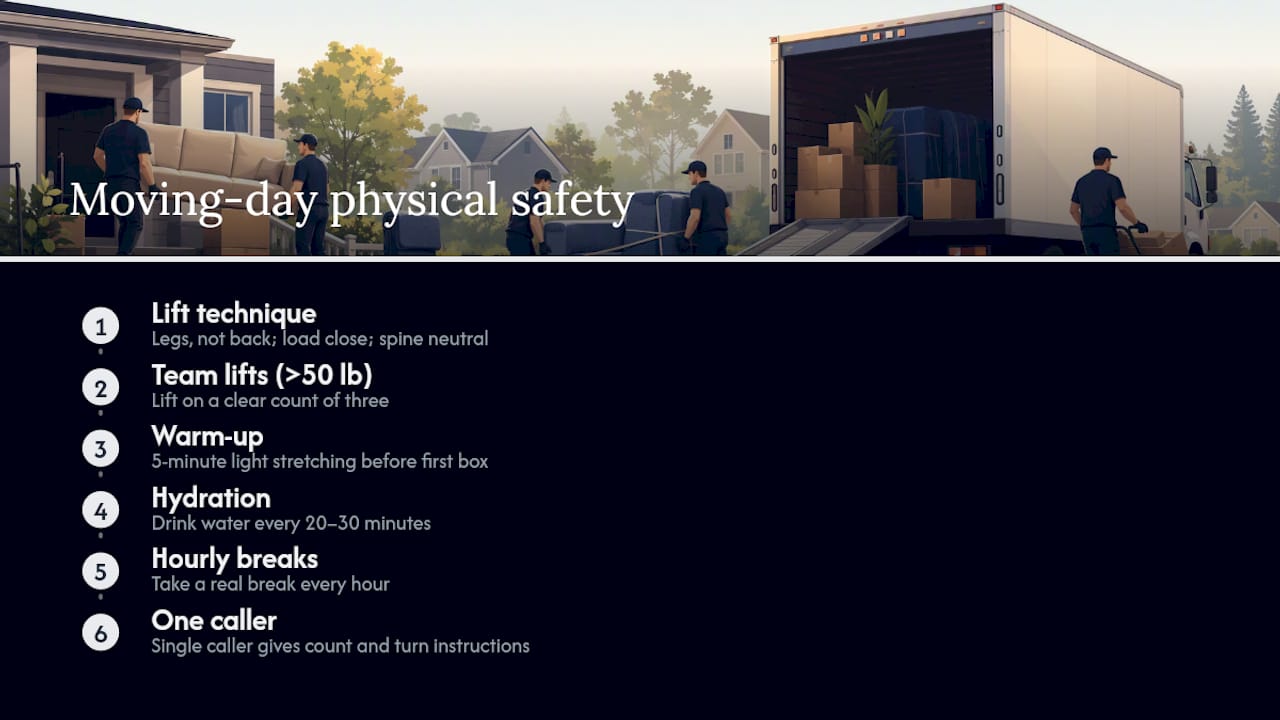
Lift with your legs, not your back, keeping the load close to your body and your spine neutral. Team lifts on anything over 50 pounds mean lifting on a clear count of three, not a vague “ready?” A five-minute warm-up with some light stretching before the first box goes a long way toward preventing pulled muscles. Drink water every 20 to 30 minutes and take a real break every hour, not just when someone finally admits they’re exhausted. Assign one caller whose job is purely to give lift and turn instructions, since two people guessing at timing is how fingers get pinched. If you feel sharp pain, dizziness, or numbness, stop immediately. That’s your body telling you the load has already won.
How do you protect your home and valuables on moving day?
Damage prevention and loss prevention are two different problems, and both need a plan before the truck backs up to the door.
- Carry valuables personally in a dedicated “owner box,” including jewellery, documents, and small electronics, rather than trusting them to the truck. Aleksmoving’s guide on packing fragile items safely covers exactly this kind of prioritization.
- Lay down floor runners or the blanket and plywood combination on any path the dolly will travel repeatedly.
- Protect door frames and stair corners with foam guards, since these edges take the most contact over a full day of hauling.
- Label fragile boxes on multiple sides and load them last, so they sit on top rather than under furniture.
- Check what your mover’s basic liability actually covers. GEICO notes that standard mover liability is often calculated per pound, which can badly undervalue a light but expensive item like a laptop. Review your homeowner or renter policy, and consider third-party coverage for anything genuinely irreplaceable.
For furniture specifically, the tactics in protecting furniture during a move pair well with the floor protection steps above.
A technician’s take on what actually prevents moving injuries
After 18-plus years of flat-rate moves with no hidden fees, the pattern is consistent: the households that get hurt or damage floors are the ones that skip a step, not the ones facing an unusually hard move. Our technician-approved safe moving tips reflect what actually holds up on stairs and tight turns, not textbook theory. If you’re planning a quote request, have your item list, floor count, and any stairs or elevators ready. It shortens the call.
— Ali
Booking help for a heavy or safe move
There’s a real cost to guessing wrong on a safe or appliance move: a cracked floor, a strained back, or a dropped heirloom you can’t replace. Professional moving companies handle the equipment and rigging decisions that turn a risky DIY job into a controlled one, often quoting flat rates with no hidden fees added after the fact.

Our crews bring appliance dollies, straps, and floor protection as standard, whether the job is a full residential move, a single heavy safe, or packing fragile valuables ahead of moving day. Our packing services cover the fragile and high-value items you don’t want to trust to a rushed afternoon, and our local moving services bring the same equipment and crew structure to shorter-distance jobs. Pricing is quoted upfront, with the scope confirmed before the truck ever shows up, so there’s no surprise line item at the end. If your move involves stairs, a safe, or anything you’d hate to see damaged, request a quote through our moving company page and get a firm number before you commit to a date.
Sources
- How to stay safe on moving day: 10 essential tips — U‑Haul
- Can I move my safe? — Liberty Safe
- How to move a heavy safe — HireAHelper
- Tips for a successful move — FMCSA
- Moving? 5 ways to keep your stuff safe — GEICO
FAQ
What is the safest way to move heavy furniture?
Use an appliance dolly with rated straps, protect the floor with blankets and plywood, and lift with a team using a clear count, keeping the load low and close to your body.
How heavy does a safe need to be before I hire movers?
Most safes over roughly 300 pounds, or any weight combined with stairs or tight turns, are safer left to riggers or a full-service crew like Aleksmoving.
What documents should I get from a moving company?
Ask for a written estimate, a bill of lading, and a full inventory list, and never sign a blank or unsigned document from a mover.
Does mover insurance cover all my belongings?
Basic mover liability is often calculated per pound, which undervalues light, expensive items, so check your homeowner or renter policy and consider third-party coverage for valuables.
How do I move safely with kids or pets on moving day?
Keep kids and pets in a closed-off room or with a sitter away from the truck and dolly path, since moving day traffic through doorways is the highest-risk zone in the house.