

TL;DR:
- Consolidated moving shares shipment space among multiple customers, reducing costs and environmental impact. It is ideal for small loads with flexible timelines but involves longer delivery windows and more handling stages. Choosing a provider with a proper consolidation centre ensures safety and tracking, making it a cost-effective option for budget-conscious movers.
Consolidated moving is defined as a logistics method where multiple customers’ shipments heading in the same direction share one truck or container, with each customer paying only for the space their belongings occupy. Also known in the freight industry as groupage or less-than-truckload (LTL) shipping, this approach splits fuel, labour, and toll costs among all customers on the same route, producing significant cost savings that a dedicated truck simply cannot match. The trade-off is a longer, less predictable delivery window. For budget-conscious Canadians and businesses with flexible timelines, consolidated moving is one of the most practical relocation options available in 2026.
What is consolidated moving and how does it work?
Consolidated moving works by routing shipments from several customers through a central consolidation centre before loading them onto a shared vehicle. At the consolidation centre, each customer’s goods are catalogued, labelled, and loaded alongside other shipments bound for the same general destination. The truck then makes multiple stops along the route, dropping off each customer’s belongings in sequence.
The step-by-step process looks like this:
- Booking: You book space on a shared truck rather than reserving the entire vehicle.
- Pick-up: The moving company collects your belongings from your origin address.
- Consolidation: Your items arrive at a consolidation centre and are loaded with other customers’ shipments.
- Transit: The truck travels the route, making stops for each customer along the way.
- Delivery: Your belongings are unloaded at your destination, typically within a 2–7 day window for long-distance moves.
The customers who benefit most from this model are those with smaller loads. Students moving into a new apartment, single professionals relocating across the province, and small businesses shipping a partial office fit this profile well. A full household with a tight deadline is a better candidate for a dedicated truck.
Pro Tip: Book your consolidated move at least two to three weeks in advance. Consolidation centres need time to match your shipment with others heading in the same direction, and last-minute bookings often result in longer wait times before your goods even leave the facility.
What are the advantages and disadvantages of consolidated moving?
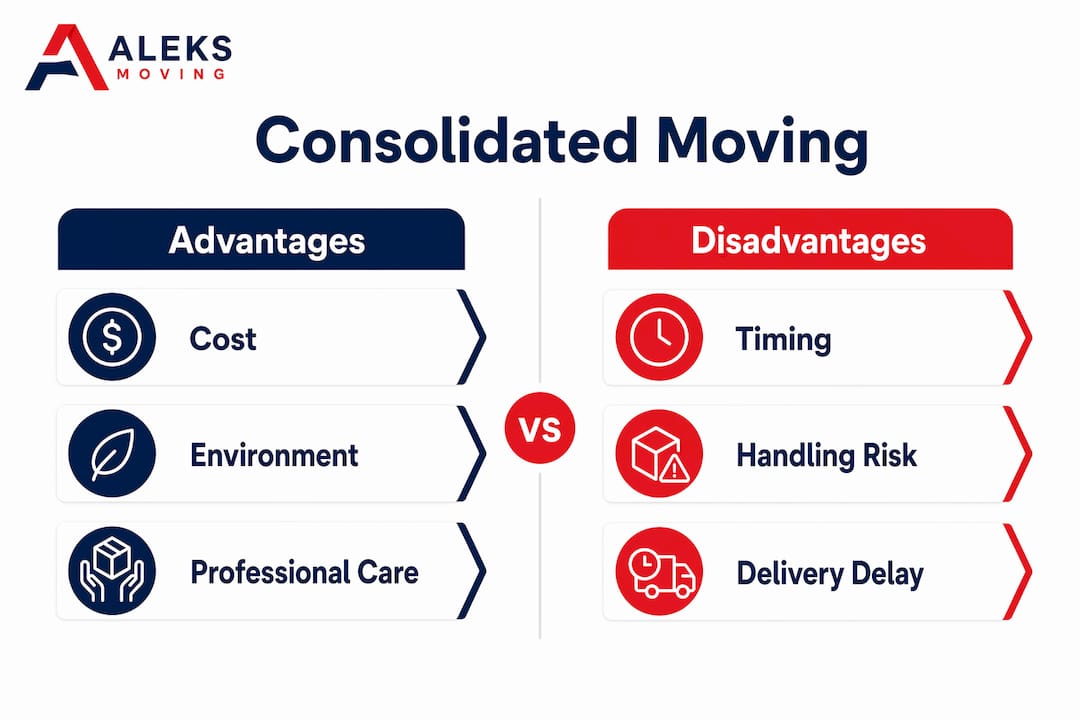
Consolidated moving is not a downgrade in service quality. It is a strategic logistics choice that lowers individual cost per shipment and reduces the carbon footprint of each move. That said, it comes with real trade-offs worth understanding before you commit.
The advantages
The most compelling benefit is cost. Consolidated moving can reduce freight costs by 10%–50% on higher-class shipments by filling truck capacity that would otherwise go unused. That saving comes directly from splitting fuel, labour, and toll expenses among multiple customers sharing the same route.
The environmental benefit is equally concrete. Fewer trucks on the road means a lower carbon footprint per shipment. For businesses with sustainability goals, consolidated freight services offer a measurable way to reduce transport emissions without sacrificing service.
Professional handling standards also hold up. Moving companies apply the same packing and loading care in consolidated moves as they do in dedicated ones. Your furniture does not receive less attention simply because it shares space with another customer’s boxes.
The disadvantages
Delivery timing is the biggest drawback. Because the truck serves multiple customers, delivery dates are rarely guaranteed and windows are wide. You need to be available and flexible, not waiting on a specific date.
The additional handling stages also increase risk. Items are loaded, transported to a consolidation centre, reloaded onto the shared truck, and then unloaded again at each stop. Each extra handling stage raises the chance of minor damage compared to a dedicated move where your goods stay sealed until final delivery.
| Attribute | Consolidated moving | Dedicated moving |
|---|---|---|
| Cost | Lower; shared among customers | Higher; full truck cost |
| Delivery timing | Flexible window, 2–7 days typical | Precise, agreed date |
| Handling stages | Multiple (consolidation centre stops) | Minimal (origin to destination) |
| Damage risk | Slightly higher due to reloading | Lower |
| Environmental impact | Lower per shipment | Higher per shipment |
| Best for | Small loads, flexible timelines | Large loads, fixed deadlines |
Pro Tip: If you have fragile or high-value items, invest in professional packing materials and double-box anything breakable. Proper packing reduces damage risk at every handling stage, whether your move is consolidated or dedicated.
What should you look for when choosing a consolidated moving provider?
The single most important factor in provider selection is whether the carrier uses a dedicated consolidation centre or informal co-loading. Professional consolidation centres offer proper inventory management, tracking, and security. Informal co-loading, where a driver simply picks up extra goods along the way, offers none of that. The risk of lost or mixed shipments rises sharply with informal arrangements.
When evaluating a provider, check for these criteria:
- Dedicated consolidation facility: Confirm the company operates or uses a proper centre, not casual roadside pickups.
- Inventory tracking: Ask whether each item receives a unique identifier and whether you can track your shipment in transit.
- Insurance coverage: Verify that your goods are covered during all handling stages, not just while on the truck.
- Clear delivery window: Get the estimated window in writing before you sign anything.
- Customer references: Ask for reviews or references from customers who have used the consolidated service specifically, not just the company’s general moving services.
- Transparent pricing: Confirm that the quote covers all stages, including consolidation centre handling fees.
Choosing a reputable moving company with a verifiable track record protects you from the most common pitfalls of shared freight. Carriers using dedicated consolidation centres achieve better inventory management and reduce risks compared to informal co-loading practices. That difference in process translates directly to the safety of your belongings.
When does consolidated moving make the most sense?
Consolidated moving fits specific scenarios better than others. Knowing when to use it saves you money. Knowing when not to use it saves you stress.
Personal moves
A student moving from Toronto to Vancouver with a bedroom’s worth of furniture is the ideal consolidated moving customer. The load is small, the timeline is flexible, and the cost savings are substantial. The same applies to a single professional relocating between cities with a partial apartment’s worth of belongings. Paying for a full truck when you only need a quarter of it is simply not practical.
Cross-country household moves with a full home’s contents are a different story. When your shipment fills most of a truck on its own, the cost advantage of consolidation shrinks considerably. A dedicated truck may cost only marginally more and will deliver on a date you choose.
Business moves
Small businesses shipping equipment, files, or partial office contents between locations benefit from consolidated freight services in the same way individuals do. The cost-sharing model works whenever the shipment volume is below full-truck capacity.
Corporate relocations involving multiple employees moving to the same city present an interesting opportunity. Grouping several employees’ household shipments into one consolidated load, sometimes called a group move, can produce meaningful savings for the employer while still delivering professional service to each employee. For businesses managing employee relocations in Ontario, this approach deserves serious consideration.
The key question in every scenario is the same: how flexible is your timeline? Consolidated moving rewards patience. If you need your goods by a specific date, a dedicated truck is the safer choice. If you can work within a window of several days, consolidated moving delivers real value without sacrificing quality.
For those looking at all the ways to reduce relocation costs, smart cost-saving strategies extend well beyond choosing a shared truck. Timing your move, decluttering before packing, and booking early all compound the savings.
Key takeaways
Consolidated moving delivers the best value when your shipment is small, your timeline is flexible, and you choose a provider with a professional consolidation centre.
| Point | Details |
|---|---|
| Cost savings are real | Consolidated moves can cut freight costs by 10%–50% by sharing fuel, labour, and toll expenses. |
| Timing flexibility is required | Delivery windows run 2–7 days for long-distance moves; precise dates are rarely guaranteed. |
| Handling risk is manageable | Extra loading stages increase damage risk slightly; professional packing reduces this significantly. |
| Provider quality matters most | Choose carriers with dedicated consolidation centres, not informal co-loading arrangements. |
| Best fit is clear | Small loads, flexible timelines, and budget priorities make consolidated moving the right call. |
My honest view on consolidated moving after years in this industry
The biggest misconception I encounter is that consolidated moving means your belongings get less care. That is simply not true when you work with a professional provider. The packing standards, the loading technique, the insurance coverage: none of that changes because another customer’s sofa is in the same truck.
What does change is control over timing. That is the real trade-off, and most people underestimate how much it matters until they are waiting on a delivery that has not arrived. I always tell customers to be honest with themselves about their schedule before booking. If you have a lease ending on a fixed date or a job starting Monday, a consolidated move is the wrong tool. If you have a week of flexibility, it is often the smartest financial decision you can make.
The environmental angle is also underappreciated. Fewer trucks on the road is a genuine benefit, not a marketing line. For businesses tracking their carbon footprint, consolidated freight services offer a concrete, measurable reduction in transport emissions per shipment.
My advice: ask every provider directly whether they operate a dedicated consolidation centre. That one question separates professional operations from informal arrangements faster than any other. The answer tells you everything about how seriously they take inventory management and shipment security.
— Ali
Aleksmoving’s consolidated and long-distance moving services
Aleksmoving brings over 18 years of experience to every relocation across Ontario and beyond, including consolidated moving options for customers who want professional service without paying for a full truck.
Our team handles the consolidation process with care, from pick-up through delivery, with transparent flat-rate pricing and no hidden fees. Whether you are a student moving cross-country, a professional relocating between cities, or a business shipping partial office contents, we tailor the approach to your load size and timeline. Contact our professional moving team for a free upfront quote and find out exactly what consolidated moving costs for your specific move.
FAQ
What is consolidated moving in simple terms?
Consolidated moving means your belongings share a truck with other customers’ shipments heading in the same direction. You pay only for the space your goods occupy, which lowers your cost significantly.
How long does a consolidated move take?
Long-distance consolidated moves typically take 2–7 days for delivery. Exact dates are rarely guaranteed because the truck serves multiple customers along the route.
Is consolidated moving safe for my belongings?
Professional handling standards in consolidated moves match those of dedicated moves. Choosing a provider with a dedicated consolidation centre, rather than informal co-loading, keeps your shipment secure and properly tracked.
Who benefits most from consolidated moving?
Students, single professionals, and small businesses with smaller loads and flexible timelines benefit most. Anyone who does not need a full truck and can work within a delivery window saves money with this method.
What is the difference between consolidated moving and a dedicated move?
A dedicated move reserves the entire truck for one customer, offering precise delivery dates and fewer handling stages. Consolidated moving shares the truck among several customers, lowering cost but widening the delivery window.