Skip to content


TL;DR:
- Phased relocation involves moving in planned stages to ensure operational continuity and reduce disruption. It spreads risk, tests the environment incrementally, and keeps essential functions running during the move. Proper planning, clear communication, and professional coordination are vital for a successful staged move.
Phased relocation is defined as a move completed in planned stages, by department, floor, or function, rather than all at once, ensuring continuous business operations throughout the transition. In the moving industry, this approach is also called a staged or wave relocation. Whether you are an Ontario business shifting offices or a family coordinating a complex residential move, the phased relocation process replaces one high-pressure moving day with a series of controlled, manageable steps. The result is less disruption, fewer costly mistakes, and a much smoother landing at your new location.
What is phased relocation and how does it differ from a standard move?
Phased relocation is a structured moving strategy where people, equipment, and operations transfer to a new location across multiple planned waves rather than in a single move. A standard “big bang” move shuts everything down on one day and restarts at the new site. A phased approach keeps at least part of your operation running at all times.
This distinction matters most for businesses. A law firm in Toronto cannot afford to lose client access for three days. A manufacturer in Hamilton cannot halt production for a full week. The phased relocation strategy solves this by sequencing moves so that critical functions stay live while non-critical ones transfer first. Residential movers benefit too, particularly families moving between cities who need time to settle children into schools before fully vacating the original home.
The Wave methodology is the most widely used framework for phased office moves. It divides the relocation into named waves, each covering a specific group of staff or a floor, with clear start and end dates. Wave methodology transforms a move into controlled, sequenced stages that allow risk management and incremental progress at every step.
How does phased relocation work step by step?
Strategic planning begins 6–12 months ahead of the first move date for most business relocations. That timeline covers site evaluation, IT audits, vendor contracts, and staff communication. Residential phased moves are typically shorter but still benefit from a structured plan starting at least 8–12 weeks out.
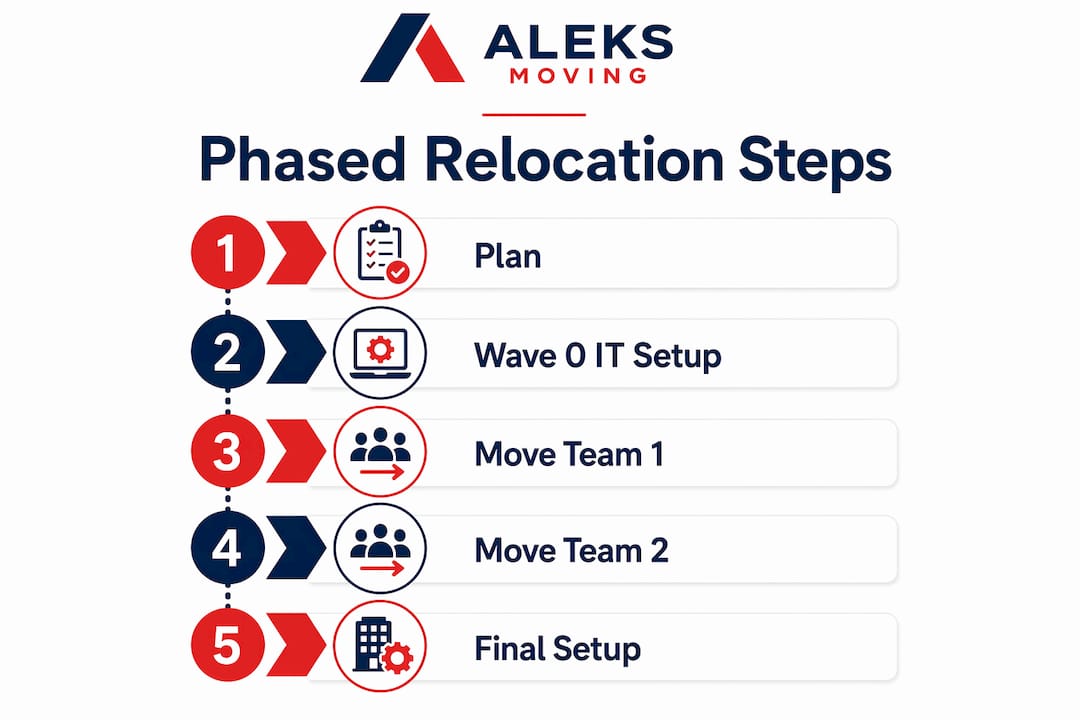
Here is how a typical phased relocation process unfolds:
- Assessment and grouping. Audit all assets, people, and functions. Group them by workflow dependency, not just by floor or department name. Teams that share files, equipment, or daily communication should move in the same wave.
- Wave 0: IT infrastructure activation. Wave 0 activates IT infrastructure and tests all systems 4–6 weeks before any staff arrive at the new site. This lead time is critical. Skipping it is the single most common cause of operational failure on move day.
- Wave 1: Non-critical functions. Move departments with the lowest operational impact first. This tests your logistics, identifies gaps in the new space, and gives your moving team real feedback before higher-stakes groups transfer.
- Parallel operation period. Both sites run simultaneously for a defined period. This is your safety net. If something goes wrong at the new location, the original site absorbs the load.
- Core function transfer. Move customer-facing, revenue-generating, or operationally critical teams once the new site is proven stable.
- Post-move stabilisation. Stabilisation typically lasts 1–4 weeks after the final wave. Use this period to resolve outstanding IT issues, return surplus furniture, and confirm all teams are fully operational.
Pro Tip: Schedule every wave during off-hours or on weekends. Moving a 20-person accounting team on a Tuesday afternoon costs you a full afternoon of billable work. The same move on a Saturday costs nothing in lost productivity.
Storage is a critical but often overlooked part of this sequence. Professional storage acts as a buffer for excess furniture and records during phased moves, preventing clutter and space conflicts at both sites.

What are the key benefits of phased relocation?
Phased relocation is a business continuity strategy, not just a logistics preference. Moving by waves spreads risk and allows real-time troubleshooting before problems affect the entire organisation. That single shift in thinking changes how you budget, plan, and measure success.
The core benefits include:
- Minimised downtime. Core operations stay live throughout the move. Revenue loss from full shutdowns is avoided entirely.
- Risk distribution. A single-point failure in a big bang move affects everyone. In a phased move, a problem in Wave 2 does not touch Wave 4.
- Real-time testing. Each wave is a live test of the new environment. You catch IT failures, space issues, and workflow gaps before they affect your most critical teams.
- Reduced employee disruption. Staff move in smaller groups, which reduces anxiety, maintains team cohesion, and lowers the risk of attrition during a stressful period.
- Predictable budgeting. Phased moves reduce emergency fees and overtime costs despite requiring more upfront planning. The budget becomes more predictable because surprises are caught early and at smaller scale.
“Phased office moves are no longer just logistics tasks. They are strategic continuity measures essential for modern businesses.” — Sterling Moving
The financial case is straightforward. A single chaotic move day that takes down your phone systems for 48 hours costs far more than the additional planning hours a phased approach requires. Ontario businesses operating in competitive sectors like finance, healthcare, and professional services cannot absorb that kind of disruption.
Common mistakes to avoid during a phased relocation
Most phased relocation plans fail not because the concept is flawed but because execution skips critical steps. Knowing where others go wrong saves you time, money, and frustration.
- Ignoring team adjacencies. Sequencing without accounting for adjacencies disrupts collaboration and reduces momentum. Move teams that share workflows in the same wave, not based on which floor is easiest to vacate first.
- Skipping Wave 0. Moving staff into a space where the IT infrastructure has not been certified is the fastest way to lose a week of productivity. Wave 0 is not optional.
- Underestimating communication needs. Dedicated communication channels for each wave improve employee engagement and reduce confusion. A single company-wide email is not enough when different groups are moving on different dates.
- No storage plan. Without a storage buffer, both sites become cluttered. Furniture piles up, records get misplaced, and your team wastes time managing chaos instead of working.
- Poor vendor coordination. IT providers, furniture suppliers, and moving crews must all operate on the same timeline. A delay from one vendor cascades through every subsequent wave.
- Underestimating cost and resource requirements. Phased moves require more planning hours and more management attention than a single-day move. Budget for a project coordinator, not just a moving truck.
Pro Tip: Build a shared project tracker, using a tool like Asana, Trello, or even a shared Google Sheet, that all vendors and internal leads can access. Visibility across teams prevents the scheduling conflicts that derail most phased moves.
Practical tips for Ontario businesses and individuals planning a phased move
Ontario’s business centres, from the Financial District in Toronto to the tech corridors in Waterloo and Ottawa, are home to organisations that cannot afford unplanned downtime. A well-structured phased relocation plan protects your operations and your people.
Here is what works in practice:
- Start planning 6–12 months early. This is not conservative. It is the minimum time needed to evaluate sites, negotiate leases, audit IT infrastructure, and brief staff properly.
- Hire movers experienced with phased relocations. Not every moving company understands wave sequencing, parallel site management, or IT coordination. Ask specifically about their experience with multi-phase office moves before signing a contract.
- Audit and label everything before Wave 1. Know exactly what you own, what you are keeping, and what you are disposing of. Unlabelled assets slow every wave and create confusion at the new site.
- Test IT at the new site before people arrive. This is Wave 0. Run every system, every application, and every network connection under realistic load before your first employee walks through the door.
- Create wave-specific communication plans. Staff moving in Wave 3 do not need the same briefing as staff moving in Wave 1. Tailor your updates to each group’s timeline and concerns.
- Use professional storage as a buffer. Ontario-based storage solutions for relocations give you a place to hold surplus furniture and records without cluttering either site.
- Schedule moves outside core business hours. Early mornings, evenings, and weekends protect productivity and reduce the physical disruption to staff who are still working on-site.
Here is a quick comparison of phased versus single-day relocation strategies for Ontario businesses:
| Factor | Phased relocation | Single-day move |
|---|---|---|
| Operational downtime | Minimal, operations stay live | High, full shutdown required |
| Risk exposure | Spread across waves | Concentrated on one day |
| Budget predictability | High, issues caught early | Low, surprises are costly |
| IT readiness | Tested in Wave 0 before staff arrive | Tested on move day under pressure |
| Staff disruption | Low, smaller groups move at a time | High, entire workforce affected at once |
| Best suited for | Businesses, complex residential moves | Small offices, simple residential moves |
For a deeper look at structuring your move around business functions and team workflows, the office relocation planning guide from Aleksmoving covers the full planning process in practical detail.
Key takeaways
Phased relocation is the most reliable way to move an Ontario business or complex household without sacrificing operational continuity or absorbing avoidable costs.
| Point | Details |
|---|---|
| Definition is clear | Phased relocation moves people and assets in planned waves, not all at once, keeping operations live. |
| Wave 0 is non-negotiable | IT infrastructure must be activated and tested 4–6 weeks before staff arrive at the new site. |
| Risk is distributed | Each wave is a contained test, so problems are caught before they affect the full organisation. |
| Communication must be wave-specific | Generic company-wide updates are not enough; each group needs tailored guidance on their timeline. |
| Storage is a strategic tool | A professional storage buffer prevents clutter and space conflicts at both the old and new locations. |
Why I think Ontario organisations underestimate phased relocation
After years of working with businesses and families through complex moves across Ontario, the pattern I see most often is this: organisations treat relocation as a logistics problem when it is actually a continuity problem. They focus on the truck and the boxes. They forget about the 200 employees who need working phones, functioning software, and a clear desk on Monday morning.
The businesses that handle phased moves well share one trait. They start planning earlier than feels necessary. A company that begins its phased relocation strategy 10 months out almost always lands better than one that starts at four months, even if the four-month team has more resources. Time is the one thing you cannot buy back once a wave is in motion.
The other mistake I see regularly is treating Wave 0 as optional. I have watched IT teams skip the infrastructure validation phase to save two weeks on the timeline, only to spend three weeks fixing network failures after staff arrived. The maths never works in their favour.
For residential movers, the phased approach is underused simply because people do not know it applies to them. A family moving from Mississauga to Kingston can absolutely benefit from moving non-essential items and furniture first, settling the children into their new school, and then completing the final move of daily essentials. It reduces stress on the family and gives everyone time to adjust. You do not need to be a corporation to benefit from thinking in waves.
My honest recommendation for any Ontario business or individual facing a complex move: treat your relocation plan the same way you would treat a project plan at work. Define your waves, assign owners, set deadlines, and build in checkpoints. The moves that go wrong are almost always the ones where someone assumed it would sort itself out on the day.
— Ali
How Aleksmoving supports phased relocations across Ontario
Planning a phased move in Ontario is significantly easier with an experienced partner who understands wave sequencing, IT coordination, and the logistics of running two sites simultaneously.

Aleksmoving has over 18 years of experience supporting phased office and residential relocations across Ontario, from Toronto and Mississauga to Ottawa and beyond. We offer flat-rate pricing with no hidden fees, so your phased relocation budget stays predictable from Wave 0 through final stabilisation. Our team handles packing, transportation, and storage coordination, giving you one trusted point of contact across every stage of your move. Whether you are relocating a 10-person office or a multi-floor corporate headquarters, we build a plan around your timeline and your operations. Explore our full range of professional moving services and request a free quote today.
FAQ
What is phased relocation in simple terms?
Phased relocation is the process of moving in planned stages rather than all at once. Each stage, or wave, transfers a specific group of people or functions to the new location while the rest continue operating normally.
How long does a phased relocation take?
For businesses, a phased relocation typically spans 6–12 months from initial planning through post-move stabilisation. Residential phased moves are shorter but still benefit from 8–12 weeks of structured planning.
What is Wave 0 in a phased office move?
Wave 0 is the IT infrastructure activation phase, completed 4–6 weeks before any staff move to the new site. It involves certifying and testing all technical systems under realistic conditions before people arrive.
Is phased relocation more expensive than a single-day move?
Phased relocation requires more upfront planning, but it reduces emergency fees, overtime costs, and revenue loss from downtime. The total cost is typically more predictable and lower than recovering from a failed single-day move.
Do Ontario residential movers use phased relocation?
Yes. Families moving between cities or managing complex logistics, such as school enrolments or overlapping leases, benefit from moving non-essential items first and completing the full move in a second or third stage.