

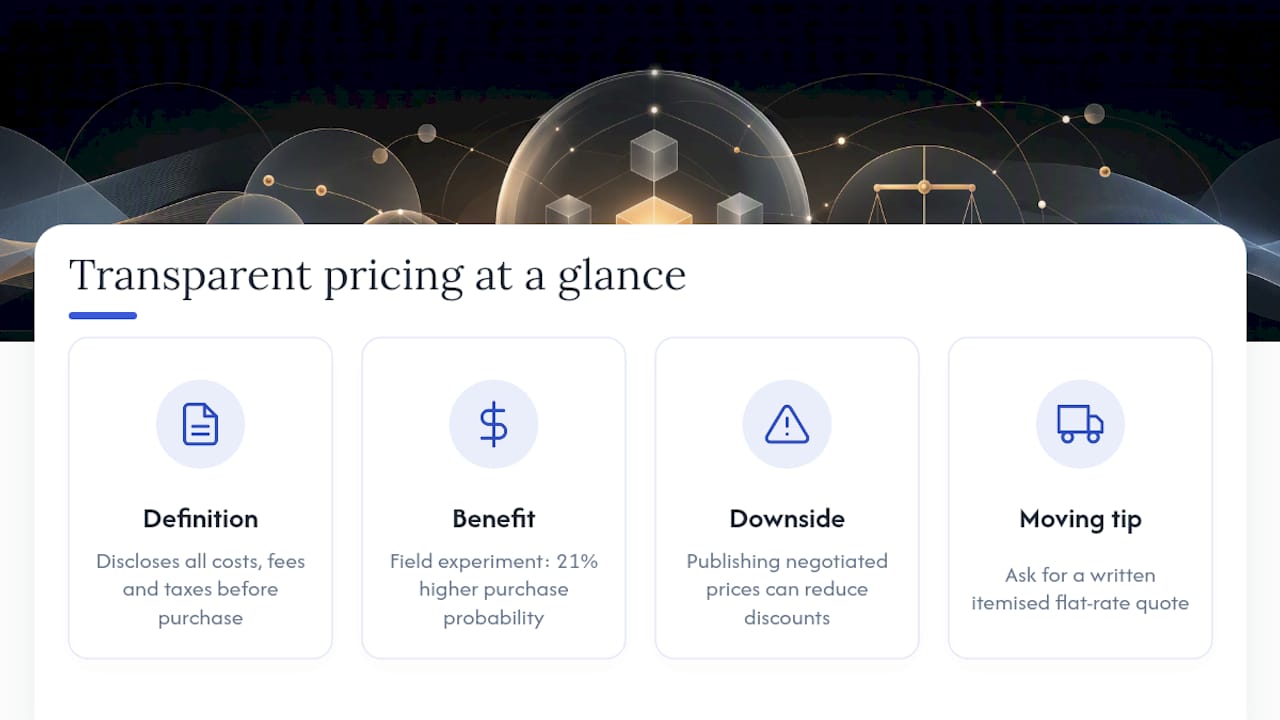
Transparent pricing is the open disclosure of every cost a buyer will encounter before they commit: the base price, applicable fees, taxes, optional add-ons, and the terms that govern the transaction. According to DealHub’s pricing glossary, it means showing clear pricing information, including all costs, fees, and the structure behind them, so buyers can make a fully informed decision. The short version: no surprises at checkout, no mystery charges on the invoice.
Why does that matter right now? Because trust is the currency of every transaction. A Harvard Business School field experiment found that voluntarily disclosing costs builds trust through what researchers call an “intimate disclosure” mechanism, and a related INFORMS study showed a 21% lift in purchase probability when diners received cost breakdowns. Aleksmoving, which has operated on a flat-rate, no hidden fees model for over 18 years across Ontario, is one practical example of what that looks like in a service business.
Under a genuinely transparent pricing model, businesses typically disclose:
- Base price: the core charge before any extras
- Fees and add-ons: fuel surcharges, service fees, optional upgrades
- Taxes: GST/HST and any provincial levies
- Scope and limits: what is included and what falls outside the quoted price
- Refund and cancellation terms: conditions under which money is returned or charges apply
Key takeaways
Transparent pricing works because it replaces uncertainty with a verifiable number, and research consistently shows that buyers reward that honesty with higher purchase rates and greater loyalty.
| Point | Details |
|---|---|
| Core definition | Transparent pricing discloses base price, fees, taxes, and terms before the buyer commits. |
| Purchase lift evidence | A field experiment found a 21% increase in purchase probability from voluntary cost disclosure. |
| Risk to manage | Publishing negotiated prices can remove discount incentives; use ranges for custom or high-value services. |
| Consumer action | Always ask for a written itemised quote and compare total landed price, not headline numbers. |
| Aleksmoving approach | Aleksmoving quotes every Ontario move at a flat firm rate with no hidden fees, covering labour, truck, and basic insurance. |
Table of Contents
- What is transparent pricing and why does it build trust?
- What does a transparent price actually show?
- What are the most common transparent pricing models?
- How does transparent pricing look across different sectors?
- What are the real benefits and risks of transparent pricing?
- How can a business implement transparent pricing step by step?
- How can consumers spot genuinely transparent pricing?
- Common questions about transparent pricing
- A note on practising what we preach
- Flat-rate moving with no surprises, from Aleksmoving
- Sources
What is transparent pricing and why does it build trust?
Transparent pricing is sometimes confused with simply publishing a number on a website. The distinction matters. Markt-Pilot’s industry explainer draws a useful line: transparent pricing is not just a price tag but a full picture of the cost structure, including how prices are calculated and what drives them.
The HBS research goes further, separating cost transparency (disclosing what it costs the seller to deliver the product or service) from price partitioning (breaking a total price into labelled components). Cost transparency operates primarily through trust: when a business reveals its costs, buyers perceive that act as honest and somewhat vulnerable, which raises their confidence in the seller. Price partitioning, by contrast, can sometimes make a total price feel smaller by presenting components separately, which is a different psychological lever entirely.
For consumers, the practical benefit is straightforward: fewer billing surprises, faster comparisons between providers, and cleaner decisions. For businesses, the payoff is measurable. The INFORMS field experiment recorded that 21% purchase lift from cost disclosure alone, and a multi-industry empirical study published in Business Horizons found that transparent firms can command higher willingness to pay from customers who value certainty over a lower but unpredictable price.
Statistic to note: A field experiment found that voluntary cost disclosure raised purchase probability by 21%, a figure that held across different price points and product types.
Pro Tip: Voluntary disclosure consistently outperforms mandated disclosure in building trust. When a business chooses to show its costs without being legally required to, buyers read that choice as a signal of confidence in the product’s value.
What does a transparent price actually show?
A transparent price is not just a number. It is a set of disclosures that together let a buyer calculate the total landed cost with no guesswork. The checklist below reflects what vendor and academic sources identify as the core elements:
- Base price: the standard charge for the core product or service
- Itemised fees: delivery, installation, processing, or service charges listed separately
- Taxes: GST/HST in Canada, plus any provincial levies that apply to the transaction
- Optional add-ons: clearly labelled extras the buyer can accept or decline
- Minimum charges or thresholds: the floor price that applies regardless of volume or scope
- Refund and cancellation rules: the conditions and timelines under which charges are reversed
The distinction between cost transparency and price partitioning is worth a moment. Cost transparency means the seller shows what it costs them to deliver the service (labour, materials, overhead). Price partitioning means the seller breaks the total into labelled line items without necessarily revealing the underlying cost structure. Both can improve buyer confidence, but HBS research shows cost transparency produces a stronger trust effect because it feels like a more honest, personal act of disclosure.
| Disclosure element | Effect on buyer behaviour | Supporting evidence |
|---|---|---|
| Cost breakdown (labour + materials) | +21% purchase probability | INFORMS field experiment |
| Itemised fees vs. bundled total | Reduces perceived hidden charges | HBS cost transparency study |
| Published price ranges | Increases comparison shopping | Business Horizons review |
| Full cost disclosure (voluntary) | Higher willingness to pay | Business Horizons empirical study |
On a service page, each element has a natural home. The base price belongs at the top, near the headline. Fees and taxes appear in a breakdown below the total. Optional add-ons sit in a clearly labelled section the buyer can expand or ignore. Refund terms link to a dedicated policy page, not buried in fine print.
What are the most common transparent pricing models?
Pricing transparency is not one-size-fits-all. Practitioner guidance recognises a spectrum from full public disclosure to guided or partially opaque pricing, and the right model depends on how standardised the product is and how variable the costs are.
Itemised or partitioned pricing lists every component separately: base fee, fuel surcharge, taxes, optional extras. Online retailers use this most visibly at checkout. The buyer sees exactly what each element costs and can remove optional items before paying.
Flat-rate pricing quotes a single, all-inclusive price for a defined scope of work. Moving companies and tradespeople use this model because it removes the anxiety of an open-ended hourly bill. The buyer knows the total before the work begins, which makes budgeting straightforward.
Tiered pricing groups features or service levels into bands (Basic, Standard, Premium) with a fixed price per band. SaaS platforms use this almost universally. The buyer self-selects the tier that matches their needs, and the price is clear within each band.
“Starting at” ranges publish a floor price without committing to a ceiling. Agencies and professional services firms use this when scope varies significantly between clients. It signals affordability without locking the seller into a price before the project is scoped.
Usage-based pricing charges in proportion to consumption: per kilometre, per gigabyte, per API call. Cloud computing platforms and some utilities use this model. Transparency here means publishing the per-unit rate clearly so buyers can estimate their own costs.
For highly custom engagements where scope genuinely cannot be determined in advance, guided or partially opaque pricing still makes strategic sense. A custom enterprise software build, for example, cannot carry a public price list without misleading buyers. In those cases, a published range or a clear “request a quote” process with a defined response time is the honest middle ground.
How does transparent pricing look across different sectors?
The mechanics of price disclosure shift considerably by industry, shaped by regulation, competitive norms, and the complexity of the product.
E-commerce is the most mature environment for price transparency. Checkout pages routinely itemise product price, shipping, taxes, and any service fees before the buyer confirms. Canadian consumers shopping online are protected by the Competition Bureau Canada’s drip pricing guidelines, which require that all mandatory fees be included in the advertised price.
SaaS and subscriptions typically publish tiered plans with a per-seat or per-month price, a feature comparison table, and a note on annual versus monthly billing. The transparency challenge here is renewal pricing: many platforms advertise introductory rates without clearly disclosing the renewal price.
Professional services (legal, accounting, consulting) often use hourly rates or project-based estimates. Transparency means publishing a rate range and a clear description of what triggers additional charges. Firms that publish starting rates tend to attract better-qualified leads because buyers self-screen before contacting.
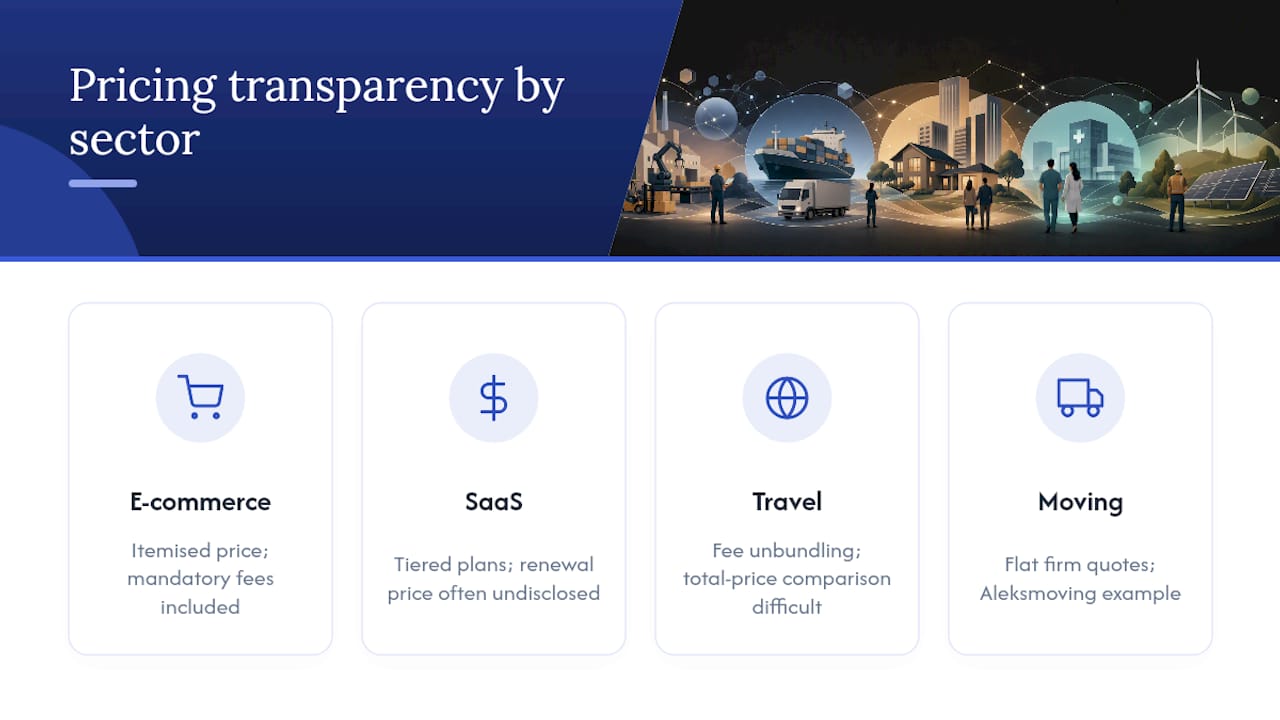
Travel and hospitality have a mixed record. Airlines pioneered fee unbundling (base fare plus seat selection, baggage, and meals), which technically discloses each cost but can make total-price comparison difficult. Hotels in Canada are increasingly required to show the total nightly rate, including resort fees, before checkout.
Moving and transport services in Canada present a particularly clear case for flat-rate transparency. Hourly billing in moving creates anxiety because the final cost depends on factors the customer cannot fully control: traffic, elevator wait times, the actual weight of furniture. A flat-rate quote removes that uncertainty entirely.
At Aleksmoving, every residential and commercial move across Ontario is quoted at a flat firm rate before the truck arrives. The quote covers the move itself, basic insurance, and agreed packing scope. There are no surprise fuel surcharges added after the fact and no “minimum hours” that inflate a short move. Customers can review how moving estimates are structured before they book, so the number on the quote is the number on the invoice.
For healthcare and enterprise sales, negotiated pricing remains the norm. Hospitals and insurers negotiate rates that are not publicly listed, and enterprise software vendors routinely price by deal size. In those contexts, transparency takes a different form: clear disclosure of what the negotiated price includes and what triggers renegotiation.
What are the real benefits and risks of transparent pricing?
The benefits are well-documented. Transparent firms tend to attract buyers who value certainty, and those buyers are often willing to pay a modest premium for the predictability. The Business Horizons empirical study found that transparency can shift competition away from price and toward service quality, which is a genuinely positive outcome for businesses that invest in their service delivery.
The risks are real too, and the research is candid about them. Wharton marketing professor John Zhang has noted that publishing negotiated prices can remove the incentive to offer discounts, because once a price is public, every buyer expects it. In markets where negotiated discounts are standard (healthcare, enterprise software, commercial real estate), full public disclosure can paradoxically raise the floor price for everyone by eliminating the flexibility that allowed selective discounting.
Statistic to note: Research published in Business Horizons found that online price transparency can increase consumer search and delay purchasing decisions, particularly when price variability across providers is high.
A second risk is price compression. When every competitor’s price is visible, competition tends to converge on the lowest number rather than on quality or service. Businesses that compete on service depth, reliability, or expertise can lose ground to lower-cost providers if price becomes the only visible differentiator.
Pro Tip: Mitigate price compression by pairing price disclosure with clear value framing. Publish what the price includes in specific terms (hours of labour, insurance coverage, materials), not just the number. Buyers who understand what they are paying for are less likely to choose a cheaper option that delivers less.
The Business Horizons review also notes that more transparency can increase consumer search time and delay decisions, particularly when price variability across providers is high. This is not always bad for the seller: a buyer who spends more time comparing is often a more committed buyer once they choose.
How can a business implement transparent pricing step by step?
Moving from opaque to transparent pricing is a process, not a switch. Here is a practical sequence that works for most service and product businesses:
- Audit your full cost and fee structure. List every charge a customer could encounter, including those that currently appear only on the final invoice. Hidden fees are often hidden by accident, not design.
- Choose your disclosure model. Decide whether full itemisation, flat-rate, tiered, or a range best fits your product and competitive context. Standardised products suit full disclosure; highly custom work suits ranges.
- Write plain-language explanations for each fee. “Fuel surcharge” means nothing to most buyers. “A fixed $25 charge that covers fuel costs for moves within 50 km” is transparent.
- Place prices where buyers look first. Service pages, not just quote forms. A buyer who has to submit a form to learn the price range will often leave before submitting.
- Test comprehension with real customers. Ask five people who have never seen your pricing page to read it and tell you what they would pay. If they cannot answer confidently, the page needs revision.
- Update contracts and FAQs to match. A transparent price page that contradicts the contract creates disputes. Align all documents.
- Monitor outcomes. Track conversion rate, dispute rate, and average order value before and after the change. The INFORMS data suggests conversion should improve; if it does not, the disclosure format may need adjustment.
Compliance note: Canada’s Competition Bureau enforces rules against drip pricing and misleading price representations under the Competition Act. Provincial consumer protection legislation (such as Ontario’s Consumer Protection Act, 2002) adds further requirements around disclosure of total prices and cancellation rights. These are not optional guidelines; they are legal obligations for businesses selling to Canadian consumers.
Pro Tip: A/B test your pricing page layout before committing. A table format often outperforms a paragraph description for complex fee structures. If you offer negotiated rates to some clients, keep those off the public page and use a “contact for volume pricing” label rather than a blank or misleading public rate.
How can consumers spot genuinely transparent pricing?
Not every page that claims to be transparent actually is. The label is easy to apply; the substance takes more effort to verify.
Start with these questions before you commit to any purchase or service:
- Can you see the total price, including taxes and fees, before you enter payment details?
- Is every line item labelled clearly enough that you know what you are paying for?
- Are optional add-ons separated from mandatory charges?
- Is the refund or cancellation policy stated in plain language, not buried in a link?
- Does the quoted price match the invoiced price, or does the invoice add charges not mentioned earlier?
Red flags that signal weak transparency: “Contact us for pricing” with no range given at all; fees described as “may apply” without specifying when; a quoted price that excludes taxes and is only revealed at checkout; cancellation terms that reference a separate document you have not been shown.
Strong disclosure looks like this: a clear total price at the top of the page, an itemised breakdown below it, a labelled section for optional extras, and a linked refund policy that is readable in under two minutes. When you are comparing providers, always compare the total landed price, not the headline number.
For moving services specifically, ask for an itemised estimate in writing, confirm what is included in the flat rate (labour, truck, basic insurance, packing materials if applicable), and ask what triggers additional charges. A guide on spotting hidden moving fees in Ontario can help you know exactly what questions to raise before you sign anything.
Common questions about transparent pricing
What does transparency in pricing mean?
It means a business discloses all costs, fees, taxes, and relevant terms before the buyer commits, so the total price is knowable in advance with no hidden charges.
Is transparent pricing the same as a low price?
No. A transparent price can be higher than a competitor’s opaque price. The value is in predictability, not necessarily in the number itself.
Is transparent pricing always a good idea?
Not universally. Wharton’s analysis cautions that publishing negotiated prices can remove incentives for discounts and may not lower costs in markets where selective pricing is standard.
What is a transparent pricing structure?
A pricing structure that shows the base price, all mandatory fees, applicable taxes, optional add-ons, and the terms governing the transaction, presented in a format the buyer can read before purchasing.
Does transparent pricing increase sales?
A field experiment recorded a 21% increase in purchase probability when cost breakdowns were provided voluntarily, suggesting that disclosure tends to improve conversion for most standardised products and services.
What are the legal requirements for price transparency in Canada?
The Competition Bureau Canada enforces rules against drip pricing and misleading price representations. Provincial laws such as Ontario’s Consumer Protection Act, 2002 require total price disclosure and clear cancellation terms for consumer transactions.
How is cost transparency different from price transparency?
Price transparency means showing what the buyer pays. Cost transparency means showing what it costs the seller to deliver the product or service. HBS research shows cost transparency builds stronger trust because it feels like a more personal act of honesty.
What should I ask a moving company to verify transparent pricing?
Ask for a written flat-rate quote that itemises what is included (labour, truck, insurance, packing if applicable), what triggers additional charges, and what the cancellation policy is. Compare the quote to the final invoice after the move.
A note on practising what we preach
Transparent pricing is not a marketing slogan for us at Aleksmoving. It is the operational commitment that shapes every quote we send.
When a customer contacts us for a residential or commercial move in Ontario, they receive a flat firm rate before we book the truck. That rate covers the move, the crew, basic insurance, and any packing scope agreed in advance. There is no fuel surcharge added after the fact, no “minimum hours” clause that turns a two-hour move into a three-hour bill, and no ambiguity about what happens if the elevator is slow.
The wording on our service pages reflects that commitment directly: customers see the total price, the inclusions, and the conditions that would change the quote (such as a significant change in inventory or a destination outside the agreed area) before they confirm anything.
With over 18 years of experience moving families and businesses across Ontario, Aleksmoving has built its reputation on one principle: the price you are quoted is the price you pay. Our services cover local and long-distance residential moves, office relocations, packing, storage, and specialty moves for antiques and artwork, all quoted at a flat rate with no hidden fees.
Flat-rate moving with no surprises, from Aleksmoving
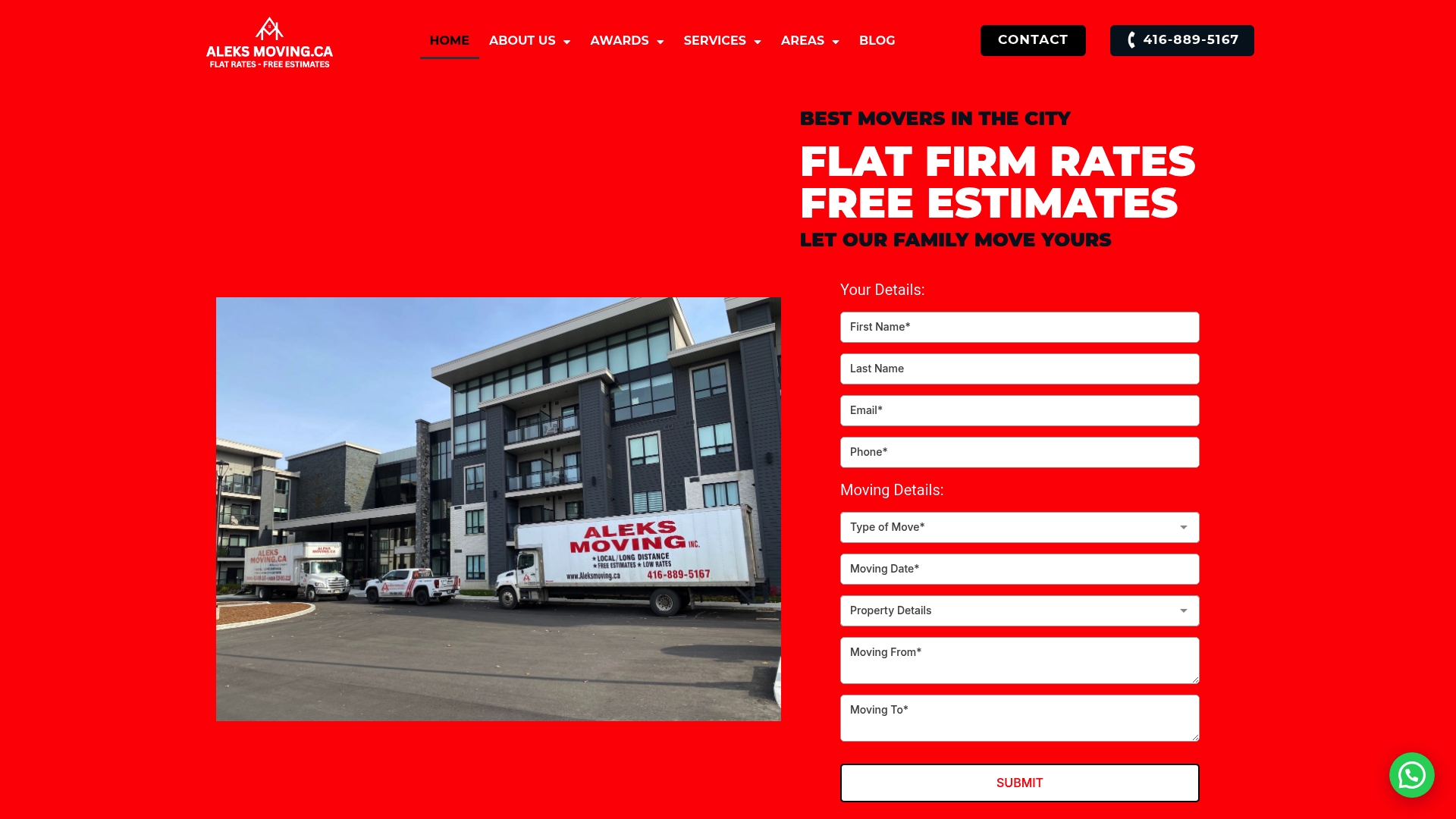
If you have been reading about transparent pricing and wondering what it looks like in practice for a move across Ontario, Aleksmoving is the direct answer. The flat-rate model means your quoted price is your final price, covering labour, the truck, and basic insurance with no add-on charges appearing after the move is done.
Choosing a flat-rate mover gives you:
- A predictable budget from the moment you book, with no open-ended hourly risk
- A written quote that itemises what is included before you commit
- Fewer disputes at invoice time because the price was agreed in advance
- Peace of mind on moving day, knowing the crew is focused on the move, not the clock
Aleksmoving serves residential and commercial clients across Ontario, with services covering local moves, long-distance relocations, packing, storage, and specialty moves. To get a written flat-rate quote for your move, visit our residential moving services page or contact us directly to discuss your move date and inventory.
Sources
The claims in this article draw on peer-reviewed research, practitioner guidance, and Canadian regulatory context. The sources below are the primary references used.
- Transparent pricing: Is it always a good idea? – Wharton
- What Is Pricing Transparency? The Complete Guide
- What is Pricing Transparency? – DealHub
- Transparent Pricing | Definition, Examples & Advantages
For Canadian regulatory context, the Competition Bureau Canada publishes guidance on drip pricing and misleading price representations. For service-specific questions about moving estimates in Ontario, Aleksmoving’s moving estimates page covers how flat-rate quotes are structured and what they include.
This article provides general information about transparent pricing practices and is not legal or financial advice. For questions about your specific obligations under Canadian consumer protection law, consult a qualified legal professional or contact the Competition Bureau Canada directly.


