Skip to content


Book local movers 2 to 6 weeks ahead, long-distance movers 6 to 8 weeks ahead, and cross-country or international movers 8 to 12 weeks or more ahead. That baseline holds for most moves, but ConsumerAffairs notes that 6 to 8 weeks is the ideal window for a typical household relocation, with 8 to 12 weeks recommended once distance or peak season enters the picture. Aleks Moving, which has coordinated residential and commercial relocations across Ontario for over 18 years, sees the same pattern play out every spring and summer.
Add 2 to 4 weeks to any of these windows if your date falls between May and September, lands on a weekend, or sits at the very end of the month.
- Local moves (under 100 km): 2 to 6 weeks out
- Long-distance moves (100+ km, different city or province): 6 to 8 weeks out
- Cross-country or international moves: 8 to 12+ weeks out
Quick answer: the earlier you call, the more control you have over your date, your crew size, and your price. Waiting until the last two weeks of a peak-season month is the single most common reason movers get stuck with limited options.
Key Takeaways
Booking a move follows a simple rule: earlier is cheaper and safer, and the gap between “ideal” and “last resort” is usually just a few weeks of lead time.
| Point | Details |
|---|---|
| Match window to move type | Book local moves 2 to 6 weeks out, long-distance 6 to 8 weeks, and cross-country 8 to 12+ weeks. |
| Add buffer for peak dates | Add 2 to 4 weeks for May to September moves, weekends, and month-end dates. |
| Pick weekday mornings when possible | Tuesday to Thursday, mid-month dates are typically 10 to 30% cheaper than weekend or month-end slots. |
| Account for extras early | Packing, storage, specialty items, and building COIs each add 1 to 3 weeks of lead time. |
| Confirm details before moving day | Reconfirm your written quote 7 to 14 days out, and lock deposit and cancellation terms early with a flat-rate mover like Aleks Moving. |
Table of Contents
- Recommended booking windows by move type
- How peak season and your exact date change availability
- What pushes your booking window earlier
- What if you’re already inside the ideal window?
- Can you book movers too early?
- How Aleks Moving handles booking, from first call to move day
- Editorial take: what actually matters in your moving timeline
- Book your move with a flat-rate mover that plans ahead
- Frequently asked questions
- Sources
Recommended booking windows by move type
“Local” generally means a move within the same city or under roughly 100 kilometres, where the truck can complete the job in a single day. “Long-distance” covers moves between cities or provinces where routing, fuel stops, and driver hours-of-service rules come into play. “Cross-country” and international moves involve multi-day transit, customs paperwork in some cases, and tighter scheduling around a limited number of long-haul crews.
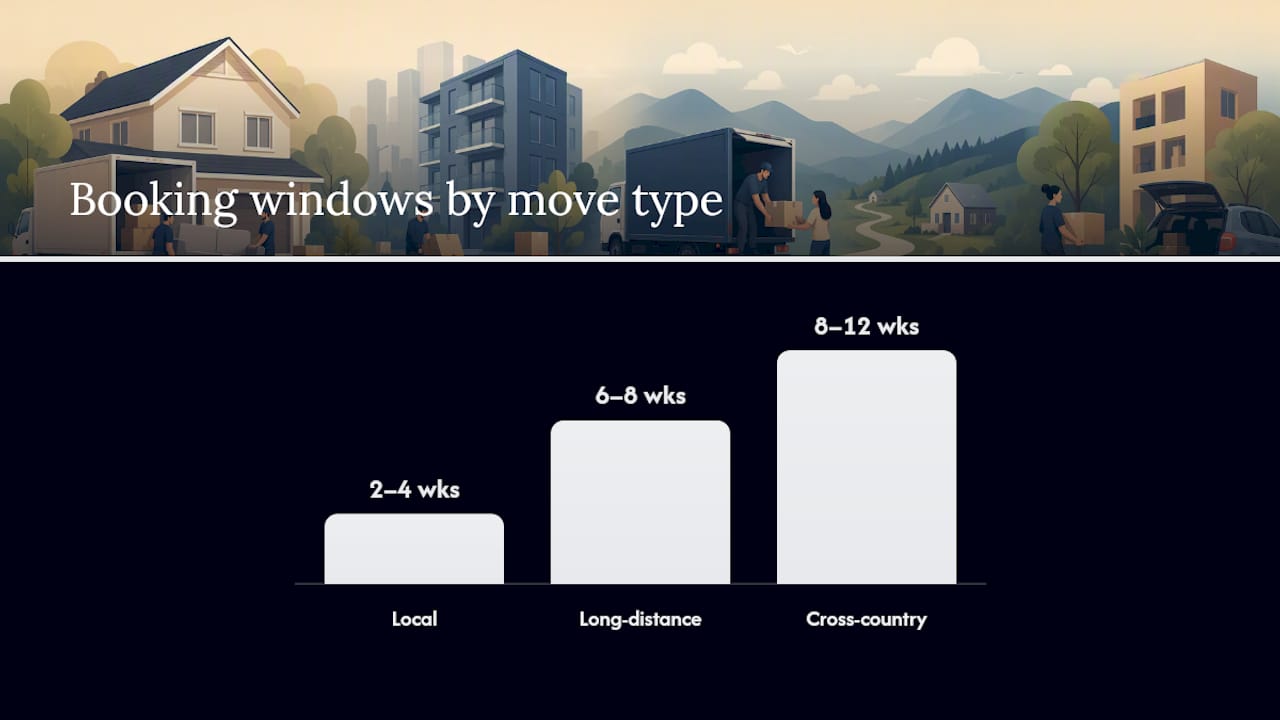
Each category has a practical reason for its lead time. Local movers juggle several jobs a day, so crew and truck availability shifts week to week. Long-distance movers need to lock a truck into a route days or weeks in advance, which is why MoveBeacon recommends booking 6 to 8 weeks out for most relocations and pushing to 8 to 12 weeks for summer or cross-country jobs. HomeMovingSecrets separates the service type from the timing too: full-service movers during peak season need 8 to 12 weeks, while a simple truck rental or moving container can often be arranged in 4 to 6 weeks.
Household size changes the math as well:
- Studio or one-bedroom apartment: 2 to 4 weeks is usually enough outside peak season.
- Two- or three-bedroom home: aim for 4 to 6 weeks to guarantee your preferred crew size.
- Four-plus bedroom or a home with a garage full of extras: book 6 to 8 weeks minimum, since these jobs need more trucks, more hands, and more time on-site.
Shorter notice can work in January or February, when demand drops off. It gets riskier fast once you’re inside three weeks during June, July, or August.
Pro Tip: If your move date is flexible by even a few days, ask your mover which day in that window still has open crews. It often unlocks a better price without changing your plans at all.
How peak season and your exact date change availability
Moving between May and September means competing with the busiest stretch of the year for every mover in the region, since school schedules, leases, and closings all cluster in the same few months. Add 2 to 4 weeks to your booking window if any part of your move falls in that stretch.
Day of the week and date in the month matter just as much as the season:
- Weekends book up first and often carry a premium, since most people want to move when they’re not at work.
- Month-end dates spike hardest of all, thanks to overlapping lease and closing deadlines.
- Weekday, mid-month mornings are the quiet corner of every mover’s calendar.
LiteMovers reports that weekday moves, especially Tuesday through Thursday, typically run 10 to 30% cheaper than weekend or month-end dates simply because demand is lower. If your lease or closing date gives you any flexibility, shifting even two or three days can change your options. Winter weather is worth a separate look too: a January move through a region prone to storms is worth booking with extra buffer in case a date needs to shift.
What pushes your booking window earlier
A handful of common complications turn a standard timeline into a tighter one. Packing and other add-on services typically require 1 to 3 extra weeks of notice, since professional packers need to be scheduled separately from the moving crew itself.
- Packing or unpacking services: add 1 to 3 weeks to your baseline window.
- Specialty items like pianos, antiques, or safes need a crew with the right equipment and experience, which narrows availability fast.
- Condo and apartment buildings often require elevator reservations, parking permits, and a Certificate of Insurance (COI) before move day, and building management can take a week or more to process paperwork.
- Commercial moves need 6 to 8 weeks to line up COIs, after-hours crew scheduling, and building approvals on both ends.
Nick Friedman’s observation, cited by ConsumerAffairs, is worth remembering here: dense urban buildings and rural properties both push timelines earlier, just for opposite reasons. City moves need permit and elevator lead time; rural moves can mean fewer available trucks in the area to begin with.
Pro Tip: If your building requires a COI, request it from your mover the moment you have a move date. It’s one of the easiest things to forget until the week before.
What if you’re already inside the ideal window?
If you’re two weeks out or less, move fast and stay flexible.
- Call several local movers immediately and ask specifically about cancellations or flex crews. MoveBeacon’s guidance is to prioritize speed over comparison shopping at this stage.
- Prioritize the essentials. If a full-service crew isn’t available, defer packing or storage add-ons rather than losing the moving date itself.
- Get everything in writing. Confirm insurance coverage, cancellation terms, and ask directly whether a rush fee or surcharge applies.
- Have a backup plan. Same-day labour-only services, short-term storage, or a partial DIY approach can bridge the gap if no full crew is available.
Pro Tip: A written quote takes five minutes and can save you from a surprise line item on moving day. Never book on a verbal price alone.
Can you book movers too early?
Booking early is rarely a mistake, but it isn’t risk-free either. An estimate given six months out can drift once your inventory changes, and some contracts lock in terms that are hard to adjust later. HomeMovingSecrets points out that early booking protects your choice of date and crew, provided you still confirm the details as your move gets closer.
Before signing anything, check the deposit amount, the rescheduling and cancellation policy, and whether the inventory list is in writing.
- Confirm your final quote 7 to 14 days before the move, once your inventory is settled.
- Reconfirm elevator bookings, parking permits, or COIs closer to the date.
- Keep a copy of every written agreement in case a date needs to shift.
How Aleks Moving handles booking, from first call to move day
Eighteen-plus years of coordinating moves across Ontario has taught Aleks Moving that the calls placed too late are almost always the ones that cost more. Every quote is flat-rate with no hidden fees, so the price you confirm at booking is the price you pay.
- What we ask for on the first call: move dates, home size, building type, and any specialty items, so we can quote accurately from the start.
- Deposit and documentation: clear terms confirmed in writing before your date is locked.
- Peak-season and last-minute demand: we hold flex crews for exactly the surge windows this guide describes, from May weekends to month-end closings.
Editorial take: what actually matters in your moving timeline
The conventional advice on booking windows treats every move like it’s on the same clock, and that’s where most planners get it wrong. A one-bedroom local move in February and a four-bedroom cross-country relocation in July aren’t the same decision wearing different outfits. They need different windows, different crews, and different levels of urgency.
What the evidence actually supports is this: booking early protects choice, not just price. The reader who calls at eight weeks isn’t necessarily saving money outright. They’re preserving the option to pick a weekday morning, a specific crew size, or a mover who can handle a piano without blinking. That optionality disappears fast once you’re inside two weeks during peak season.
If there’s one thing to prioritize first, it’s confirming your actual move category and any building logistics before worrying about the exact week to call. A condo move with an elevator booking requirement has a real hard deadline buried in it that has nothing to do with the movers themselves.
Book your move with a flat-rate mover that plans ahead
Aleks Moving gives you one clear advantage over waiting until the last minute or piecing together a DIY move: a flat, firm quote with no hidden fees, locked in as early as you need it, and backed by over 18 years of handling exactly the timing pressures this guide describes. Whether you’re booking a local move six weeks out or a long-distance relocation during peak summer season, our crews are scheduled around the same windows outlined above, including flex capacity for condo elevator bookings and commercial COIs.

If your move includes packing, storage, or specialty items, ask about those services when you request your quote so nothing gets left out of your timeline. Ready to lock in your date? Request a free quote from Aleks Moving today and get a written timeline built around your actual move, not a generic estimate.
Frequently asked questions
What’s the cheapest day of the week to book movers?
Tuesday through Thursday mornings tend to run cheapest, since weekend and month-end dates draw the highest demand and often carry a premium.
Do movers expect tips?
Tipping isn’t required, but it’s a common courtesy for crews handling heavy or fragile items well. Many households tip $20 to $40 per mover for a full day, adjusted for the size and difficulty of the job.
When should I start packing relative to my move date?
Start packing non-essentials 4 to 6 weeks out and finish everything but daily-use items about a week before moving day. If you’re hiring packing services, book them at the same time as your movers, since they need their own scheduling window.
Is it ever too early to call a moving company?
Not usually, but confirm your final details and inventory 7 to 14 days before the move so your quote stays accurate.
Sources
- How Far in Advance to Book Movers (2026) | ConsumerAffairs®
- When to Book Movers (And How Far in Advance) | MoveBeacon
- Best time of year to move (and how much you can save) | HomeMovingSecrets
- When to Hire Movers: Booking timeline and best time to move | LiteMovers