Skip to content


TL;DR:
- Proper inventory management is essential for a smooth move, preventing loss, supporting insurance claims, and ensuring accountability.
- It involves detailed tracking, labeling, photographing, and reconciling all items before, during, and after relocation, regardless of move size.
Moving without a proper inventory is a bit like packing for a trip without a list. You are almost certain to forget something, and the consequences can be far more costly than a forgotten toothbrush. Understanding why inventory management in relocation is so critical can save you money, reduce stress, and protect your belongings from the moment they leave your door to the moment they arrive at the next one. Whether you are a family relocating across Ontario or a business shifting an entire office, what you track determines what arrives safely and on time.
Table of Contents
- Key takeaways
- Why inventory management in relocation is more than a checklist
- Why inventory matters: the key reasons
- Common inventory challenges and how to beat them
- Practical steps for your Ontario move inventory
- What good inventory management actually delivers
- My take on why inventory is always underestimated
- Move with confidence with Aleksmoving
- FAQ
Key takeaways
| Point | Details |
|---|---|
| Inventory prevents loss | Tracking every item before and during a move reduces the chance of belongings going missing or being mislabelled. |
| Insurance depends on records | Detailed inventory lists with photos support faster, more accurate insurance claims if damage or loss occurs. |
| Businesses need extra rigour | Commercial moves require phased inventory controls to maintain operations and avoid costly downtime. |
| Data accuracy is non-negotiable | Errors in your inventory list before a move will be magnified after it. Clean data first. |
| Post-move reconciliation matters | Comparing your inventory list after arrival catches discrepancies early and prevents long-term problems. |
Why inventory management in relocation is more than a checklist
Most people think of a moving inventory as a rough list of boxes. In practice, it is a structured system for tracking, classifying, and documenting every item being relocated. It includes descriptions of each item’s condition, its assigned box or container number, the room it came from, and where it should go at the destination.
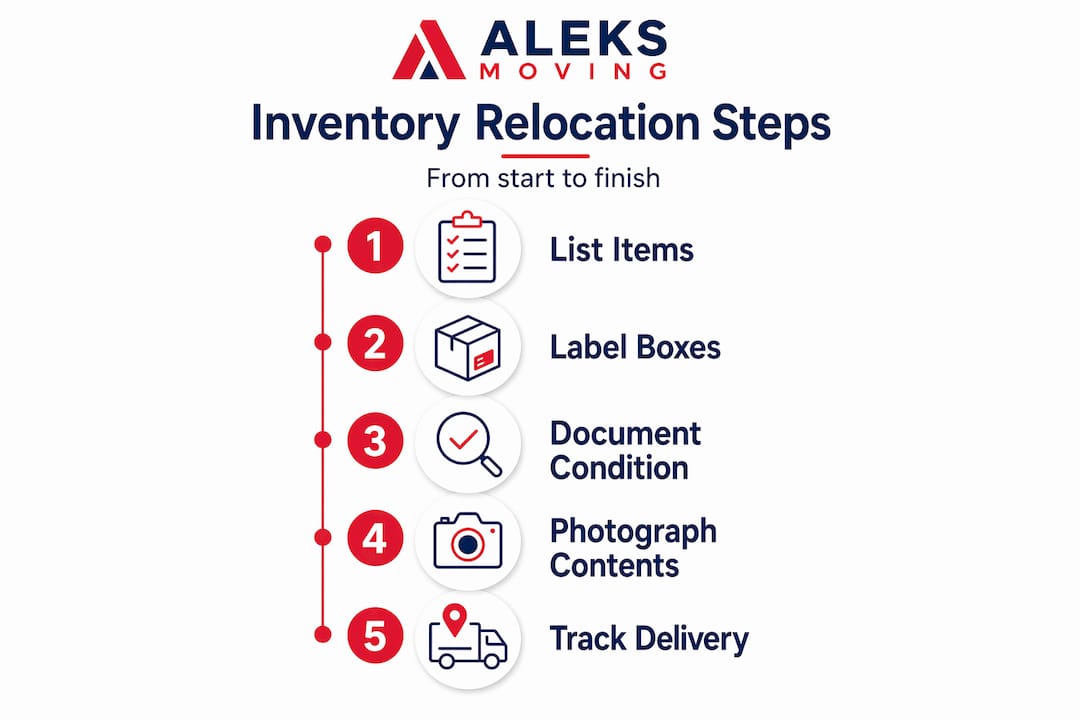
Creating and maintaining an inventory list typically involves three phases: recording items before the move, labelling and tracking during transit, and reconciling everything after arrival. The role of inventory lists in relocation becomes most obvious when something goes wrong. A missing box is recoverable when you know exactly what was in it and can trace its last known location.
The complexity of inventory management shifts considerably depending on the type of move. Residential relocations involve personal effects, furniture, and sometimes high-value items like artwork or antiques. Commercial moves add layers of complexity including equipment tagging, IT asset tracking, and coordination across departments. Here is what a solid inventory system covers in both contexts:
- Item identification: Each item or box receives a unique label or number tied to a master list
- Condition documentation: Notes or photos record the pre-move state of fragile or valuable items
- Room or zone assignment: Items are tagged with their origin and destination locations
- Priority classification: Some items need to move first or last based on operational needs
- Responsibility assignment: Each category of items has a named owner on the moving team
One common misconception is that only large businesses need this level of detail. The truth is that even a two-bedroom apartment move benefits from a clear inventory. It removes ambiguity, speeds up unpacking, and gives you the documentation you need if you need to file an insurance claim.
Why inventory matters: the key reasons
Understanding the importance of inventory in moving goes beyond keeping things organised. It touches every part of the process from the quote you receive to the way your belongings are handled on the truck.
- Loss and damage prevention. When every item is logged and labelled, movers know exactly what they are carrying and where it belongs. Descriptive inventory is key for organisation and supports stronger insurance claims, protecting both movers and customers. A box labelled “miscellaneous” disappears without a trace. A box labelled “master bedroom: bedside lamp and clock, fragile” does not.
- Accountability and transparency. A detailed list creates a shared understanding between you and your moving team. Everyone knows what is expected, what has been loaded, and what still needs attention. This reduces disputes and miscommunication significantly.
- Accurate insurance claims. Inventory accuracy and detailed records simplify insurance claims and valuation protection during moves. If a piece of furniture arrives damaged and you have a photo showing its pre-move condition, your claim is straightforward. Without that documentation, disputes can take weeks to resolve.
- Business continuity. For commercial moves in Ontario, downtime is money. Relocating inventory without shutting down operations requires phased planning, dedicated crews, and strict inventory controls to maintain accuracy and safety. Knowing which assets are critical and moving them first keeps your operation running.
- Logistical planning. A thorough inventory allows movers to estimate truck space accurately, sequence loading properly, and flag anything that needs special handling. This is where the benefits of relocation inventory show up most clearly in time and cost savings.
Pro Tip: Take photos of every room before packing and photograph each box’s contents before sealing it. Pair these images with your written inventory for a record that is almost impossible to dispute.
Common inventory challenges and how to beat them
Even people who understand the role of inventory lists in moving often run into trouble with execution. These are the most frequent pitfalls and how to address them practically.
- Inaccurate or outdated data. Relocation amplifies existing data errors. If your inventory is based on a list you created two years ago, it will not reflect what you actually own today. Audit your inventory before you pack, not after.
- Failure to classify items properly. Not all items carry the same risk or value. Failing to flag fragile, high-value, or time-sensitive items separately leads to them being treated the same as everything else. Create sub-categories in your list for electronics, antiques, documents, and anything irreplaceable.
- Lack of communication. The inventory list is only useful if everyone involved in the move has access to it. When movers, owners, and coordinators are working from different information, small gaps become major disruptions. Share the list digitally so all parties see the same version in real time.
- Skipping post-move reconciliation. Many people treat the move as finished once the truck is unloaded. Post-move reconciliation identifies hidden issues and corrects inventory discrepancies early, reducing long-term data problems. Set aside time on moving day to walk through your list before signing off.
- Underestimating commercial complexity. Business moves in Ontario often involve IT equipment, licensed software, and regulated documents. These need their own inventory sub-process with sign-off from department heads. If you are relocating an office, read through a practical office relocation guide before you begin.
Pro Tip: Use a free spreadsheet tool or a dedicated moving app to build your inventory list. Even a simple digital format beats paper because you can search it, share it instantly, and update it without reprinting anything.
Practical steps for your Ontario move inventory
Knowing the theory is one thing. Putting it into practice before your moving day is what separates a smooth relocation from a stressful one. Here is a clear comparison of approaches to help you decide how to build your inventory system.
| Approach | Best for | Key benefit | Main limitation |
|---|---|---|---|
| Paper list with room labels | Small residential moves | Simple and low-cost | Hard to search or share |
| Spreadsheet with photos | Mid-size home or small office | Easy to update and share | Requires discipline to maintain |
| Moving app with barcode scan | Large homes or multi-room offices | Fast item tracking and real-time updates | Small learning curve |
| Professional inventory service | High-value or commercial moves | Expert documentation and accountability | Added cost |
Start your inventory at least two weeks before moving day. Work room by room and record every item you plan to move. Note the condition of anything fragile or valuable, and photograph those items individually. Assign each box a number and keep a master list that matches box numbers to contents and destination rooms.
When working with a professional moving company, share your inventory list before the move begins. A structured approach with a dedicated team ensures accountability for inventory accuracy and prevents small issues from becoming major disruptions. This is especially true for business relocations in Ontario where multiple departments and asset types are involved.
For special cases like artwork, antiques, or electronics, note serial numbers and approximate values on your list. This is the foundation of any insurance claim and gives movers the context they need to handle those items with extra care.
What good inventory management actually delivers
The tangible results of strong inventory practices show up before, during, and long after a move is complete.
Reduced loss and damage incidents are the most immediate gain. When every item is tracked and labelled, the chances of a box going missing or arriving in the wrong room drop sharply. Clear inventory management differentiates service providers in competitive markets and protects both sides from disputes.
Insurance claims become faster and less contentious. Movers and clients who walk into a claim with photos, condition notes, and a numbered item list resolve issues in days rather than weeks. That kind of documentation pays for the time it took to create it many times over.
For businesses, the benefits extend to customer satisfaction and operational continuity. Measuring inventory accuracy and order cycle times offers better success indicators than just confirming a system went live. A business that moves with minimal disruption to its clients earns trust that is hard to buy any other way.
“The real value of a moving inventory is not just knowing where things are. It is having proof of how they were before the move even started.”
And for future moves or storage arrangements, a well-maintained inventory becomes your starting point. You already know what you own, what it is worth, and what needs special handling. That is a significant head start.
My take on why inventory is always underestimated
I have seen hundreds of moves go sideways for reasons that had nothing to do with the movers or the truck. The problem was almost always the same. Someone assumed the move would be straightforward and skipped the inventory step entirely.
What I have learned is that people underestimate inventory because it feels like admin work rather than moving work. It does not feel as urgent as booking a truck or arranging utilities. But when a client calls after a move because a piece of furniture they cannot replace is gone, and there is no record it was ever loaded, that conversation is painful for everyone involved.
The businesses I have seen handle moves well treat inventory management as an operational project, not a last-minute task. They assign ownership, use real tools, and verify results. Homeowners who do the same feel the difference immediately when unpacking. Everything has a place because everything was planned.
My honest advice is this: the time you spend building your inventory before the move is the time you save searching for things, filing disputes, and repurchasing items you already owned. View it as an investment in your own peace of mind.
— Ali
Move with confidence with Aleksmoving
Planning a move across Ontario is far less stressful when you have the right team and the right systems behind you. At Aleksmoving, we bring over 18 years of experience to every residential and commercial relocation, and we know firsthand how much proper inventory tracking protects our clients.

Whether you are moving a family home or relocating an entire office, our team works with you to document, handle, and deliver your belongings with care. We offer flat-rate pricing with no hidden fees, so your budget is as predictable as your inventory list. Explore our full range of moving services to see how we support Ontario movers from the first box to the final walkthrough. We are ready to help you move right.
FAQ
What is inventory management in relocation?
Inventory management in relocation means systematically tracking, labelling, and documenting every item being moved before, during, and after a move to prevent loss, support insurance claims, and keep the process organised.
Why does inventory matter for an Ontario move?
Ontario moves, particularly commercial ones, involve high volumes of items and tight timelines. A proper inventory reduces the risk of loss, keeps movers and clients accountable, and speeds up post-move reconciliation.
How do I create an inventory list for moving?
Work room by room, assign each box a number, note the contents and condition of each item, and photograph anything fragile or valuable. Share the list digitally with your moving team before moving day.
Can a moving inventory help with insurance claims?
Yes. Detailed inventory records with photos and condition notes make insurance claims faster and easier to resolve, giving you documented proof of an item’s pre-move state.
Do businesses need a different inventory approach than homeowners?
Yes. Commercial moves require categorising IT assets, licensed equipment, and regulated documents separately, assigning departmental ownership, and often using phased inventory controls to maintain business operations during the move.