

TL;DR:
- Labelling moving boxes reduces unpacking time by clearly indicating contents, destination, and handling needs. Proper labels on multiple sides and in the upper third of boxes ensure they are visible during stacking and transport. Immediate labeling after sealing minimizes errors and streamlines the entire moving process.
Labelling moving boxes is the single most effective step you can take to reduce unpacking time and moving-day confusion. A clear label tells every mover, helper, and family member exactly where each box belongs and what is inside, without anyone needing to ask. Properly labelled boxes can cut total unpacking time by up to 50%, which means less time surrounded by clutter and more time settling into your new home. Whether you are moving across town in Ontario or across the country, a consistent labelling system is the difference between a smooth move and a stressful one.
Why label moving boxes: the core benefits
Box labelling, sometimes called box inventory marking in professional moving circles, serves three core purposes: identification, placement, and protection. Each one directly reduces the time and effort your move requires.
Identification means anyone picking up a box knows its contents at a glance. Labels act as a communication tool that lets movers place boxes in the correct rooms without constant supervision from you. That independence speeds up unloading considerably.
Placement means your movers carry each box directly to the right room on the first attempt. Without labels, every box becomes a question. With labels, your crew works through the truck efficiently and without interruption.
Protection means fragile items get the careful handling they need. A box marked FRAGILE in bold red on every side is far less likely to be tossed on top of a stack than one with no markings at all. Most unpacking delays happen because people open multiple boxes searching for contents. Labels eliminate that extra step entirely.
What should you write on a moving box label?
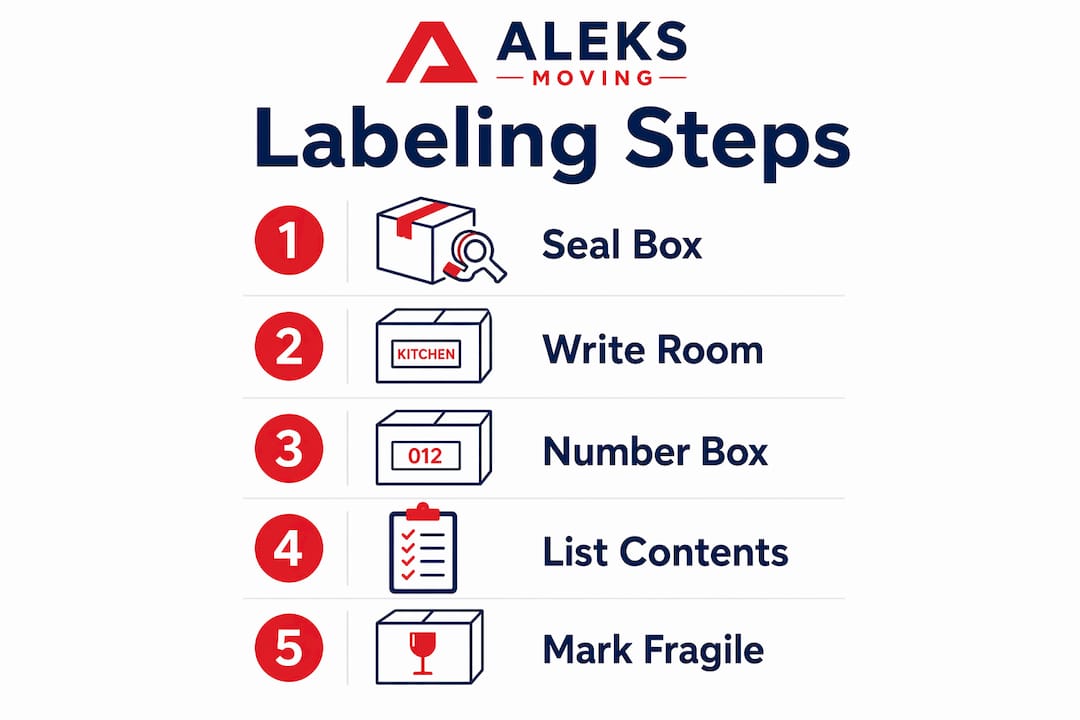
The most effective labels include four pieces of information: the destination room, a sequential box number, a short list of key contents, and a handling instruction if needed.
- Destination room: Write the room name clearly at the top of the label in large letters. “Master Bedroom,” “Kitchen,” or “Kids’ Room” gives movers an instant target.
- Box number: A sequential number on every box lets you track your packing order and cross-reference a master inventory list. Box 14 of 40 is far easier to manage than an unnamed box.
- Key contents: List 3–5 specific items inside. “Plates, mixing bowls, coffee maker” is far more useful than “kitchen stuff.” This level of detail enables finding essentials in under 10 seconds without opening the box.
- Handling instructions: Write FRAGILE in red on all sides with arrows pointing up for any box containing breakables. Fragile stickers alone are often overlooked or peel off, so hand-written red text is more reliable.
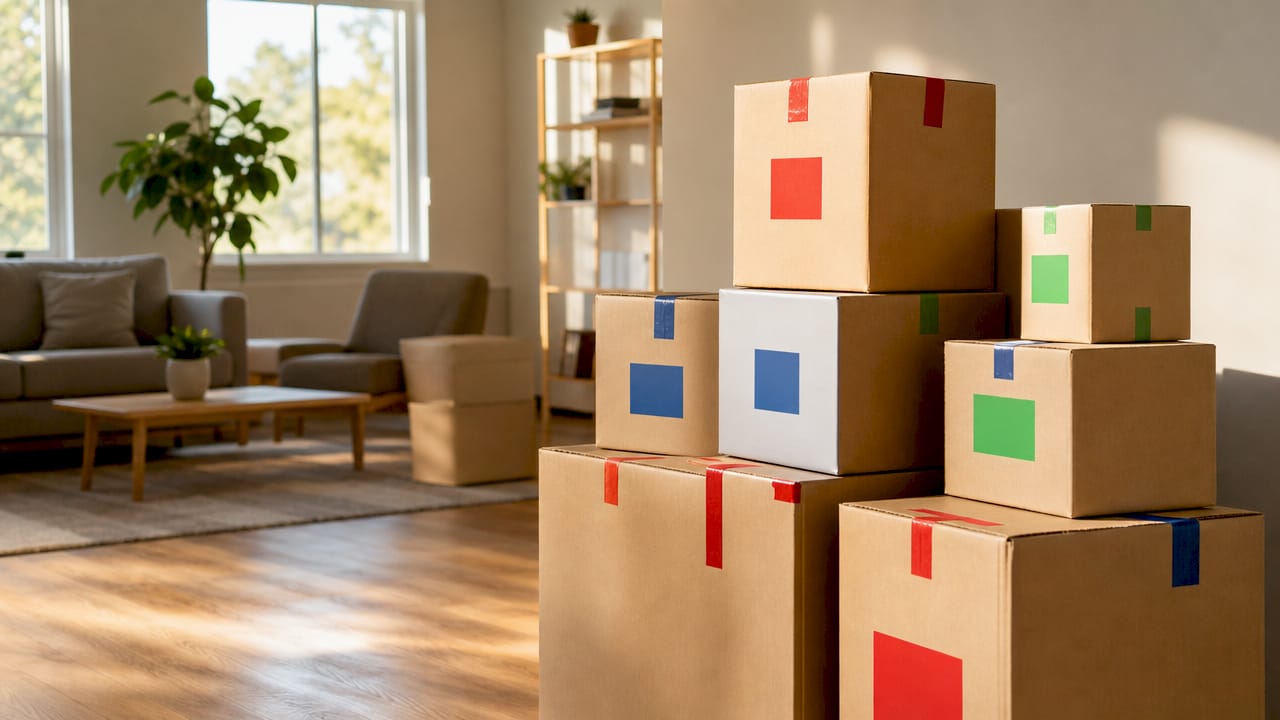
- Colour coding: Assign one colour of tape or sticker to each room. Blue for the bathroom, green for the kitchen, yellow for the living room. Colour coding significantly accelerates unloading compared to text labels alone because visual cues work faster than reading.
Pro Tip: Keep a master inventory notebook or a simple spreadsheet where each box number corresponds to its contents. If you need your coffee maker on day one, you will know it is in Box 7 without tearing open half the kitchen.
Where should you place labels on moving boxes?
Label placement is just as important as label content. A perfectly written label does nothing if no one can see it.
Label at least two sides and the top of every box to guarantee visibility regardless of how boxes are stacked or arranged in the truck. Labelling only the top is one of the most common mistakes movers make. Once boxes are stacked, the top label is completely hidden.
- Place labels in the upper third of each box side. The bottom half of a box is often obscured by the box sitting on top of it during transport. A label in the upper third stays visible even in a tightly packed truck.
- Use large, legible writing. A thick black marker on a white label reads clearly from across a room. Thin pen or pencil writing gets lost in the chaos of move day.
- For fragile boxes, place handling instructions on all four sides and the top. This leaves no angle from which a mover can miss the warning.
- Printed labels from a home printer are neater and more consistent than handwriting, especially if you are managing many boxes. Pre-printed room labels are available at most office supply stores across Canada.
Pro Tip: Use a colour of masking tape that contrasts with your box colour. Bright tape strips across the top corners of each side make boxes instantly sortable from a distance, even before anyone reads the text.
When should you label boxes during packing?
Timing your labelling correctly prevents one of the most frustrating problems in any move: the mislabelled box.
Label each box immediately after sealing it, not before or during packing. When you label a box before filling it, the contents often change as you pack. You end up with a box marked “Books” that also contains a lamp and two picture frames.
- Label the room name in advance only if you are certain the box will hold only items from that room.
- Never label a partially packed or empty box. An empty box with a label is a source of confusion on move day.
- Label on the spot, while the contents are fresh in your mind. This is when your list of 3–5 key items will be most accurate.
- If you pack over several days, review labels on previously sealed boxes before the move. Contents sometimes shift or get added.
Mislabelled boxes create a chain reaction of problems. A box marked “Living Room” that contains bathroom supplies means your movers carry it to the wrong floor. You then spend time relocating it yourself, which defeats the purpose of hiring help.
What are the most common labelling mistakes to avoid?
Most labelling problems come from rushing or cutting corners late in the packing process. Recognising these mistakes before they happen saves real time on move day.
- Labelling only the top: Stacked boxes hide top labels completely. Always label the sides.
- Using vague terms: “Misc,” “stuff,” or “random” tells no one anything useful. Write specific item names.
- Illegible handwriting: A label no one can read is no label at all. Use a thick marker and print clearly.
- Overstuffing boxes: A box packed so tightly that the sides bulge leaves no flat surface for a label. Keep boxes manageable in size and weight.
- Skipping colour coding: Text alone requires reading. Colour coding lets movers sort boxes visually and quickly. Colour coding is one of the simplest yet most effective tools for organising a move.
- No master inventory: Without a numbered list of box contents, finding a specific item after the move means opening box after box. A simple list takes 10 minutes to maintain and saves hours of searching.
Pro Tip: Set aside a dedicated “open first” box for each room and label it clearly with that phrase plus the room name. Fill it with the items you will need within the first 24 hours: phone chargers, toiletries, a change of clothes, and basic kitchen supplies.
For a full walkthrough of the packing process, the step-by-step packing guide from Aleksmoving covers how professional movers sequence their work from start to finish.
Key takeaways
Labelling every box immediately after sealing it, with the destination room, a sequential number, and a short contents list, is the single most reliable way to cut unpacking time and reduce move-day confusion.
| Point | Details |
|---|---|
| Label content matters | Include room name, box number, 3–5 key items, and handling instructions on every label. |
| Placement is critical | Label at least two sides and the top, in the upper third, so labels stay visible when stacked. |
| Timing prevents errors | Seal the box first, then label it immediately while contents are accurate in your mind. |
| Colour coding speeds sorting | Assign one colour per room so movers can sort boxes visually without reading every label. |
| Avoid vague labels | Replace “misc” or “stuff” with specific item names to eliminate guesswork during unpacking. |
What I have learned from watching hundreds of moves
After being part of countless residential moves across Ontario, the pattern is clear: the families who label thoroughly always unpack faster and with far less frustration. The ones who skip labelling or rush it at the end spend their first days in a new home opening box after box, searching for things they need right now.
The most surprising thing I have observed is how much a simple colour coding system changes the energy on move day. When movers can see a green strip of tape and know it goes to the kitchen without stopping to read, the whole truck empties faster. It is not a complicated system. A roll of coloured tape costs a few dollars. The payoff in time and reduced stress is significant.
The discipline required is the hard part. When you are tired and just want to seal the last few boxes, writing a proper label feels like extra work. It is not. It is the work that makes everything else easier. I have seen moves where the last 10 boxes were labelled “misc” and those are always the boxes that cause the most trouble two weeks later.
The detailed labelling guide from Aleksmoving is worth reading before you start packing. It lays out the exact system our team uses on every move.
— Ali
Aleksmoving makes your move more organised from day one
Moving across Ontario is a lot smoother when you have a team that already knows how to label, pack, and place every box correctly.
Aleksmoving has over 18 years of experience handling residential relocations across Ontario. Our team uses a consistent labelling and placement system on every move, so your boxes arrive in the right rooms and your unpacking starts without confusion. We offer flat-rate pricing with no hidden fees, and our residential moving services are built around reducing your stress from the first box packed to the last one unpacked. Request a free quote today and find out how straightforward a well-organised move can be.
FAQ
Why is labelling moving boxes so important?
Labelled boxes let movers place items in the correct rooms without asking questions, which speeds up unloading and reduces your unpacking time significantly. Clear labels also protect fragile items by communicating handling instructions to everyone involved.
What is the best information to put on a moving box label?
Write the destination room, a sequential box number, and a list of 3–5 key contents on every label. Add FRAGILE in red on all sides for breakable items.
Should you label the top or the sides of moving boxes?
Label at least two sides and the top of every box. Top labels become hidden when boxes are stacked, so side labels in the upper third of the box are the most reliably visible.
When is the right time to label a moving box?
Label each box immediately after sealing it. Labelling before or during packing leads to inaccurate labels because contents often change as you fill the box.
Does colour coding really help during a move?
Colour coding is one of the most effective visual tools for organising a move. Assigning one colour per room lets movers sort boxes at a glance, without reading every label, which speeds up unloading noticeably.


