Skip to content


TL;DR:
- A well-planned office move in Ontario hinges on thorough lease review and legal preparation to avoid costly penalties.
- Successful relocation requires coordinated workflows for assets, IT, and space, with detailed timelines and clear staff communication.
Moving your office is one of the most operationally demanding projects you will manage as a business owner or office manager. A poorly planned office relocation workflow in Ontario can cost you days of downtime, trigger lease penalties, and quietly damage staff morale in ways that linger long after moving day. The good news is that most of those risks are avoidable with the right preparation. This guide walks you through every stage of the Ontario office moving process, from lease review through post-move verification, with specific guidance for the legal, logistical, and IT considerations that trip up even experienced managers.
Table of Contents
- Key takeaways
- Legal and lease groundwork first
- Planning your office relocation workflow
- Executing the move: step-by-step
- Post-move verification and follow-up
- My take on Ontario office relocations
- Move with confidence using Aleksmoving
- FAQ
Key takeaways
| Point | Details |
|---|---|
| Start with your lease | Review commercial lease obligations before booking anything to avoid financial penalties. |
| Stage your IT migration | Move servers and infrastructure in batches to keep systems running during the transition. |
| Build a realistic timeline | Align your move date with lease end terms, staff schedules, and operational peak periods. |
| Prepare for Ontario winters | Plan contingency routes and protect sensitive equipment against cold and wet conditions. |
| Verify before you declare done | Confirm IT, utilities, and space setup are fully operational before staff arrive on day one. |
Legal and lease groundwork first
The most expensive mistakes in any office relocation workflow in Ontario happen before a single box is packed. They happen at the lease stage, and they are almost entirely preventable.
Commercial lease agreements in Ontario typically require written landlord consent before you relocate, and many include restoration clauses obligating you to return the space to its original condition. Skipping this step exposes you to breach-of-lease claims, withheld deposits, or continued rent obligations even after you have left the building. Aligning your move date with your lease end date is not optional planning. It is risk management.
Here is what to review and confirm before you do anything else:
- Lease exit clause. Confirm your notice period (typically 60 to 90 days for commercial spaces in Ontario) and get it in writing with your landlord.
- Restoration obligations. Identify which modifications require removal or repair before you vacate.
- Landlord consent. Some leases require approval for subletting, early exit, or even moving certain installed equipment.
- Utility and service accounts. Contact your internet provider, hydro, gas, and phone carriers early. Transferring commercial service contracts in Ontario can take two to four weeks.
- Insurance. Confirm your business liability coverage extends to the new premises from day one, and check whether your movers carry commercial cargo insurance.
- Permits for the new location. Certain Toronto or GTA municipalities require elevator booking permits or loading dock reservations for commercial moves.
Pro Tip: Get your lawyer or commercial real estate adviser to review both your current and new lease simultaneously. Conflicts in overlapping terms are far more common than most managers expect, and catching them early saves significant money.
Effective lease review practice is the single most overlooked step in office relocation project management. Most businesses focus on the logistics first and the legal second. That order should be reversed every time.
Planning your office relocation workflow
Once your lease obligations are clear, you can build a genuine plan. A thorough office relocation planner for Ontario covers four parallel workstreams: assets, people, timeline, and space design.
Asset and IT inventory
Start with a full audit of every physical asset in your current office. Furniture, workstations, network equipment, servers, printers, and specialty items all need to be catalogued before any packing begins. For your IT infrastructure, map your network topology and identify which systems are mission-critical and which can tolerate a brief outage. This distinction will shape your entire migration approach.
Choosing your relocation team
Selecting the right corporate relocation services in Ontario matters more than most managers realise. Look for movers with documented experience in commercial office moves, not just residential. Your movers should understand elevator booking procedures, loading dock coordination, and the handling of sensitive IT hardware.
Timeline planning
Use this table as a baseline for your office move checklist in Ontario:
| Phase | Timeframe before move day | Key tasks |
|---|---|---|
| Lease and legal review | 12 to 16 weeks | Confirm exit terms, secure landlord consent |
| Vendor selection | 10 to 12 weeks | Shortlist and book movers, IT contractors |
| Asset inventory | 8 to 10 weeks | Catalogue furniture, equipment, and IT assets |
| Staff communication | 6 to 8 weeks | Announce move, assign departmental move leads |
| Packing and labelling | 2 to 4 weeks | Pack non-essential items, label by zone |
| IT pre-migration | 1 to 2 weeks | Set up network at new location, test connectivity |
| Move day and follow-up | Day of and week after | Execute physical move, verify systems, collect feedback |
Communication strategy
Telling your staff about the move early is not just courteous. It reduces resistance and gives department heads time to flag operational concerns before they become problems. Assign a move coordinator in each department and create a shared project document where status updates are visible to everyone. For managing employee transitions during a move, clear and consistent communication is the difference between a smooth handover and weeks of confusion.
Pro Tip: Send a detailed new-office guide to staff at least one week before move day. Include parking options, transit routes, the new floor plan, and who to contact for IT issues. This alone cuts the volume of day-one help desk requests significantly.
Executing the move: step-by-step
Execution is where the plan meets reality, and reality in Ontario often includes cold weather, tight loading docks, and IT systems that do not behave as expected. Here is a practical step-by-step workflow for move day and the days surrounding it.
- Set up IT infrastructure at the new location first. Ideally, your network should be live and tested at the new office at least five business days before the physical move. This gives your IT team time to troubleshoot connectivity issues without the pressure of a full office waiting behind them.
- Use a staged server migration approach. Moving servers in batches rather than shutting everything down at once dramatically reduces downtime risk. Carleton University’s School of Computer Science moved more than 55 servers using exactly this approach during winter conditions, keeping user impact to a minimum throughout.
- Extend your network subnet across both locations. Expanding network subnets to cover both the old and new office allows servers to remain integrated and accessible during the phased migration, rather than going dark between moves.
- Coordinate physical moves by zone. Move one department or floor section at a time. This keeps chaos contained and makes it easier to verify that nothing was left behind before you close out each zone.
- Protect equipment against Ontario weather. Winter moves in Ontario require specific precautions. Cold and moisture can damage electronics, and icy loading docks create safety risks. Use climate-controlled vehicles for servers, wrap equipment in moisture-resistant padding, and confirm that pathways are salted and clear before loading begins.
- Keep a day-of-move checklist active. Assign someone to walk through the old office at the end of each move day with a checklist. Confirm that every room, storage area, and server rack has been cleared.
A contingency plan is not a sign of poor planning. It is a sign of experience. Build a four-hour buffer into your move timeline and pre-negotiate with your movers about how overtime is handled if the move runs long.
The comparison below captures two common approaches and their practical trade-offs:
| Approach | Risk level | Downtime | Best suited for |
|---|---|---|---|
| Big-bang move (all at once) | High | 1 to 3 days potential | Very small offices with minimal IT |
| Staged migration | Low | Hours, not days | Any office with networked IT infrastructure |
Working with movers who have Ontario-specific experience also matters here. Local permit requirements, building access rules in the GTA, and utility coordination timelines are all things an experienced Ontario commercial mover will already know how to handle.
Post-move verification and follow-up
The move is not done when the last box arrives. Post-move verification is where you confirm that the business is actually operational, not just physically located in a new space.
Work through this checklist in the first 48 to 72 hours after the move:
- IT systems validation. Test every workstation, shared drive, printer, VoIP phone system, and business application. Pay particular attention to cloud-connected services that may require re-authentication from a new IP address.
- Utilities and facilities. Confirm that internet, hydro, HVAC, and security systems are all functioning. Report any deficiencies to building management immediately and in writing.
- Office layout check. Walk the floor with your original layout plan and verify that furniture, equipment, and signage are positioned correctly. Small misplacements now create large frustrations later.
- Staff feedback loop. Send a short survey to staff within the first week. Ask specifically about workspace functionality, IT issues, and anything that is missing or incorrect. This surfaces problems you would not otherwise hear about until they have already affected productivity.
- Lease close-out at the old location. Return keys, conduct a move-out inspection with your landlord, and document the condition of the space with photographs. This protects you against future deposit disputes.
- Update your business address. Canada Revenue Agency, your bank, business licences, suppliers, and any regulatory bodies need your new address on file. Many Ontario businesses underestimate how long this list actually is.
For a complete reference, Aleksmoving’s office relocation practical guide covers additional considerations specific to Ontario businesses that are worth reviewing after your move is complete.
My take on Ontario office relocations
Over many years working with Ontario businesses on commercial moves, I have noticed one pattern more than any other. Companies that struggle with office relocations almost always underinvested in the legal and lease review stage. They spent weeks planning packing logistics while ignoring the fact that their lease required 90 days notice and a restoration scope that would cost them $15,000.
I have also seen businesses treat IT migration as an afterthought, essentially unplugging everything on Friday and hoping it all works on Monday. It rarely does. The staged IT cutover approach is not a preference. It is the only responsible way to manage a move for any organisation that depends on networked systems, which is every office in Ontario.
The costs most businesses fail to anticipate are not the movers or the boxes. They are the hidden costs: two days of staff productivity lost to IT issues, a client presentation cancelled because the boardroom screen was not set up, and the quiet morale dip that comes when staff feel the move was disorganised. Those costs do not show up on any invoice, but they are real.
My strongest advice is to treat the business move workflow as a project, not an event. Assign a project lead, build a timeline with milestones, and create accountability for each phase. The businesses that do this finish on time, on budget, and with their teams intact.
— Ali
Move with confidence using Aleksmoving
Planning a complete office relocation workflow in Ontario takes time, expertise, and a partner who knows the local terrain.
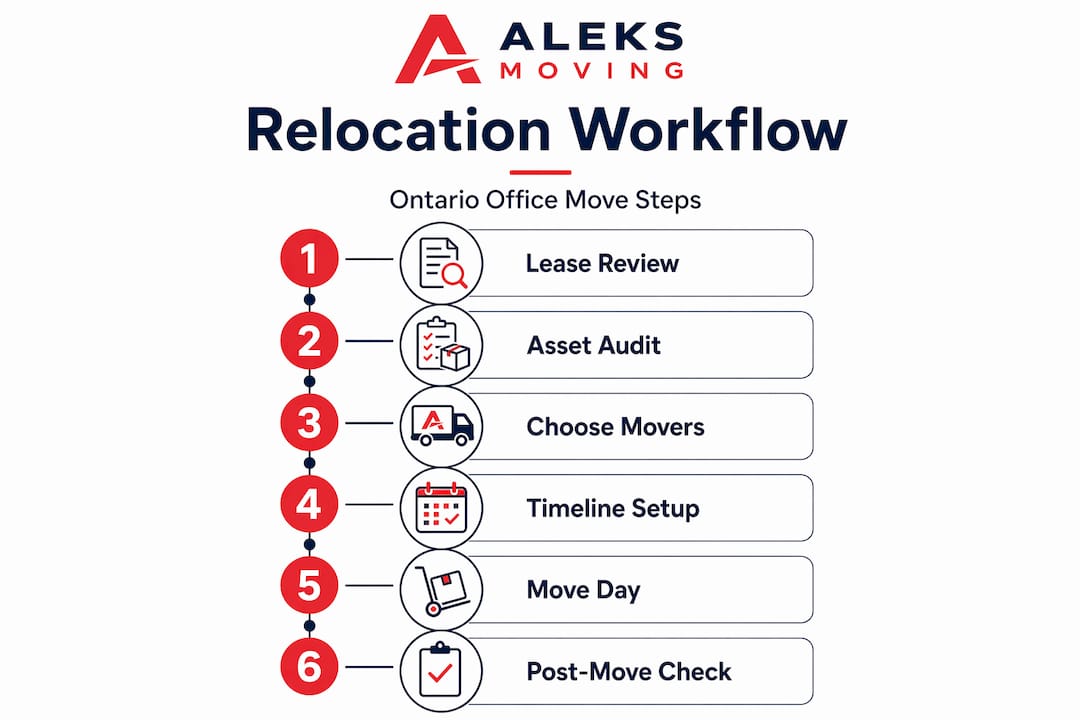

Aleksmoving has been supporting Ontario businesses with dependable, flat-rate commercial moving services for over 18 years. From coordinating loading dock permits in the GTA to handling sensitive IT equipment and office furniture with care, we manage the logistics so you can focus on keeping your business running. We also offer secure storage solutions and specialty item handling for anything that needs extra attention during the transition. Whether you are relocating across the street or across the province, our team brings the corporate relocation experience your office move deserves. Contact us today for a free, no-obligation quote.
FAQ
What should I do first when planning an office relocation in Ontario?
Review your commercial lease before anything else. Lease agreements in Ontario often require 60 to 90 days notice and landlord consent, and overlooking these terms can result in financial penalties or legal disputes.
How do I minimise IT downtime during an office move?
Use a staged migration approach rather than shutting everything down at once. Moving servers in batches while extending your network subnet across both locations keeps critical systems accessible throughout the move.
How far in advance should I start planning an office move in Ontario?
Start the planning process at least 12 to 16 weeks before your target move date. This gives you time to satisfy lease obligations, book reliable Ontario commercial movers, and complete IT setup at the new location before staff arrive.
What are the biggest risks in an Ontario office relocation?
The most common risks are lease compliance failures, unplanned IT downtime, and weather-related delays during winter moves. Each of these is manageable with early planning and the right partners in place.
Do I need permits to move a commercial office in Ontario?
In many cases, yes. Building access permits, elevator reservations, and loading dock bookings are commonly required in the GTA and other Ontario municipalities. A mover with local Ontario experience will know exactly which permits apply to your specific location.