

This glossary clarifies the moving-industry terms you’ll actually see on estimates, bills of lading, and invoices, and what each one means for your final bill and your liability if something breaks. The FMCSA’s glossary treats the bill of lading as both a receipt and a binding contract, which tells you how seriously to read one before signing. Movers like Aleksmoving, with over 18 years in the business, and glossaries from providers such as Alliance Relocation Services build their paperwork around these same terms. Know them and you’ll avoid surprise fees, read your estimate correctly, and know exactly when to demand something in writing.
Key Takeaways
Clear moving terminology protects your final bill: a binding estimate on the bill of lading, documented accessorial charges, and verified valuation coverage prevent the disputes that catch most Ontario movers off guard.
| Point | Details |
|---|---|
| Insist on a binding estimate | A binding estimate locks your price; a non-binding one can shift once actual weight is calculated. |
| Read the bill of lading fully | It’s your contract and receipt, so confirm inventory, accessorials, and pricing before signing. |
| Know your valuation coverage | Released value pays by weight; full value protection reimburses repair or replacement cost. |
| Watch for hostage load tactics | Refusing to release goods without extra payment is a reportable abuse, not a normal fee dispute. |
| Choose a transparent provider | Aleksmoving pairs 18+ years of experience with flat-rate pricing and written binding estimates. |
Table of Contents
- Must-know moving terms and what each means for your move
- How to use these terms to avoid surprise charges and disputes
- Common services and equipment explained
- Pricing, estimates, contracts and valuation: what each term means for your bill
- Common payment terms and timing
- Cancellation and rescheduling policies and terminology
- What ‘access to residence’ means for your quote
- Explanation of weight and volume terms used in moving estimates
- Terminology related to storage options and charges
- How Aleksmoving puts this glossary to work for your move
- Sources
Must-know moving terms and what each means for your move
Every mover uses a version of this vocabulary. Here’s what shows up most often on Ontario moving estimates and contracts, and what each term actually costs or protects.
- Accessorial services (or accessorial charges): anything beyond loading, hauling, and unloading, such as packing, appliance disconnection, or stair carries. These are billed separately from your base transport cost, so ask for a full accessorial list before moving day.
- Binding estimate: a written price guarantee based on the services and items listed. The total won’t change unless you add services, which makes it the safer option for budgeting.
- Non-binding estimate: a price that can shift once movers calculate your actual weight and time. It’s an educated guess, not a promise.
- Estimate revision: an updated price after your inventory or services change from what was originally quoted, usually triggered by extra boxes, added furniture, or a longer carry distance than expected.
- Hostage load: when a mover refuses to unload your goods until you pay more than the agreed price. Industry sources flag this as a serious, reportable abuse, not a normal negotiating tactic.
- Packed by Owner (PBO): boxes you pack yourself. Carriers routinely limit liability on PBO boxes, so a claim for a broken item inside one can be denied if there’s no external damage to the box.
- Long carry: an extra charge when the truck can’t park close to your door, for example when it’s stuck a considerable distance away because of a narrow lane or blocked driveway.
- Shuttle service: a smaller vehicle used to move your goods when the main truck can’t reach your home at all, common on narrow city streets or in buildings with tight parking.
- Delivery spread: the window of days during which your goods may arrive, typical on long-distance moves where an exact date can’t be guaranteed.
- Linehaul: the actual transport charge for hauling your shipment between cities, calculated by distance and weight.
- Bill of lading (BOL): the contract and receipt for your shipment, and the single most important document you’ll sign. It should list your inventory, services, and price exactly as agreed.
- Released value protection: basic coverage included at no extra cost that pays out by weight, not replacement cost, meaning a damaged 50 pound television might net you a few dollars.
- Full value protection: coverage that reimburses at repair, replacement, or current market value, usually for an added fee.
- Full-service move: the mover packs, loads, transports, and unloads everything.
- Partial-service move: you handle some tasks (usually packing) while the mover does the rest.
- DIY move: you rent a truck and do the labour yourself, trading cost for effort and risk.
Pro Tip: Walk through every room with your mover, or on a video call if it’s a virtual survey, and list every item you plan to bring. A sloppy inventory is the number one reason estimates balloon on moving day.
How to use these terms to avoid surprise charges and disputes
Understanding a term is one thing. Using it to protect yourself is another. Here’s a short checklist for before and during your move:
- Build a room-by-room pre-move inventory, including closets, garages, and storage areas.
- Request an in-home or virtual survey rather than a phone quote, since phone estimates are the least accurate.
- Ask specifically for a binding estimate and confirm where that number appears on the bill of lading.
- Get every accessorial charge (stairs, long carry, shuttle) written into the estimate, not promised verbally.
- Confirm your valuation coverage, released value or full value, and decide if you need to buy up.
- Ask about the mover’s policy on shuttle service or long carry before booking, especially if you live on a narrow street or in a high-rise.
- Verify the company’s registration and check its reviews before you sign anything.
Put these questions in writing and keep the replies:
- “Is this a binding or non-binding estimate, and where does that show up on the bill of lading?”
- “What counts as an accessorial charge on my move, and what would each one cost?”
- “What happens if my inventory changes the day of the move?”
Before hiring, check for a visible tariff, verifiable business registration, and a track record you can confirm independently. Consumer Moving Reviews recommends checking a company’s registration and reviews as a baseline before signing anything. Aleksmoving publishes flat-rate pricing with no hidden fees, a model that lines up directly with the transparency this checklist demands.
Pro Tip: If a crew tries to hand you a revised bill of lading with new charges you didn’t agree to, don’t sign it on the spot. Ask for the change in writing and take time to review it, even if that means a short delay.
Common services and equipment explained
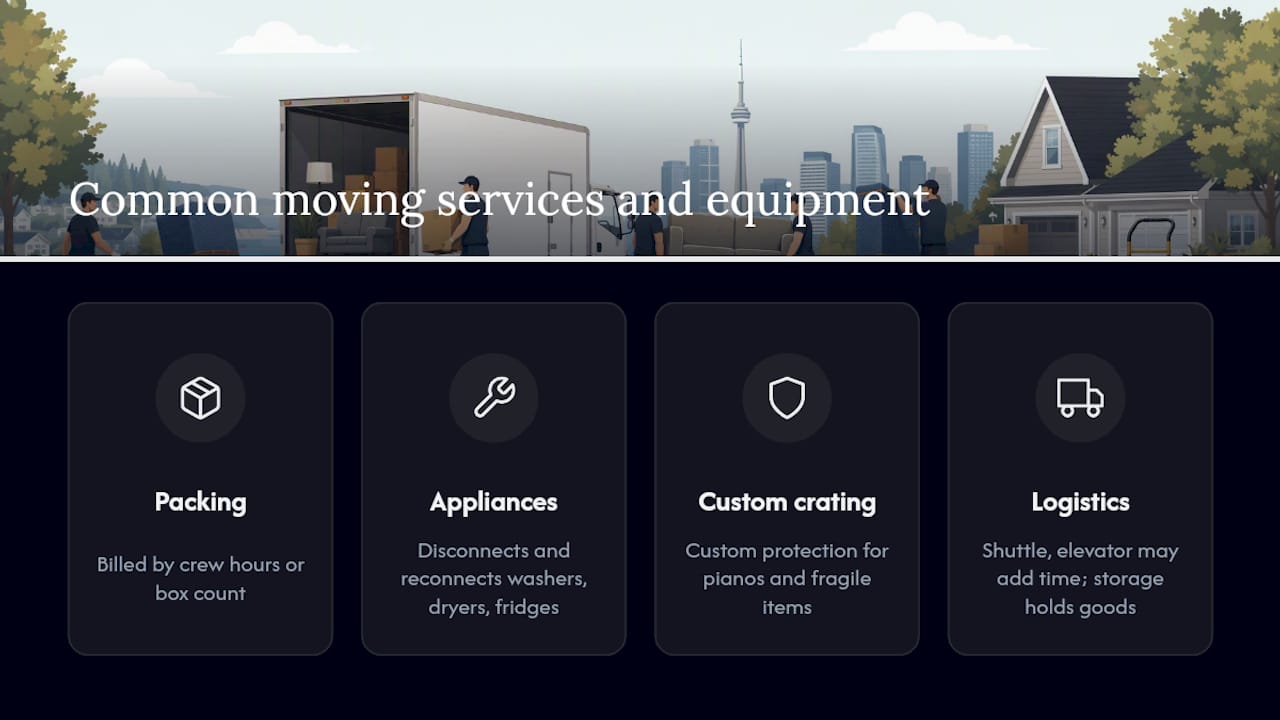
Packing services cover full or partial box packing, usually priced by crew hours or by box count. Appliance servicing disconnects and reconnects washers, dryers, and fridges. Piano or fragile-item crating builds custom protection for high-value pieces. A shuttle becomes necessary when your driveway is too narrow or a bridge too low for the main truck. Storage-in-transit holds your goods temporarily between pickup and delivery. Elevator carries add time and sometimes cost in buildings without service elevators reserved for moving day. Standard equipment includes dollies, furniture pads, and tie-downs, all normally included in a professional quote. Accept third-party services only when your mover doesn’t offer the equivalent in-house, since bundled service usually means clearer liability if something goes wrong.
Pricing, estimates, contracts and valuation: what each term means for your bill
A binding estimate locks your price; a non-binding estimate can move once actual weight and time are calculated. Watch for the “110% rule” on interstate non-binding estimates, where the mover can’t demand more than 110% of the original quote at delivery, a useful red-flag benchmark if a final bill runs higher.
The bill of lading works as both your receipt and your contract, so FMCSA guidance is blunt: read it before you sign, and confirm every accessorial charge and inventory item appears on it. Treat it the way you’d treat a lease, since anything left off is much harder to dispute later.
Valuation and insurance aren’t the same thing. Released value pays by weight; full value protection pays to repair or replace, as This Old House explains in comparing the two. Before signing, insist in writing on your full inventory, every accessorial charge, pickup and delivery windows, payment terms, and the cancellation policy.
Common payment terms and timing
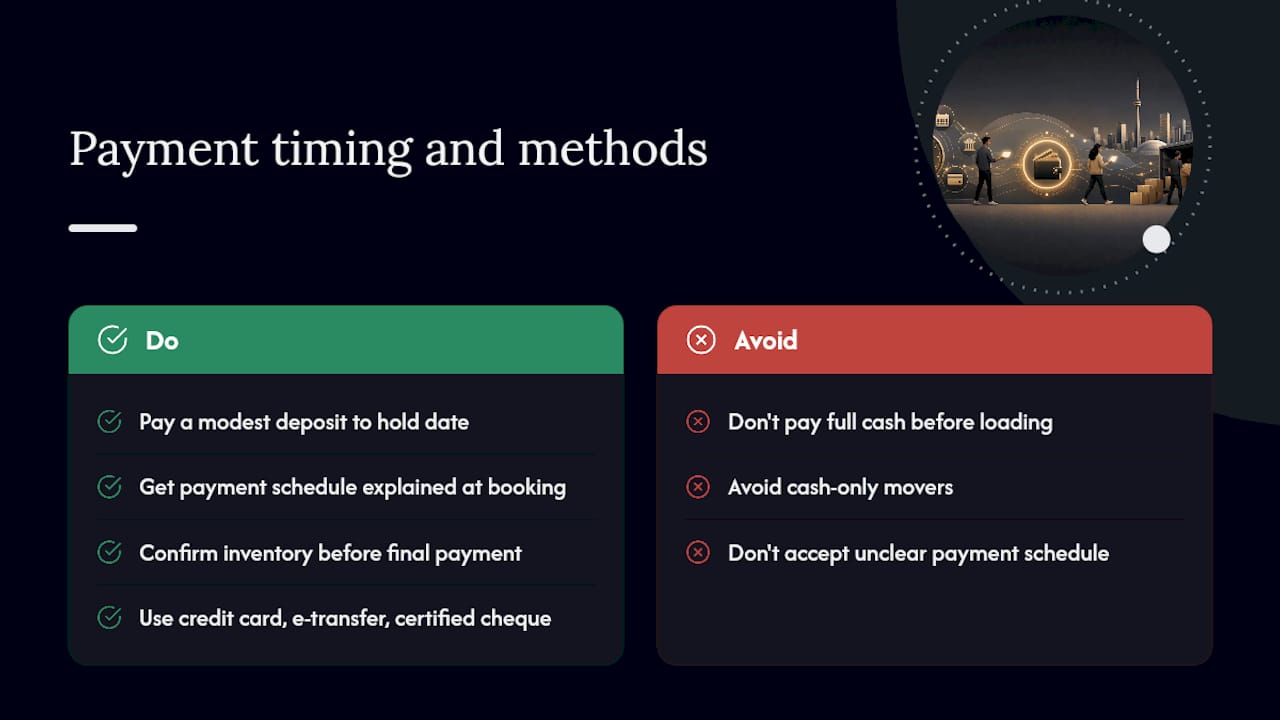
Most Ontario movers ask for a deposit to hold your date, typically a modest percentage of the total estimate, with the balance due at delivery. Read your contract for the exact deposit amount and refund conditions before you pay anything.
Final payment is usually collected once your goods are unloaded and you’ve confirmed the inventory against the bill of lading. Some companies split payment across pickup and delivery on long-distance moves, particularly when a delivery spread stretches across several days.
Accepted payment methods vary by company. Many movers take credit cards, e-transfer, or certified cheque, while some avoid cash-only arrangements as a matter of policy, since cash payments are harder to dispute if a problem arises later. Be cautious of any mover who demands full payment in cash before loading a single box, since that pattern shows up repeatedly in warnings about predatory moving practices. A legitimate company will explain its payment schedule clearly at booking, not spring it on you at the truck.
Cancellation and rescheduling policies and terminology
Every contract should spell out a cancellation window, the number of days before your move when you can cancel without penalty, and what happens if you cancel later than that. Ask for this in writing at booking, not after you’ve already paid a deposit.
Rescheduling terms cover what happens if you need to shift your moving date. Some companies apply your deposit toward a new date at no cost if you give enough notice; others charge a rebooking fee, especially during peak summer months when trucks and crews are booked solid.
“Force majeure” clauses occasionally appear in contracts to cover weather events or emergencies beyond either party’s control. If your contract doesn’t mention what happens during a snowstorm or road closure, ask before you sign, not on moving day when it’s too late to negotiate.
What ‘access to residence’ means for your quote
Access to residence describes how easily a truck and crew can reach your unit: the number of stairs, whether there’s a working elevator, and how far the truck can park from your door. This single factor drives a surprising share of accessorial charges.
A third-floor walk-up with no elevator usually adds a stair-carry fee, since it takes longer and more labour to carry furniture up flights of stairs than to wheel it through a ground-level door. Buildings with elevators aren’t automatically cheaper either, since a slow freight elevator or a strict booking window can add time charges of its own.
Parking matters just as much as stairs. If a truck can’t park within a reasonable distance of your entrance, that gap triggers the long carry charge described earlier, sometimes stacked on top of an elevator or stair fee. Tell your mover about your building’s access details, including condo board rules or reserved elevator hours, when you book your estimate, not on moving day.
Explanation of weight and volume terms used in moving estimates
Interstate and many local estimates in the moving industry are built on weight, cubed volume, or a mix of both, so it helps to know the difference. Gross weight is the loaded truck’s total weight; tare weight is the empty truck’s weight; the difference between the two gives your shipment’s actual weight, which Consumer Moving Reviews lists among the terms worth understanding before your goods hit the scale.
Cubic feet measures the space your belongings occupy in the truck rather than their weight, common for local moves priced by truck space or crew hours instead of distance.
If your final bill cites a weight ticket, ask to see both the gross and tare weight slips, not just the final number. A discrepancy here is one of the more common billing disputes in the industry, and having the paperwork in hand settles it faster than any phone call.
Terminology related to storage options and charges
Storage-in-transit (SIT) holds your goods temporarily, usually 30 to 90 days, at a mover’s warehouse between pickup and final delivery, often used when your new home isn’t ready yet. Short-term storage typically covers a few weeks to a couple of months and priced by the month or week.
Long-term storage stretches beyond that window and usually carries a different rate structure, sometimes with a discount for a longer commitment. Ask specifically whether your quote separates storage fees from transport charges, since bundling them can make it hard to see what you’re actually paying for.
Access terms matter too. Some facilities allow you to retrieve items mid-storage for a fee; others lock inventory until final delivery. If you’ll need anything before your move-in date, confirm access terms before signing a storage agreement, not after your boxes are already palletized in a warehouse somewhere across Ontario.
A mover’s take on what actually trips people up
Most disputes I’ve seen trace back to the same two gaps: an inventory that didn’t match what actually got loaded, and an estimate whose wording nobody read closely before moving day. Get the bill of lading right, and most of these headaches disappear. Aleksmoving has spent over 18 years building flat-rate quotes around exactly that discipline.
How Aleksmoving puts this glossary to work for your move
Knowing the terms is step one. Getting a mover who applies them honestly is step two, and that’s where Aleksmoving fits into your plan. We build every quote around an in-home or virtual inventory survey and put binding estimate language directly on the bill of lading, so the number you agree to is the number you pay.

Aleksmoving offers residential moving, professional packing services, and both short and long-term storage, all under flat-rate pricing with no hidden accessorial surprises. Over 18 years of moves across Ontario back that promise, along with client testimonials that speak to how few surprises show up on the final invoice. Deposits are modest, payment methods are flexible, and every accessorial charge gets confirmed in writing before your crew shows up. Ready to see what a clear, binding quote looks like for your move? Request your moving quote and get pricing that matches exactly what lands on your bill of lading.
Sources
For deeper definitions and regulatory context, consult the FMCSA glossary for federally regulated terms, This Old House for valuation comparisons, Consumer Moving Reviews for plain-English definitions, Moving Support for the 110% rule and hostage load warnings, and Alliance Relocation Services for homeowner-focused checklists. For service details and quotes, visit Aleksmoving directly.
- Glossary | FMCSA
- Moving Terms Glossary: 125 Mover Terms Explained in Plain English | Consumer Moving Reviews
- Moving Glossary — 75+ Industry Terms Defined | Moving Support
- Understanding Residential Moving Terminology: A Guide for Homeowners – Alliance Relocation Services