

To transfer utilities when you move in Canada, contact each provider yourself, ideally two to three weeks before moving day. Ask each one to close service at your old address and open it at the new one. Your moving company does not do this for you, and neither does your landlord by default. Hydro, gas, water, internet and mail forwarding all run on separate systems, so each one needs its own request.
We have moved thousands of Ontario households, and the utility call is the task people forget most often. It is also the one that leaves you with no lights in a new home, or a bill from your old one. This guide covers what to do, in what order, and what changes if you rent.
TL;DR
- Nobody transfers your utilities for you. You start the move request with every provider, and utilities say so directly.
- Give electricity providers about 7 to 10 business days of notice. Hydro Ottawa asks for at least 10 business days, and many Ontario utilities now want the request submitted online.
- Confirm which utility serves your new address before you submit anything. Do not guess.
- Book a final meter reading for your move-out date, and buy mail forwarding before you move, because neither can be done after the fact.
- Renters should check the tenancy agreement first. It decides which utilities you set up and which are included in rent.
Table of Contents
- Why utilities do not transfer automatically
- Step 1: Find out who serves your new address
- Step 2: Give the right notice
- Step 3: Submit the move requests
- Step 4: Close the loop on your old home
- If you rent: who sets up what
- Beyond utilities: mail and government records
- A simple timeline
- Our perspective: the paperwork belongs on the same calendar as the truck
- Let us take care of the heavy lifting
- FAQ
- Sources
Why utilities do not transfer automatically
Moving companies carry your furniture. Utility companies hold your accounts. The two never talk to each other, and a moving company has no authority over your hydro or gas account.
In Ontario the picture is also very local. Electricity is delivered by one of dozens of local distribution companies, such as Toronto Hydro, Alectra, Hydro One or Hydro Ottawa. Water is usually billed by your municipality or, in some cities, bundled with the electricity bill. Moving across a city line often means moving to a different provider for at least one service.
Even when you stay inside one provider’s area, it is usually a two-step process: close the old address and open the new one. That often produces a new account number, so update any automatic payments or pre-authorized debits.
Step 1: Find out who serves your new address
This is the step most people skip, and it causes most of the delays. Registering with the wrong utility means your request is rejected and you start again, usually with the clock running.
Here is how to confirm your providers:
- Electricity: Check your future home’s most recent bill with the seller or landlord, or look up the service area on the Ontario Energy Board’s interactive service area map. Do not rely on a neighbour’s guess. Utility boundaries can run through the middle of a street.
- Natural gas: Ask the landlord, seller or your real estate lawyer’s office which gas company serves the home, and whether the home uses gas at all. Some newer homes and condos are all-electric.
- Water and sewer: Check your municipality’s website. In some cities, such as Markham and Vaughan, the electricity provider also bills municipal water, so you may handle both in one request.
- Internet, TV and phone: Search your new address on providers’ websites. Availability varies by building, especially in condos with bulk agreements.
If you are buying, your real estate lawyer’s office will often need to request new accounts for you. Hydro One, for example, has a separate option for real estate law offices requesting an account on a client’s behalf.
Step 2: Give the right notice
Here is a practical notice guide. Treat it as a minimum, and add extra time if you are moving at month-end, in summer or on a long weekend, when everyone else is moving too.
| Service | What to request | When to start |
|---|---|---|
| Electricity | Close old account, open new one | 2 to 3 weeks before. Hydro Ottawa asks for 10 business days minimum |
| Natural gas | Stop at old address, start at new | 2 to 3 weeks before |
| Water and sewer | Final reading, new account | 2 to 3 weeks before, or per your municipality |
| Internet and phone | Transfer or cancel and reorder | 2 to 4 weeks before, since installs can be booked up |
| Canada Post | Mail forwarding | At least 3 to 5 days before, depending on how you buy it |
| Government of Canada | Address change with each department | As soon as you know your date |
The notice window is not a courtesy. Major Ontario providers such as Alectra and Hydro One typically need 7 to 10 business days to process a move, and last-minute phone requests are often not accepted. If you are on a tight schedule, our guide on securing urgent movers covers how to plan around short notice, and the same logic applies to utilities: ask early.
Step 3: Submit the move requests
Most large Ontario utilities now run move requests through an online form. A few examples of where these live:
- Toronto: Toronto Hydro has a start, stop, move account page where you choose between moving within Toronto, closing an account or opening a new one.
- Hydro One territory: The Hydro One moving request page lets you open a new account or move within the service territory.
- Alectra territory: The Alectra open, close or transfer page covers moves within and into its area.
- Ottawa: Hydro Ottawa uses an online moving form, submitted at least 10 business days before your move.
Have these ready before you start:
- Your current account number and the service address
- Your move-out date and move-in date
- The new address, including unit number
- Meter readings, if requested
- For a rental, your lease or proof of tenancy
Meter readings and water
If the same company bills your electricity and water, you may need to give separate water meter readings for move-out and move-in dates. Skipping that can lead to billing errors or delays closing your account. Take a dated photo of each meter on your last day at the old home and your first day at the new one. It takes a minute and gives you proof if a bill looks wrong.
Step 4: Close the loop on your old home
The end of a move is where people lose money. You stay responsible for an account until you have formally given notice, so a forgotten account can keep billing you after you have handed over the keys.
- Ask for a final meter reading dated on your move-out day.
- Confirm the closing in writing or by email, and keep it.
- Cancel or redirect pre-authorized payments tied to the old account number.
- Check your final bill for a date that matches your move-out day.
If you want to understand your energy use before setting up the new place, a home-energy guide on measuring electricity consumption explains the basics, though it is written for France, so check rates and rules with your Ontario provider.
If you rent: who sets up what
Renting adds one question before all the others: is any utility already included in your rent? The Condo Authority of Ontario’s tenants’ guide says the tenancy agreement specifies whether costs such as electricity, water or parking are included. Read yours before you call anyone.
Then:
- Utilities included: You may not need any account. Confirm that in writing with the landlord.
- Utilities not included: You usually open the accounts yourself. Do not assume your landlord will do it.
- Suite meters: Some rentals have electrical meters that measure only your unit. The Landlord and Tenant Board’s brochure on suite meters explains what these are and how they work.
On the other side, landlords and property managers can arrange agreements with utilities to move service between tenants automatically. Without one, failing to tell the utility a tenant has left can send the account back to the owner. Some municipalities offer help too: for example, the City of Peterborough has a water services program for landlords and property managers for tenant move-ins and move-outs. If you manage rentals, ask your own utility what it offers.
For the rest of the rental move, see our moving checklist for renters in Ontario and the step-by-step renter moving guide.
Beyond utilities: mail and government records
Utilities are only part of the paperwork. Two other items catch people out.
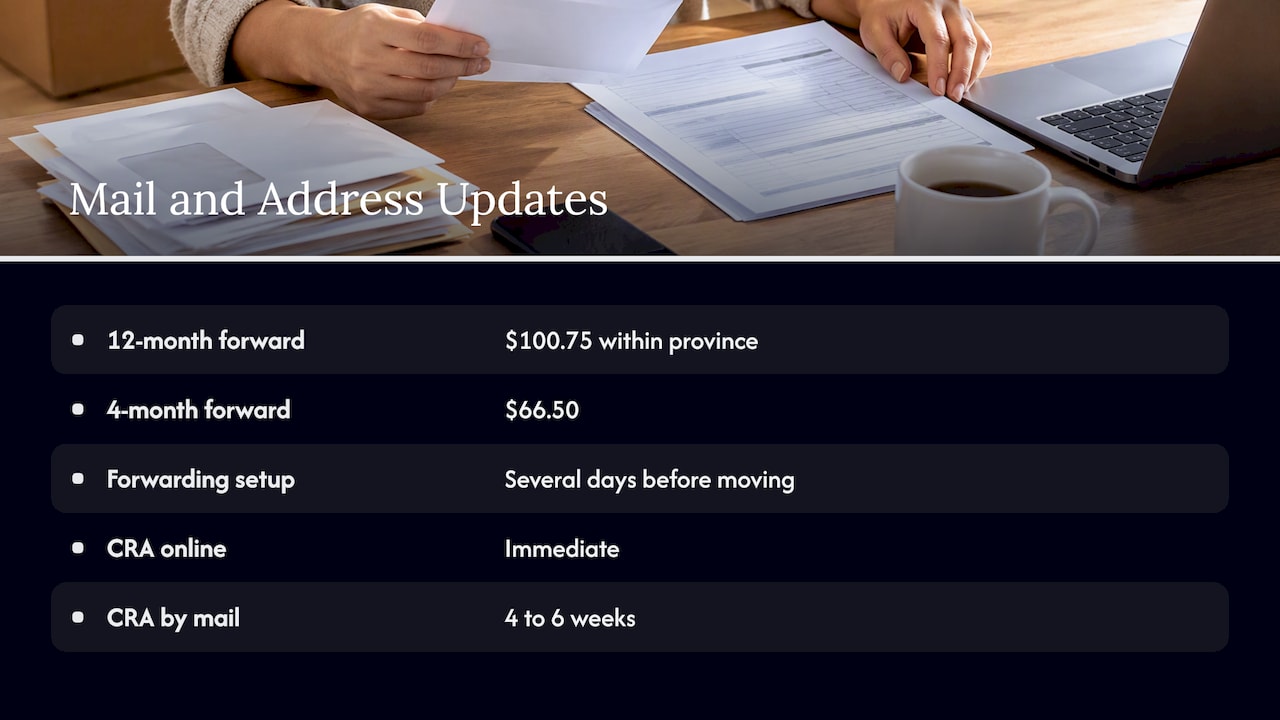
Canada Post mail forwarding. It is paid and priced by duration and distance. As of October 2026, a 12-month within-province forward costs $100.75, and a 4-month one costs $66.50. It needs to be set up several days in advance and does not forward parcels. Buy it before you move, because it is not retroactive.
Government address changes. Your new address is not shared automatically, because government systems are not connected. You update each department separately. For the CRA, do it as soon as possible so your payments and correspondence arrive and your identity can be validated when you call. Doing it online is immediate, while a mailed request can take 4 to 6 weeks.
If you want one list that ties all this together, a home-closing checklist written for US first-time buyers shows the same pattern of tasks, though the rules and providers differ from Canada’s.
A simple timeline
4 weeks before
- Confirm your utility providers at the new address.
- Check your lease or purchase documents for utility responsibilities.
- Book internet installation.
2 to 3 weeks before
- Submit electricity, gas and water move requests.
- Buy Canada Post mail forwarding.
- Start government and bank address changes.
1 week before
- Confirm you received a confirmation for each request.
- Pack a box with chargers, bulbs and a flashlight for the first night.
Moving day
- Photograph meters at both addresses.
- Confirm the lights, heat and water work on arrival.
After the move
- Check the first bill for the right dates and account number.
- Keep final bills and confirmations for your records.
For the physical side of the same timeline, our guide to preparing for a move in Ontario runs alongside this list.
Our perspective: the paperwork belongs on the same calendar as the truck
After more than 18 years of moving Ontario families and businesses, we see the same pattern. People book the truck weeks ahead and then try to arrange utilities the night before. By then, the online forms have a waiting period they cannot beat.
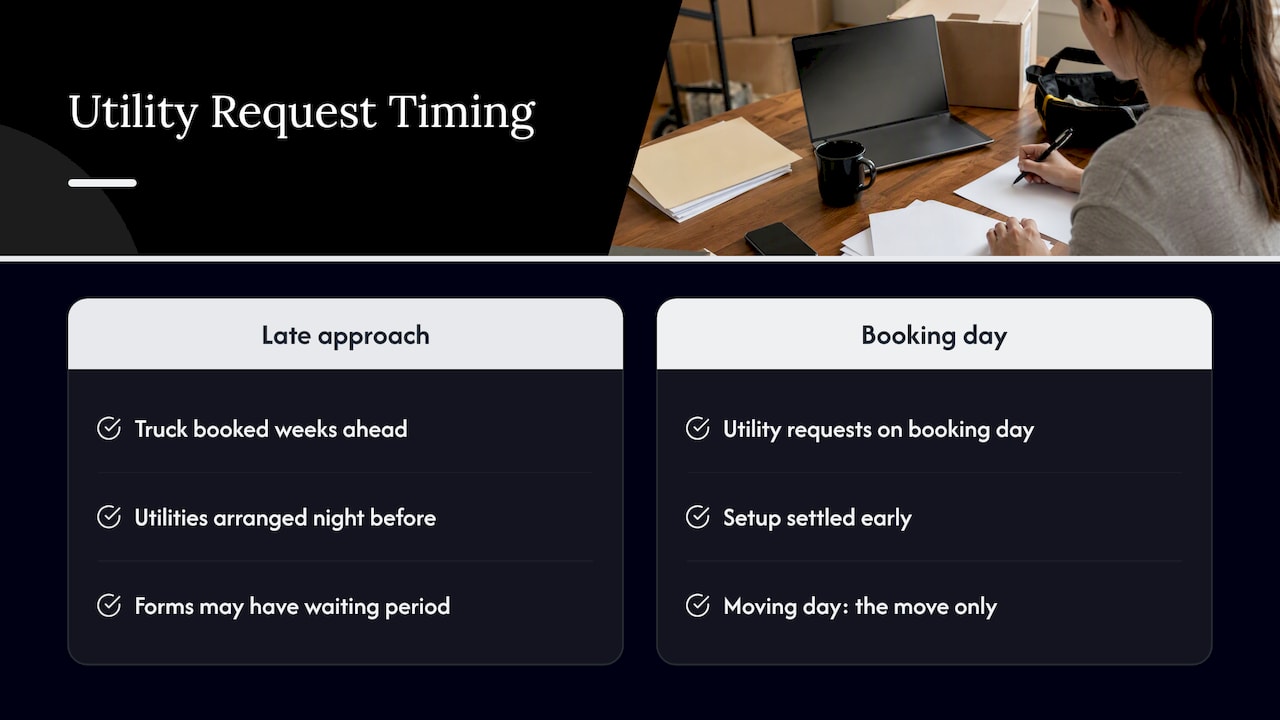
Our advice is simple. Put your utility requests on the same calendar as your moving date, and do them on the day you book your move. We give a flat-rate quote with no hidden fees, so your moving costs are settled early. Your utility setup should be settled early too, so the only thing left on moving day is the move.
We also suggest two habits that save trouble. Take photos of every meter. And keep the confirmation email from every provider in one folder. If anything goes wrong in the first bill, you will be glad you did.
We cannot open or close your accounts for you, and no mover can. What we can do is make sure that when you arrive, the home is ready for your boxes, and that your packing, loading and delivery go as planned.
— Ali
Let us take care of the heavy lifting
Once your utilities are lined up, the rest of the move is ours. We handle local moves, long-distance relocations, packing and storage across Ontario, with a free upfront quote. If you are boxing things yourself, bin rental has a one-off delivery and pick-up fee of $150. Office moves are covered on our commercial moving page. Contact us for your free quote, and let our family move yours.
FAQ
Do my utilities transfer automatically when I move?
No. You need to contact each provider and ask them to close the old account and open the new one. Utilities say you are personally responsible for starting the request, and until you formally give notice you can remain liable for the old account.
How far in advance should I transfer my hydro?
Aim for two to three weeks. Large Ontario providers typically need 7 to 10 business days, and Hydro Ottawa asks for at least 10 business days. Allow more time around month-end or holiday weekends.
Who sets up utilities when I rent?
It depends on your tenancy agreement. The agreement specifies whether utilities such as electricity or water are included in your rent. If they are not, you normally open the accounts yourself, so confirm with your landlord rather than assuming.
What if I do not know which utility serves my new address?
Do not guess. Use the Ontario Energy Board’s service area map for electricity, and ask the landlord, seller or your lawyer’s office about gas and water. Applying to the wrong provider is a common reason for delayed connections.
Do I need to change my address with the government separately?
Yes. Federal departments do not share your new address with each other, so you update the CRA, Service Canada and others individually. Online CRA updates are immediate, while mailed requests can take 4 to 6 weeks.
Sources
- Alectra Utilities: moving
- Alectra Utilities: open, close or transfer an account
- Hydro One: moving requests
- Hydro Ottawa: conditions of service
- Toronto Hydro: start, stop, move account
- City of Peterborough: landlords and owners
- Condo Authority of Ontario: condo tenants’ guide
- Landlord and Tenant Board: suite meters brochure
- Canada Post: mail forwarding
- Government of Canada: change your address
- CRA: change your address