Skip to content


TL;DR:
- A project manager is the key person responsible for coordinating all aspects of an office move from planning to completion. Appointing one early, ideally 6 to 12 months before the move, ensures lead times for contractors and critical tasks like internet setup are met. Effective management focuses on workstream dependencies and communication to prevent delays and budget overruns.
The role of project manager in office moves is to serve as the single point of accountability for every aspect of the relocation, from initial planning through to move-day execution and post-move resolution. Without this central coordinator, parallel workstreams collide, budgets slip, and employees arrive on day one to find no internet, misplaced furniture, or unfinished fit-out. Office relocation project management is the recognised industry term for this discipline, and it covers far more than logistics. It spans IT infrastructure, HR communications, contractor scheduling, lease obligations, and risk management, all running at the same time.
What are the primary responsibilities of a project manager during an office move?
The project manager owns the full scope of the relocation, not just the moving trucks. That distinction matters because office relocations involve 8–9 parallel workstreams, including IT, fit-out, furniture, HR communications, and operations. Each stream has its own contractors, timelines, and dependencies. The project manager sets the master schedule, assigns ownership, and holds every stream accountable to the same move date.
Core responsibilities break down into five areas:
- Scope and budget definition. The project manager sets realistic cost envelopes and documents what is and is not included. Scope creep is the fastest route to a budget overrun.
- Contractor and specialist coordination. IT vendors, furniture suppliers, fit-out contractors, and removal companies all need a single point of contact. The project manager fills that role.
- Risk identification and escalation. Risks are logged, rated, and escalated early. A project manager who surfaces problems late is not managing risk; they are reporting damage.
- Stakeholder communication. Leadership, department heads, and employees each need different information at different frequencies. The project manager calibrates those messages.
- Post-move resolution. Defects, missing items, and IT faults do not stop at move day. The project manager owns fixes for delays and scope changes until the office is fully operational.
Pro Tip: Build a single shared decision log from day one. Every agreed change, no matter how small, goes into it with a date and owner. This prevents the “I thought we agreed” conversations that derail timelines in the final weeks.
The project manager also runs regular coordination meetings. Starting eight weeks before the move date, weekly 30-minute meetings keep all workstream leads aligned. As the move date approaches, those meetings increase to twice weekly. This cadence catches interface problems before they become crises.

How does workstream interface management prevent office move problems?
Most cost and schedule overruns stem from failures managing dependencies between parallel workstreams, not from individual tasks going wrong. A furniture installer who arrives before IT has confirmed power and data outlet locations cannot complete their work. A removal company booked for a specific date cannot flex if the fit-out contractor runs three days late. These are interface failures, and they are the project manager’s primary concern.
The table below shows common workstream pairings and the interface risks that arise between them.
| Workstream A | Workstream B | Common interface risk |
|---|---|---|
| IT infrastructure | Furniture installation | Power and data outlet locations must be confirmed before desks are positioned |
| Fit-out contractor | Removal company | Construction delays push move date, leaving removal company without a confirmed slot |
| HR communications | IT and operations | Employee move guides go out before IT confirms system readiness, creating false expectations |
| Furniture specification | Building services | Changes to desk layouts alter power load requirements and data cabling runs |
| Lease team | IT provisioning | Internet order is delayed because lease signing date is not communicated to IT on time |
Changes in one workstream ripple across others. A furniture spec change, for example, can shift power outlet positions, which forces IT to re-route cabling, which delays the fit-out sign-off, which pushes the move date. The project manager tracks these ripple effects in real time and communicates changes to every affected party immediately.
Pro Tip: Map your workstream dependencies visually at the project kick-off. A simple one-page dependency chart, shared with all workstream leads, makes it obvious who needs to talk to whom before making any change.
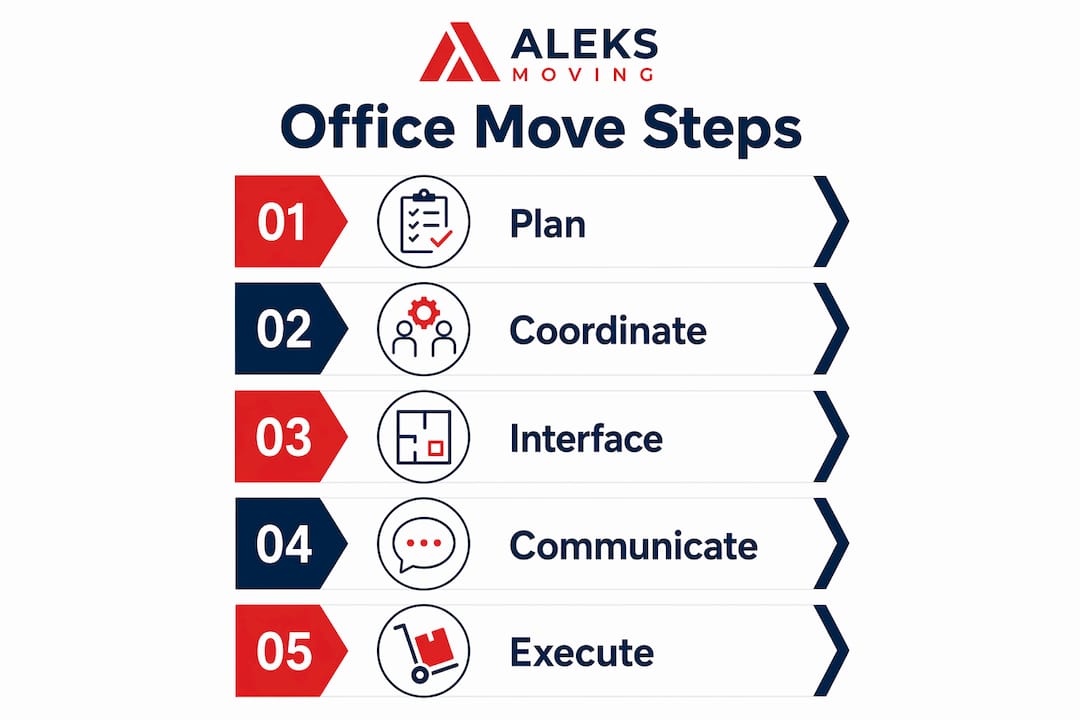
The project manager’s job is not to supervise every task inside each workstream. It is to manage the connections between them. That is a fundamentally different skill set, and it is why experienced office relocation project planners focus their attention on the interfaces rather than the individual deliverables.
When should a project manager be appointed for an office relocation?
Appointment timing is one of the most consequential decisions in office move leadership. For moves above 50 employees, appointing an experienced project manager at lease signing reduces decision bottlenecks and minimises budget and deadline risks. The industry standard is appointment 6–12 months before the move date for any move involving more than 50 staff.
Early appointment matters for several concrete reasons:
- Internet provisioning. Internet ordering requires a 60–90 day lead time and must be initiated at lease signing, not weeks later. A project manager appointed early treats this as a day-one task.
- Lease obligation review. Dilapidations, reinstatement clauses, and access restrictions in the lease affect the fit-out programme. The project manager needs time to read and act on these.
- Contractor procurement. Quality IT vendors, fit-out contractors, and furniture suppliers book out months in advance. Late appointment means settling for whoever is available.
- Budget accuracy. Early involvement gives the project manager time to get real quotes rather than estimates, producing a budget that reflects actual costs.
- Move committee formation. A project manager appointed early can establish a move committee with representatives from IT, HR, finance, and operations, giving the project legitimate authority across departments.
The question of internal versus external project managers depends on move complexity. Internal staff managing moves while keeping their regular workload leads to unrealistic expectations and divided attention. For moves above 100 people, an external dedicated project manager treats the relocation as a business-critical event rather than an administrative task. For smaller moves, a well-supported internal lead with a clear mandate and protected time can be effective.
The typical project manager cost sits between £40,000 and £120,000. That fee pays for itself by preventing a single major overrun, such as a missed move date that requires a lease extension or an IT failure that costs days of lost productivity.
What tools and communication strategies do project managers rely on?
Good project management provides confidence and control through clear decisions and early risk escalation, not through frequent status updates. A project manager who sends daily emails but never flags a risk early is creating noise, not control. The goal is reliable reporting that tells stakeholders what they need to know, when they need to know it.
Effective office move coordination depends on a few non-negotiable practices:
- Single source of truth. All timelines, decisions, and responsibilities live in one shared tool, whether that is Microsoft Project, Asana, or a well-maintained spreadsheet. Fragmented information across email threads causes missed dependencies.
- Defined decision rights. Every decision has a named owner. The project manager does not make every call, but they do know who does and they chase outstanding decisions before they become blockers.
- Honest reporting over polished presentations. A traffic-light status report that shows amber or red on a problem area builds more stakeholder trust than a deck that hides issues until they explode.
- Escalation paths. The project manager knows exactly who to call when a contractor fails to deliver, a budget line blows out, or a workstream lead goes silent.
- Contractor communication protocols. External vendors need a single point of contact and a clear change-request process. Ad hoc calls to different team members create conflicting instructions.
Pro Tip: Send a short weekly written update to senior stakeholders, even when nothing has changed. Silence breeds anxiety. A three-sentence “all on track” note takes two minutes and prevents unnecessary escalations from above.
For project managers planning their first large office relocation, the role of logistics in office moves is a useful starting point for understanding how physical transportation fits into the broader coordination picture. Equally, understanding how to plan a smooth office move from a scheduling perspective helps frame the full timeline before the first contractor meeting.
Key takeaways
The project manager is the single point of accountability in an office relocation, and appointing one early, with clear authority across all workstreams, is the most effective way to prevent budget overruns and missed move dates.
| Point | Details |
|---|---|
| Appoint early | Appoint a project manager 6–12 months before the move date to secure contractors and manage lead times. |
| Manage interfaces, not just tasks | Most overruns come from workstream dependencies failing, not individual tasks going wrong. |
| Treat internet as day-one priority | Internet provisioning requires a 60–90 day lead time and must start at lease signing. |
| Use honest, structured reporting | Clear risk escalation and transparent status updates build more stakeholder confidence than polished decks. |
| Match PM type to move size | Moves above 100 people benefit from a dedicated external project manager with full-time focus on the relocation. |
What I have learned managing complex office relocations
Office moves reveal something most organisations do not expect: the hardest part is not the physical move. It is the week before, when three workstreams are simultaneously behind schedule and every contractor is waiting on someone else. I have seen well-funded relocations fall apart in the final ten days because no one had mapped the dependencies between IT cabling and furniture installation. The IT vendor assumed the desks would be in place. The furniture team assumed the cabling was done. Neither team had spoken to the other in two weeks.
The conventional wisdom says a project manager’s job is to keep things on schedule. That is true, but incomplete. The real job is to keep workstream leads talking to each other, especially when they are under pressure and tempted to go quiet. The project manager who holds a 20-minute call between the IT lead and the fit-out contractor on a Wednesday afternoon prevents a crisis that would otherwise surface on Friday at 4 p.m.
I am also sceptical of the idea that internal staff can manage a large relocation alongside their regular roles. The math does not work. A move involving 150 people across multiple floors requires full-time attention for at least the final three months. Asking a facilities manager or an office administrator to absorb that on top of their existing workload is how organisations end up with a move that costs twice the original budget and leaves employees without working IT for a week.
The one shift I have noticed in recent years is that project managers are being brought in earlier, sometimes at the point of lease negotiation rather than after signing. That timing change alone has a measurable effect on outcomes. The project manager who reads the lease before it is signed can flag reinstatement clauses, access restrictions, and IT provisioning timelines before they become contractual problems. That is the kind of early involvement that genuinely changes the result.
— Ali
Aleksmoving’s office relocation support for Ontario businesses
Planning an office move in Ontario involves far more coordination than most teams anticipate. Aleksmoving brings over 18 years of commercial relocation experience to every project, working alongside your internal teams and external contractors to keep the physical move aligned with your broader project timeline.

Aleksmoving’s office moving services are built around flat-rate, transparent pricing with no hidden fees, so your project manager can hold the budget line without surprises. Whether you are relocating 20 workstations or a full corporate floor, the team coordinates packing, transportation, and placement to fit your confirmed move date. Reach out for a free quote and get a clear picture of costs before your planning locks in.
FAQ
What is the role of a project manager in an office move?
The project manager is the single point of accountability for the entire relocation. They coordinate all workstreams, manage contractor relationships, track risks, and own post-move resolution.
How early should a project manager be appointed for an office relocation?
For moves involving more than 50 staff, the industry standard is appointment 6–12 months before the move date. Early appointment secures contractors and allows critical lead times, such as internet provisioning, to be met.
What is the biggest cause of office move overruns?
Most overruns come from failures at workstream interfaces, not individual tasks. When IT, furniture, and fit-out teams are not coordinating their dependencies, delays in one stream cascade across all others.
Should I use an internal or external project manager for an office move?
For moves above 100 people, a dedicated external project manager produces better outcomes. Internal staff managing moves alongside their regular workload face divided attention and unrealistic expectations.
How often should a project manager hold coordination meetings during an office move?
Starting eight weeks before the move date, weekly 30-minute coordination meetings are the recommended minimum. In the final weeks before the move, those meetings should increase to twice weekly to catch late-stage issues before they become crises.