Skip to content


What is a moving inventory and why does it matter?
A moving inventory is a detailed, systematic record of every household item being relocated, capturing descriptions, quantities, and condition notes for each piece. Think of it as the paper trail that keeps your entire move honest. It serves two distinct purposes: as an organisational tool that helps you pack, label, and unpack with confidence, and as a legal reference document that protects you if anything goes missing or arrives damaged.
Professional movers are required to prepare a shipment inventory during loading, and that document becomes the primary evidence in any dispute over loss or damage. If your mover does not produce one, Canada’s Office of Consumer Affairs recommends creating your own immediately before loading begins. The process itself is straightforward: items receive unique numbered labels during loading, condition notes are recorded alongside each entry, and the document travels with the shipment from origin to delivery.
A moving inventory is sometimes confused with commercial logistics terms like “inventory in transit” or “slow-moving inventory,” which refer to warehouse stock management. Those are entirely different concepts. Your moving inventory is a protective document built around your personal belongings, not a supply chain report.
Here is what a complete moving inventory typically covers:
- A numbered identifier for each item or box, matched to a physical label
- A brief description of contents and the room of origin
- Visible condition notes at the time of loading, including any existing scratches or dents
- Signatures from both you and the mover at pickup and delivery
- Optional details for valuables: make, model, serial number, and estimated value
Table of Contents
- Why creating a moving inventory benefits you
- What to include in your moving inventory list
- How to create a moving inventory list, step by step
- Which tools and apps can help you manage your moving inventory?
- How to track item condition throughout your move
- Expert insights from Aleksmoving on moving inventories in Canada
- Ready to move with a team that takes inventory seriously?
- Key takeaways
Why creating a moving inventory benefits you
The most direct benefit is financial. An accurate inventory list gives movers the information they need to calculate shipment volume, weight, truck size, and the number of crew members required. Without it, your quote is essentially an educated guess, and estimates that shift on moving day are one of the most common sources of frustration for people relocating across Ontario.
Beyond cost accuracy, a moving inventory checklist changes how you experience unpacking. An itemised inventory lets you locate any item without opening every box, turning a chaotic first night into a manageable one. That same process of cataloguing everything you own also forces a useful reckoning: you will find items you forgot about, things you have not used in years, and belongings that simply are not worth the cost of moving.
Insurance is the third pillar. If a mover damages or loses something, a written inventory with condition notes and photos is the difference between a successful claim and a form letter. Most moving insurance policies recommend or require a written record of valuable items.
The moving inventory benefits at a glance:
- Produces accurate moving quotes by detailing volume, weight, and special handling needs
- Reduces surprise costs and scheduling delays on moving day
- Provides documented proof of item condition for insurance claims
- Speeds up unpacking by letting you search rather than guess
- Doubles as a decluttering audit before packing begins
What to include in your moving inventory list
Every entry in your moving inventory checklist should carry enough detail to be useful without slowing you down. For everyday household goods, a short description is sufficient. For furniture, electronics, artwork, and collectibles, you need more.
At a minimum, each entry should include:
- Box number or item ID: a unique identifier that matches the physical label on the box or item
- Room assignment: kitchen, master bedroom, living room, and so on, to guide placement at the destination
- Contents description: a brief summary of what is inside, written in plain language
- Condition notes: any visible damage, wear, or distinguishing marks recorded before loading
- Fragile or special handling flag: a simple note if the box or item needs extra care
For high-value items, add the make, model, serial number, purchase date, and estimated value. This level of detail matters when filing an insurance claim or replacing something that cannot be replicated. A vintage lamp, a signed print, or a high-end appliance all deserve their own line with full details. Knowing how to label moving boxes correctly ties directly into this step, since the label on the box must match the identifier in your inventory.
How to create a moving inventory list, step by step
Starting your inventory before you pack a single box is the single most effective thing you can do for an organised move. It gives you an accurate picture of what you own, helps you declutter, and means your box numbers are assigned before tape touches cardboard.
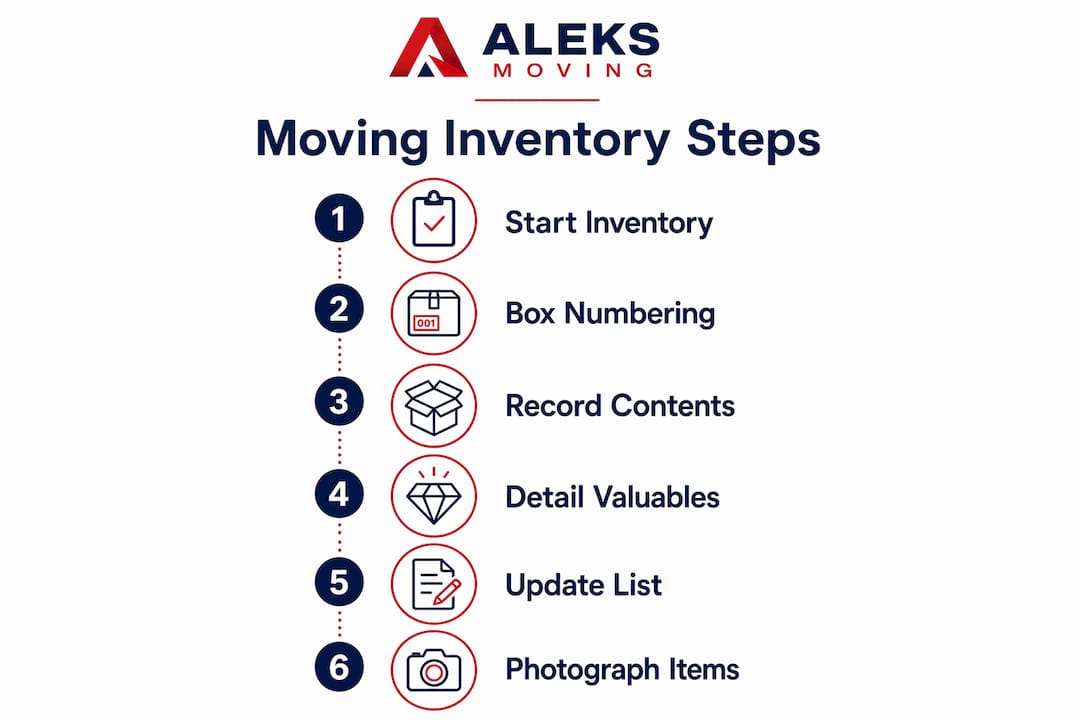
Step 1: Walk through your home room by room.
Catalogue what you have before anything is packed. This is also the right moment to decide what to donate, sell, or discard. Decluttering before inventory work begins lowers your move volume and your final cost.
Step 2: Assign a unique number to each box or item.
Use a simple sequential system: K-1, K-2 for kitchen boxes, BR1-1, BR1-2 for the first bedroom, and so on. Write the number on the box and record it in your inventory.
Step 3: Record contents and condition.
For each box, note a brief description of what is inside and flag any pre-existing damage on items going in. Photograph the contents before sealing the box. Digital photos stored alongside your inventory provide visual proof that no written description can fully replace.
Step 4: Add detail for valuables.
Any item worth more than a few hundred dollars deserves its own line with make, model, serial number, and estimated value. Keep receipts or appraisals in a separate folder.
Step 5: Update as you pack.
Your inventory is a living document. Add new entries as boxes are filled and note any changes in condition. A packing workflow for relocation that runs in parallel with your inventory keeps both documents accurate.
Step 6: Photograph boxes and large items.
Take a photo of each sealed, labelled box and every major piece of furniture before it leaves your home. This creates a timestamped visual record.
Pro Tip: Use the “3–5 words per box” rule for everyday items: “kitchen pots and pans,” “bathroom towels,” “office cables.” Keep a separate, more detailed master list for valuables. This balance keeps packing moving at a reasonable pace while protecting the items that matter most.
Which tools and apps can help you manage your moving inventory?
Paper checklists work for initial planning, but a digital inventory is far more practical for the actual box-by-box process. Digital records are searchable, support photo attachments, and can be shared with family members or your moving crew without the risk of a paper list going missing in the truck.
Several apps are available to Canadian movers:
- Sortly is a visual inventory app that lets you photograph items, assign QR code labels, and organise everything by room or category. It works on iOS and Android and is available in Canada.
- Nest Egg focuses on home inventory for insurance purposes. You photograph items, record values, and store receipts, making it well-suited for documenting high-value belongings before a move.
- Smart Inventory System offers barcode scanning and category management, useful for movers who want a more structured tracking approach across a large number of items.
For teams managing multiple relocations or service-based inventory needs, platforms like Findle offer structured digital cataloguing with photo support and category management that translates well to household move documentation.
When choosing a tool, prioritise ease of photo capture, the ability to export or share the list, and offline functionality in case you are packing somewhere without reliable Wi-Fi. A tool you will actually use consistently beats a feature-rich app you abandon after day two.
How to track item condition throughout your move
Condition tracking is not a one-time task. It runs from the moment an item is loaded to the moment it is placed in your new home. The goal is a continuous record that reflects the state of your belongings at every stage of the relocation.
At pickup, note the visible condition of every significant item before it goes onto the truck. Condition notes at pickup and delivery are the foundation of accountability. If a piece of furniture has a scratch before loading, that scratch needs to be in the record so it cannot be attributed to the move later.
At delivery, check each item against your inventory as it comes off the truck. Do not wait until everything is inside to start comparing. If something arrives damaged or is missing entirely, note it on the delivery paperwork before you sign. Reporting discrepancies promptly is critical; delays in flagging damage can complicate or invalidate a claim.
Practical condition-tracking habits:
- Use a simple flag system in your inventory: “good,” “minor wear,” or “pre-existing damage” for each entry
- Photograph items at both pickup and delivery for a before-and-after comparison
- Record the date and time of any damage noted at delivery
- Keep a copy of the signed inventory from your mover alongside your personal record
The importance of inventory management in relocation goes beyond organisation. A well-maintained condition log is your strongest protection if a dispute arises after the truck pulls away.
Expert insights from Aleksmoving on moving inventories in Canada
After 18 years of helping families and businesses relocate across Ontario, we have seen the same avoidable problems come up again and again. The biggest one: people wait until they are mid-pack to start their inventory, by which point boxes are already sealed and condition notes are guesswork.
One distinction that catches many people off guard is the difference between your personal inventory list and the official Household Goods Descriptive Inventory that your mover creates. Your personal list aids organisation but is not a legally binding carrier document. The mover’s inventory, signed at both pickup and delivery with numbered stickers matched to each item, is the official record used for claims. You need both.
Common mistakes we see, and how to avoid them:
- Starting too late: Begin your inventory during the decluttering phase, not after packing starts.
- Skipping condition notes: “Good condition” is not enough. Note specific marks, dents, or wear on furniture and electronics.
- Losing the mover’s copy: Keep the signed mover’s inventory in a folder with your moving contract and insurance documents.
- Ignoring storage areas: Garages, attics, and storage rooms are consistently under-documented. Walk through them deliberately.
- Not updating as you pack: An inventory written on day one and never touched again will not reflect what actually went on the truck.
For clients moving smaller loads, Aleksmoving’s movelite™ service handles compact relocations with the same inventory discipline applied to full household moves, so nothing falls through the cracks regardless of move size. Preparing your home properly before the crew arrives also makes a real difference; our guide on how to prepare your house for movers walks through exactly what to have ready.
Ready to move with a team that takes inventory seriously?
At Aleksmoving, we bring over 18 years of experience to every relocation across Ontario and beyond. Our crews follow a clear inventory process at every move, flat-rate pricing with no hidden fees, and a commitment to keeping your belongings accounted for from pickup to delivery. Whether you are moving a studio apartment or a full family home, we treat your inventory with the same care we would want for our own.
Get a free quote and let our team handle the details.
Key takeaways
A moving inventory is the single most important document you can create before your move, protecting your belongings, your budget, and your ability to file a claim if anything goes wrong.
| Point | Details |
|---|---|
| Start before you pack | Begin your inventory during decluttering so condition notes are accurate and box counts are complete. |
| Two inventories exist | Your personal list aids organisation; the mover’s signed Household Goods Descriptive Inventory is the legal carrier record. |
| Condition notes are critical | Record visible damage at pickup and delivery, and photograph items before the truck departs. |
| Digital tools outperform paper | Apps like Sortly and Nest Egg support photo storage and searchable records, both available in Canada. |
| Accuracy saves money | A complete inventory produces precise moving quotes by detailing volume, weight, and special handling needs. |