Skip to content


TL;DR:
- Effective office relocation document handling uses a three-bucket strategy to sort records into digital, shredding, or original storage categories. Starting the process at least eight weeks before the move, with proper chain-of-custody protocols, minimizes costs and ensures compliance. Promptly shredding expired files and safeguarding sensitive records protect legal requirements and maintain trust.
Document handling in office relocation is the systematic management of scanning, shredding, and securely transporting business records to maintain compliance, protect sensitive data, and keep operations running without interruption. Poor records management during a move is one of the leading causes of regulatory penalties and operational disruption for Canadian businesses. The industry standard for this process is records management, and applying it deliberately during a relocation separates businesses that recover quickly from those that spend months untangling missing files and compliance gaps. This guide gives business owners and office managers a clear, practical framework built around 2026 best practices, realistic timelines, and secure document transfer protocols.
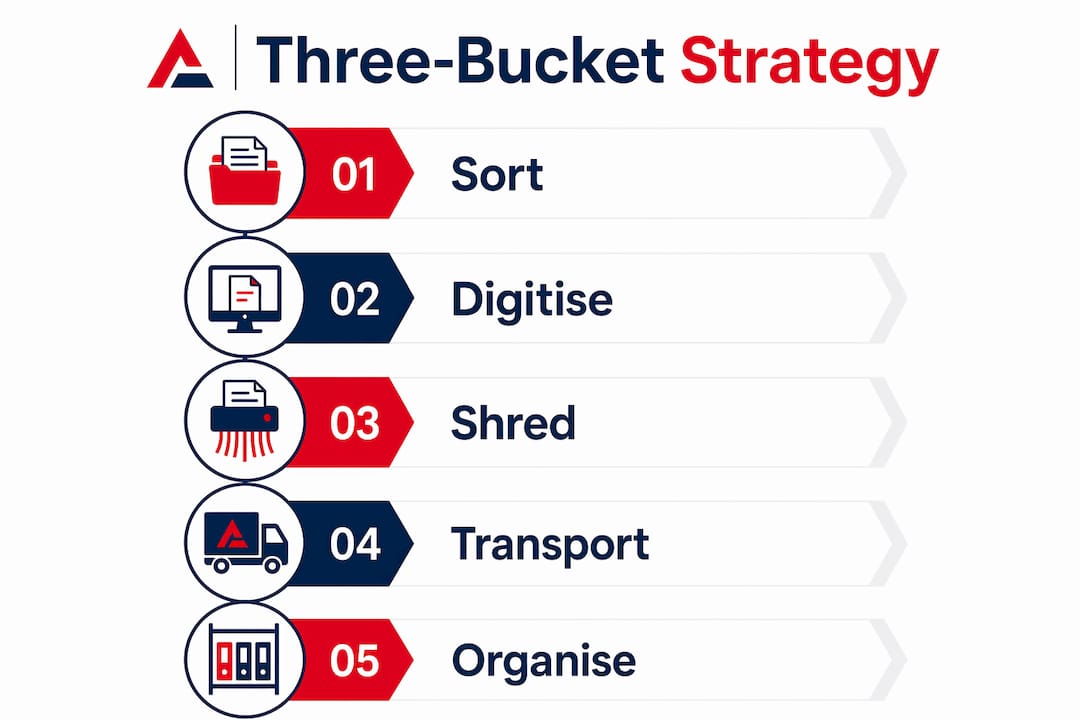
What is the three-bucket strategy for document handling in office relocation?
The three-bucket strategy is the most effective triage method for managing business records during an office move. A three-pronged document approach divides every file into one of three categories: scan and digitise, shred and destroy, or keep as a physical original. This framework prevents the most common and costly mistake in office moves, which is trying to move everything without sorting first.
Here is how each bucket works in practice:
- Scan and keep digital copies. Active records, client files, contracts under review, and frequently referenced documents belong here. Digitising these files before the move means your team can access them from day one at the new location, even if boxes are still being unpacked.
- Shred documents past their legal retention period. Every industry has retention rules. Tax records in Canada generally require a seven-year retention period under the Income Tax Act. Any document past its required retention window is a liability, not an asset. Shredding it before the move reduces physical volume and eliminates compliance risk.
- Keep essential originals in secure physical storage. Signed contracts, incorporation documents, original deeds, and government-issued certificates often cannot be replaced with a digital copy alone. These go into locked, labelled containers and travel with documented chain of custody.
Applying this framework early cuts the volume of physical documents you need to transport, which directly reduces moving costs. Indiscriminate scanning increases costs and complexity without improving compliance. Triage first, then scan only what earns its place in the digital archive.
Pro Tip: Start the three-bucket sort at least eight weeks before your move date. Waiting until the final two weeks forces rushed decisions and increases the risk of shredding documents you still need or moving files you should have destroyed.
How to build a realistic timeline for moving office paperwork
A realistic timeline for relocating business files starts eight weeks before the move date, not two. Businesses should begin sorting at least eight weeks out and complete all scanning two to three weeks before the move to allow time for quality checks and verification. That buffer matters because scanning errors, missing pages, and misfiled documents are far easier to fix before the move than after.
A practical timeline looks like this:
- Weeks 8 to 6 before the move. Conduct a full inventory of all physical files. Apply the three-bucket strategy to every cabinet, storage room, and off-site archive. Identify which documents require certified destruction and book a shredding service.
- Weeks 5 to 4 before the move. Begin scanning documents in the “digitise” bucket. Use consistent naming conventions and folder structures from the start. Assign a team member to verify scan quality and completeness.
- Weeks 3 to 2 before the move. Complete all scanning and run a final quality check. Schedule secure shredding for the destruction bucket. Confirm that certificates of destruction will be issued. Pack physical originals into labelled, locked containers.
- Moving day and the week after. Transport physical originals with documented chain of custody. Verify that all digital files are accessible from the new location before unpacking is complete.
- Within 14 days post-move. Update your registered address with government agencies, the Canada Revenue Agency, and any regulatory bodies relevant to your industry. Missing this window can result in penalties and missed correspondence.
The role of logistics in office moves extends well beyond furniture and equipment. Document handling needs its own project plan, its own deadlines, and its own accountable team member.
What are the security and compliance requirements for sensitive documents?
Security during a records transfer is not just about locked boxes. Chain-of-custody gaps during office moves are a serious compliance risk, particularly in regulated industries like healthcare, finance, and law. A gap in the chain of custody means you cannot prove who had access to a document at any given point during the move. That gap can trigger audit failures, regulatory fines, and client trust issues.
The following measures close those gaps:
- Use locked containers and tamper-evident seals for all physical records in transit. Open boxes are not acceptable for confidential files.
- Apply barcode tracking to every container. Barcode tracking and library carts maintain an auditable trail from origin to destination.
- Document every handoff. Record who packed each container, who transported it, and who received it at the new location. Photographic evidence of sealed containers before and after transport supports audit readiness.
- Require certificates of destruction for all shredded documents. Certified destruction is required for compliance under regulations including HIPAA for healthcare, SOX for public companies, and PIPEDA for Canadian businesses handling personal information.
- Verify mover insurance coverage for document transport. A professional moving company should carry coverage that extends to records and sensitive materials.
“Compliance checklists and photographic evidence of sealed containers protect audit readiness during moves. Documented handling is not optional for regulated industries. It is the minimum standard.”
Pro Tip: For healthcare and legal firms, assign a compliance officer to sign off on every stage of the document transfer. That sign-off becomes part of your audit trail and demonstrates due diligence to regulators.
Working with a mover experienced in corporate moving challenges reduces the risk of chain-of-custody failures because they understand the documentation requirements before the truck arrives.
What are practical steps for organising files during and after the move?
Effective organisation during a move requires a system built before the first box is packed. Good labelling and master inventory spreadsheets prevent loss during moves and are critical for insurance claims and compliance verification. A label on a box that says “Finance Files” is not enough. Every container needs a unique identifier, a contents summary, and a destination room at the new office.
The following practices build a reliable system:
- Create a master inventory spreadsheet that lists every container by ID, contents, origin location, and destination. Update it in real time as boxes are packed and moved.
- Use consistent digital naming conventions. Every scanned file should follow a standard format: department, document type, date, and version. “HR_EmploymentContract_2024-03_v1” is retrievable. “Scan001” is not.
- Apply metadata and retention tags to digital files. Digital document compliance requires metadata and retention policies equivalent to physical records to avoid versioning errors and compliance failures.
- Separate active files from archived files in both physical and digital storage. Active files need immediate access at the new office. Archives can go into off-site storage or a secure digital vault.
- Set up access controls at the new location before staff arrive. Define who can access which digital folders and which physical filing areas. Do not carry over informal access habits from the old office.
| Organisation task | Recommended approach |
|---|---|
| Box labelling | Unique ID, contents summary, destination room |
| Digital file naming | Department, type, date, version number |
| Metadata tagging | Retention period, classification level, owner |
| Physical archive storage | Off-site secure facility or locked on-site room |
| Access controls | Role-based permissions set before move-in day |
Digitisation alone does not guarantee compliance. A scanned file without proper metadata, retention tags, and access controls is just a digital mess instead of a physical one.
What are common pitfalls and cost traps in office document management during a move?
The most expensive mistake in office document management during a move is starting too late. Businesses that begin sorting in the final two weeks before a move end up transporting files they should have shredded, scanning documents they should have kept as originals, and paying for storage they do not need. Each of those errors has a direct cost.
Common pitfalls include:
- Moving unnecessary physical documents. Every box of paper that travels to the new office costs money to pack, transport, and store. Shredding obsolete files before the move cuts that cost directly.
- Scanning everything without triage. Scanning every document in the office sounds thorough. It is actually expensive and counterproductive. Files that have no retention requirement and no operational value waste scanning time and inflate digital storage costs.
- Ignoring lease restoration clauses. Leases often require returning the office to original condition through “make good” clauses. Furniture and document disposal costs tied to these clauses should be budgeted early, not discovered on the final day.
- Failing to budget for certified shredding. Professional shredding services with certificates of destruction are not free. Budget for them at the start of move planning, not as an afterthought.
- Overlooking off-site storage costs. If your new office has less physical storage than your current one, you need a plan for off-site records storage. Storage options for relocations vary widely in cost and security level. Compare them before the move, not after.
Early budgeting for shredding, scanning, and storage services prevents the financial surprises that derail otherwise well-planned office relocations.
Key takeaways
Effective document handling in office relocation requires a three-bucket triage strategy, an eight-week timeline, and documented chain of custody to protect compliance and control costs.
| Point | Details |
|---|---|
| Start sorting eight weeks out | Begin the three-bucket triage at least eight weeks before the move to avoid rushed decisions. |
| Scan with purpose, not volume | Digitise only active and necessary records; shred expired files to cut transport and storage costs. |
| Require certificates of destruction | Certified shredding is mandatory for compliance under PIPEDA, HIPAA, SOX, and similar regulations. |
| Document every handoff | Barcode tracking and photographic evidence maintain chain of custody and support audit readiness. |
| Update addresses within 14 days | Notify the Canada Revenue Agency and relevant regulators of your new address within 14 days post-move. |
What I have learned from watching office moves go wrong
After years of working alongside businesses through complex relocations, the pattern I see most often is this: document management is treated as a packing problem instead of a compliance problem. Teams focus on getting boxes into the truck and assume the paperwork will sort itself out at the other end. It never does.
The businesses that handle relocating business files well treat the move as a genuine opportunity. They use it to audit what they actually have, shred what they should have destroyed years ago, and build a digital archive that works better than the filing cabinets they are leaving behind. A relocation is one of the few moments when an organisation has a legitimate reason to touch every file it owns. That is a rare chance to modernise records management, and most businesses waste it by rushing.
Compliance is not a burden in this context. It is a competitive advantage. A business that can produce any document, prove its chain of custody, and demonstrate retention compliance is a business that regulators, clients, and auditors trust. That trust has real commercial value. I always recommend integrating scanning and shredding into the move plan from week one, not as an afterthought. And I recommend working with a moving partner who understands that documents are not just cargo. They are liability, history, and evidence all at once.
— Ali
How Aleksmoving supports secure document handling for office moves
Aleksmoving brings over 18 years of experience to complex commercial relocations across Ontario, and that experience includes understanding what is at stake when sensitive records are in transit.
When you work with Aleksmoving on an office relocation in Ontario, you get a team that treats your documents with the same care as your equipment. We coordinate secure transport with proper tracking, work alongside your shredding and scanning vendors, and help you plan the physical side of your records move so nothing falls through the cracks. Our flat-rate pricing means you know the cost upfront, with no surprises tied to document volume or extra handling. Contact Aleksmoving for a free quote and a customised plan that fits your move timeline and compliance requirements.
FAQ
What is the three-bucket strategy for office document management?
The three-bucket strategy divides all business records into three categories: scan and digitise, shred and destroy, or keep as a physical original. It is the most effective triage method for reducing volume and managing compliance during an office move.
How early should businesses start handling documents before a move?
Businesses should begin sorting and inventorying documents at least eight weeks before the move date, with all scanning completed two to three weeks before moving day to allow time for verification.
What is a certificate of destruction and why is it required?
A certificate of destruction is a formal document issued by a certified shredding service confirming that records were destroyed in compliance with applicable regulations. It is required under PIPEDA, HIPAA, SOX, and similar frameworks to demonstrate compliant disposal of confidential records.
How long do businesses have to update their registered address after a move?
Businesses generally have 14 days after a move to update their registered address with government agencies, including the Canada Revenue Agency, to remain compliant and avoid penalties.
Does digitising documents mean a business is automatically compliant?
No. Digital files must carry proper metadata, retention tags, and access controls to meet compliance standards. A scanned file without classification and retention policies carries the same compliance risk as a misfiled paper document.