Skip to content


TL;DR:
- An efficient office relocation workflow involves systematic planning, preparation, execution, and post-move optimization to minimize disruptions and costs. Proper early planning, clear communication, and credentialed vendors are essential for Guelph businesses to protect productivity and control expenses during their office moves.
An effective office relocation workflow is the systematic series of steps a business follows to plan, prepare, execute, and optimise its move with minimal downtime and cost overruns. For small and medium-sized businesses in Guelph, a structured approach to the office relocation workflow is not optional. Poorly managed moves can cost businesses approximately $900,000 in lost productivity. That figure alone makes the case for treating your Guelph office moving process as a formal project, not a weekend task. Aleksmoving has supported commercial clients across Ontario for over 18 years, and the pattern is consistent: businesses that plan early move better, spend less, and recover faster.
What are the essential stages in a guelph office relocation workflow?
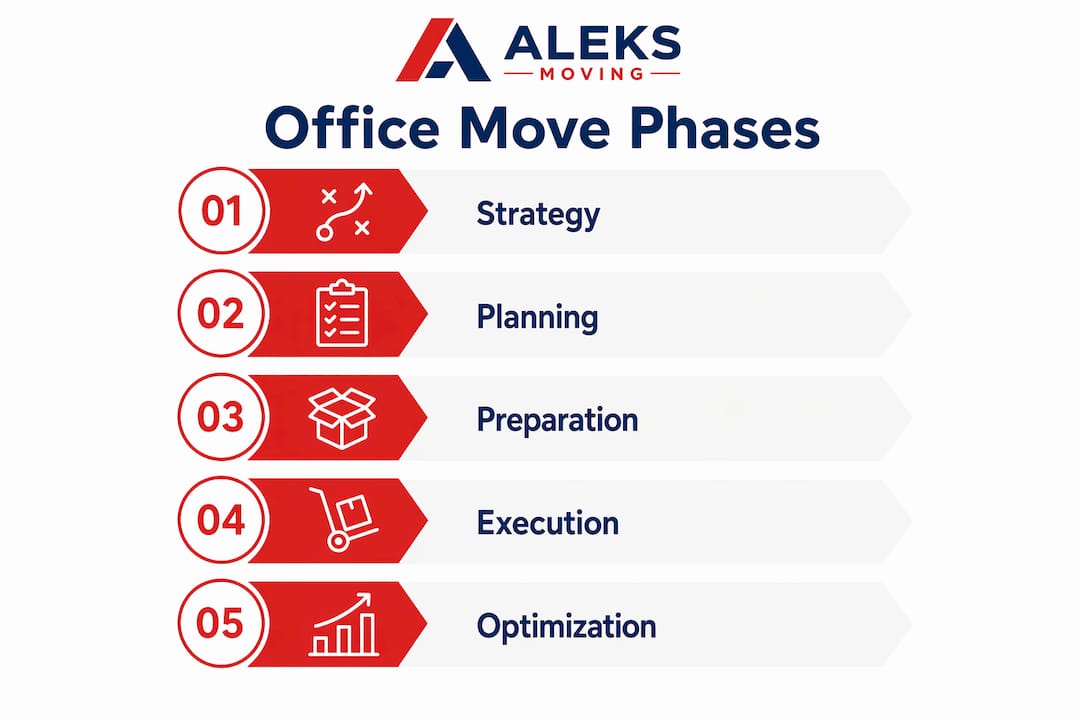
Corporate relocation planning, the recognised industry term for this process, breaks into four distinct phases. Each phase has a defined window, clear deliverables, and specific owners. Skipping a phase does not save time. It transfers the cost to a later stage, usually at a higher price.
Six to twelve months before the move
This is your strategy phase. Define why you are moving, what the new space must achieve, and who will lead the project. Companies that plan at least 6–12 months ahead reduce relocation costs by up to 20%. That saving comes from avoiding rush fees, last-minute vendor markups, and logistical errors that compound under time pressure. Assemble a cross-departmental relocation team that includes IT, HR, Finance, and Operations. One person should serve as the single point of contact for all vendor and stakeholder communication.
Three to six months before the move
Finalise your new floor plan, confirm your lease terms, and lock in your moving vendor. This is also when you build your internal communication strategy. Employees need to know the timeline, the reason for the move, and what is expected of them. Vendors need signed agreements, not verbal commitments. Use a phased checklist to assign tasks by department and track progress weekly.
Four to eight weeks before the move
Confirm all logistics and schedules with your movers, IT team, and facilities contacts. Final confirmations at this stage prevent last-minute disruptions that derail move day. Begin labelling furniture and equipment by destination zone in the new office. Distribute a packing guide to all staff so personal workstation items are packed consistently.
Pro Tip: Book your elevator access and loading dock at both locations at least three weeks before move day. These bookings fill up fast in Guelph’s downtown core and Stone Road commercial areas.
Move day and post-move optimisation
On move day, your relocation team leads execution. One person manages the movers on site. Another handles IT reconnection. A third manages employee arrivals and space orientation. After the move, tracking space utilisation from day one helps identify layout adjustments before habits form around an inefficient setup.
| Phase | Timing | Key Tasks |
|---|---|---|
| Strategy | 6–12 months out | Define goals, assemble team, begin vendor research |
| Planning | 3–6 months out | Finalise floor plan, confirm lease, lock in vendors |
| Preparation | 4–8 weeks out | Confirm logistics, label assets, distribute packing guide |
| Execution | Move day | Coordinate movers, IT reconnection, staff orientation |
| Optimisation | Post-move | Monitor space use, adjust layout, gather staff feedback |
Which tools and vendors should guelph businesses use?
The right vendors and digital tools reduce the margin for error across every phase of your business relocation steps. Guelph businesses have access to strong local options, but the selection process requires more than a Google search.
Choosing a commercial moving company
Selecting movers with credentials and insurance is the single most effective way to reduce damage risk and unexpected costs. Verify that your mover carries commercial liability coverage and has documented experience with office relocations, not just residential moves. Aleksmoving offers flat-rate pricing with no hidden fees, which matters when you are managing a fixed relocation budget. Their team handles packing, transportation, and unpacking, which reduces the number of vendors you need to coordinate.
Proper packing reduces damage and simplifies unpacking, contributing to a faster return to normal operations. Professional packing services are worth the cost for IT equipment, filing systems, and fragile office furniture.
Digital tools for project tracking
Project management platforms like Asana, Trello, and Monday.com each support task assignment, deadline tracking, and team communication in one place. For space planning, tools like AutoCAD or SketchUp allow you to map furniture placement before the truck arrives. Gable Offices provides booking and occupancy data that helps you monitor how your team actually uses the new space after move-in.
Pro Tip: Create a shared digital folder with all vendor contracts, floor plans, and contact lists. Give every member of your relocation team access. This eliminates the “who has the document” problem on move day.
| Vendor Type | Example | Best For | Consideration |
|---|---|---|---|
| Commercial mover | Aleksmoving | Full-service office moves in Guelph | Confirm flat-rate pricing and insurance |
| Project management | Asana, Trello | Task tracking across departments | Free tiers work for most SMEs |
| Space planning | AutoCAD, SketchUp | Pre-move layout design | Requires some technical familiarity |
| Occupancy tracking | Gable Offices | Post-move space optimisation | Best for teams of 20 or more |
- Verify WSIB coverage and commercial insurance before signing any mover contract.
- Request references from at least two previous commercial clients in Guelph or the surrounding area.
- Confirm that your mover has experience with IT equipment and sensitive office assets.
- Get your quote in writing with a clear scope of work and no open-ended line items.
How can guelph businesses manage internal communication during a move?
Communication is where most office transitions in Guelph quietly fall apart. The logistics get planned. The vendor gets booked. But employees receive fragmented updates, feel excluded from decisions, and arrive at the new office confused and frustrated. That friction costs productivity and goodwill.
Assigning a dedicated relocation team with representatives from IT, HR, Finance, and Operations creates a clear structure for decisions and updates. Each representative owns communication within their department. The project lead owns communication with vendors and senior leadership. This structure prevents the same question from reaching five different people and getting five different answers.
Regular status meetings matter more than most managers expect. A 20-minute weekly check-in with your relocation team surfaces problems before they become crises. A brief all-staff update every two weeks keeps the broader team informed without overwhelming them. For your office transition planning in Guelph, consider hosting one in-person Q&A session for staff about four weeks before the move. This is where you address concerns about commute changes, parking, desk assignments, and amenities.
Communication dos and don’ts for your Guelph workspace relocation:
- Do send a written summary after every major decision so staff have a reference point.
- Do give employees a clear timeline with dates, not just phases.
- Do acknowledge concerns openly. Dismissing them creates resistance.
- Don’t communicate only through email. Use your team’s preferred channels, whether that is Slack, Teams, or a shared intranet page.
- Don’t wait until two weeks before the move to tell staff about desk assignments or seating arrangements.
- Don’t assume managers will cascade information accurately without a written brief to work from.
A medium-sized professional services firm in Guelph that assigns a single internal move coordinator and holds bi-weekly staff briefings typically completes its transition with less than one full day of productivity loss. Firms that skip structured communication routinely report two to five days of disruption.
What common challenges occur during guelph office relocations?
The most frequent problems in a Guelph corporate office relocation are predictable. That means they are also preventable, provided you plan for them explicitly rather than assuming they will not happen to you.
Here are the most common pitfalls and how to address them:
- Last-minute packing. Staff who are not given clear packing instructions leave the job to the last day. This creates chaos on move day and increases the risk of lost or mislabelled items. Distribute a written packing guide at least three weeks before the move and set a firm packing deadline.
- Vendor delays. A mover who double-books or a building manager who forgets to reserve the freight elevator can derail your entire schedule. Confirm all bookings in writing and follow up by phone 48 hours before move day.
- IT disruptions. Reconnecting servers, phones, and workstations is consistently the longest post-move task. Engage your IT team or a managed services provider at least six weeks before the move to plan the disconnection and reconnection sequence.
- Underestimating the post-move period. Most businesses plan the move day in detail and then assume the office will be functional by the next morning. Budget two to three days for full operational recovery, including IT, mail forwarding, and signage updates.
- Budget overruns from poor vendor selection. Open-ended quotes and verbal agreements are the primary source of surprise costs. Every vendor engagement should have a written scope and a fixed or capped price.
Pro Tip: Build a contingency fund of 10–15% of your total relocation budget. Unexpected costs in office moves are not rare. They are standard. Having a buffer means you make decisions calmly rather than reactively.
For a detailed breakdown of how to plan an office move in Ontario, including contingency frameworks and vendor checklists, Aleksmoving has published a practical guide covering the full process.
Key takeaways
A structured office relocation workflow in Guelph, built around early planning, clear communication, and credentialled vendors, is the most reliable way to protect productivity and control costs.
| Point | Details |
|---|---|
| Start planning early | Beginning 6–12 months out reduces relocation costs by up to 20%. |
| Build a cross-departmental team | Include IT, HR, Finance, and Operations with one designated project lead. |
| Confirm logistics at 4–8 weeks out | Written confirmations with all vendors prevent last-minute disruptions. |
| Communicate consistently with staff | Bi-weekly updates and one in-person Q&A session reduce resistance and confusion. |
| Budget a contingency reserve | Set aside 10–15% of your total budget to cover unexpected costs without panic. |
What i have learned from office moves in guelph
After working with businesses across Guelph and the broader Ontario region, the pattern I see most often is this: companies underestimate how much the move affects their people, not just their furniture. The physical logistics are manageable. The human side is where things get complicated.
The businesses that handle relocations best are the ones that treat communication as a deliverable, not an afterthought. They assign it to a specific person, give it a schedule, and hold to that schedule even when nothing dramatic has changed. Consistency builds trust with your team, and trust is what keeps productivity stable during a disruptive period.
My other strong observation is that early vendor engagement pays off in ways that are hard to quantify until you see the alternative. A mover booked six months out has time to understand your specific needs, your building access constraints, and your IT requirements. A mover booked three weeks out is fitting you into a gap. The quality of service reflects that difference.
Technology helps, but it does not replace judgement. Space planning software and project management tools are genuinely useful. But the businesses that use them well are the ones that also have a clear decision-maker who is empowered to act quickly when something changes. Tools without authority behind them just create more meetings.
If you are planning a Guelph corporate office relocation, my honest advice is to start earlier than you think you need to, involve your team sooner than feels necessary, and choose your mover based on commercial experience and verified credentials, not price alone.
— Ali
How Aleksmoving supports your guelph office move
Planning a Guelph office relocation is a significant undertaking, and having the right moving partner makes a measurable difference at every stage.
Aleksmoving brings over 18 years of commercial moving experience to businesses across Guelph and Ontario. We offer flat-rate pricing with no hidden fees, so your budget stays predictable from quote to completion. Our team handles packing, transportation, and unpacking for offices of all sizes, and we coordinate directly with your relocation team to fit your schedule. Whether you are moving a 10-person office or a 100-person operation, our commercial moving services are tailored to your specific needs. Contact us for a free upfront quote and let us take the complexity off your plate.
FAQ
What is an office relocation workflow?
An office relocation workflow is the structured sequence of planning, preparation, execution, and post-move steps a business follows to move its office with minimal disruption. It covers everything from vendor selection and internal communication to move-day coordination and space optimisation.
How far in advance should guelph businesses start planning an office move?
Guelph businesses should begin planning 6–12 months before their target move date. Starting this early reduces relocation costs by up to 20% by avoiding rush fees and last-minute vendor markups.
What is the biggest risk in a poorly managed office relocation?
The biggest financial risk is lost productivity. Poorly managed office relocations can cost businesses approximately $900,000 in productivity losses due to downtime and operational disruptions.
How do i choose a reliable commercial mover in guelph?
Select a mover with verified commercial experience, WSIB coverage, and commercial liability insurance. Request written quotes with a fixed scope of work and ask for references from previous office relocation clients in the Guelph area.
What should be included in an office move checklist for guelph businesses?
A thorough office move checklist for Guelph should cover goal setting, team assembly, vendor contracts, floor planning, staff communication, IT disconnection and reconnection, packing procedures, move-day coordination, and post-move space review.