

TL;DR:
- Furniture disassembly involves carefully taking apart larger items to ensure safe, efficient transport during a move. Professional movers often include it as part of their service, using proper tools and protective methods to prevent damage to your furniture. Proper disassembly speeds up loading, reduces damage, and simplifies reassembly at your new location.
Most people don’t think about furniture disassembly until they’re staring at a king-sized bed frame in a doorway on move day. What is furniture disassembly, exactly? It’s the process of breaking down your furniture into smaller, manageable parts before transport, and it affects everything from how safely your belongings arrive to how quickly the movers can load the truck. Get it right and your move runs smoothly. Skip it and you risk damaged furniture, scuffed walls, and a very long day.
Table of Contents
- Key takeaways
- What furniture disassembly actually means
- Why disassembly matters for your move
- How mover service levels affect disassembly
- How to disassemble furniture for a move
- Reassembly and dealing with tricky furniture
- My honest take on furniture disassembly
- Ready to move? Aleksmoving handles the hard parts
- FAQ
Key takeaways
| Point | Details |
|---|---|
| Disassembly protects your furniture | Breaking down pieces before a move prevents joint stress, scratches, and structural damage during transport. |
| Not all movers include it | Full-service movers typically handle disassembly, but labour-only movers often charge extra or require you to prep first. |
| The right tools matter | Using low-torque tools on flat-pack furniture prevents stripped holes and ruined parts. |
| Labelling hardware saves time | Bagging and labelling screws and fittings during disassembly makes reassembly far faster and less stressful. |
| Professionals bring extra protection | Trained movers use blankets, dollies, and proper technique to reduce damage risk throughout the process. |
What furniture disassembly actually means
Furniture disassembly is the planned, deliberate process of taking apart furniture pieces so they can be moved safely and efficiently. It goes well beyond loosening a few bolts. Done properly, it involves understanding how each piece was built, which joints can be safely separated, and in what order to dismantle the components.
Not every piece of furniture in your home requires disassembly. Some items, like a solid wood coffee table or a small bookshelf, can travel intact. Others absolutely need to be broken down before they leave the room. Common furniture pieces that typically require disassembly include:
- Bed frames (particularly queen and king sizes, platform beds, and bunk beds)
- Dining tables with removable legs or extension leaves
- Office and computer desks, especially L-shaped or corner designs
- Sectional sofas and sofa beds, which have connectors, hinges, and pull-out mechanisms
- Wardrobes and armoires with removable shelves, rails, and side panels
- Flat-pack furniture assembled from components, such as IKEA-style pieces
Understanding the type of construction matters too. Research on furniture joinery types categorises joints into three groups: non-disassemblable (glued or permanently fixed), conditionally disassemblable (can be taken apart carefully but may not survive repeat cycles), and fully disassemblable (cam locks, bolt fasteners, and expandable connectors designed for repeated assembly). Fully disassemblable furniture, the kind held together with cam bolts and barrel nuts, is the easiest and safest to take apart for a move.
Pro Tip: Before move day, photograph each piece of furniture from multiple angles. These photos become your reassembly reference and save significant time at your new home.
Why disassembly matters for your move
There’s a practical reason professional movers prioritise this step. Moving sectional sofas without disassembly creates joint stress and can cause permanent structural damage, leaving you with wobbly frames or cracked panels that no amount of tightening will fix. The same applies to large bed frames, wardrobes, and desks that are forced through tight stairwells or doorways intact.
The benefits of proper furniture disassembly go beyond just protecting the furniture itself:
- Safer handling. Smaller, lighter components reduce the risk of injury for the people doing the lifting.
- Faster loading. Flat, disassembled panels stack efficiently in the truck, using space better and reducing the number of trips.
- Doorway and stairwell clearance. Many large pieces physically cannot exit a room without being taken apart first.
- Reduced wall and floor damage. Carrying compact parts through hallways causes far less contact with surfaces than manoeuvring bulky assembled pieces.
- Easier transport. Disassembled furniture sits flat and stable in the truck, reducing movement and the chance of tipping or shifting.
Efficient furniture disassembly also speeds up both loading and unloading, which directly reduces the total hours billed on a time-based move. That’s a real, measurable saving. You can explore more about preparing furniture for long-distance moves to see how disassembly fits into a broader moving plan.
How mover service levels affect disassembly
Not all moving companies handle disassembly the same way, and knowing the difference before you book saves a lot of frustration. Full-service movers almost always include furniture disassembly as part of their standard service. Labour-only movers, the kind you hire just to carry boxes and load the truck, often charge extra for disassembly or expect you to have everything broken down before they arrive.
Here’s a general comparison of what to expect:
| Service type | Disassembly included? | Tools provided? | Reassembly included? |
|---|---|---|---|
| Full-service movers | Usually yes | Yes | Often yes |
| Labour-only movers | Rarely, or at extra cost | Sometimes | Rarely |
| Furniture assembly service | Yes (this is the focus) | Yes | Yes |
| DIY with rental truck | No, fully on you | You supply | You supply |
It’s worth confirming these details directly with your mover before signing anything. Ask specifically whether disassembly is included in the quoted rate, whether they bring their own tools, and whether reassembly at the destination is part of the service. Labour-only movers typically focus on loading and unloading, with disassembly treated as a separate, priced-by-request task.
Professional movers who do handle disassembly also bring more than just a screwdriver. Professional disassembly services typically include moving blankets, dollies, and tools matched to your specific furniture, reducing the risk of damage throughout the entire process.
Pro Tip: Always get written confirmation of what is and is not included in your moving quote. “We handle everything” means different things to different companies.
How to disassemble furniture for a move
Whether you’re doing it yourself or overseeing a crew, having a clear process makes the difference between a smooth move and a chaotic one. Follow these steps:
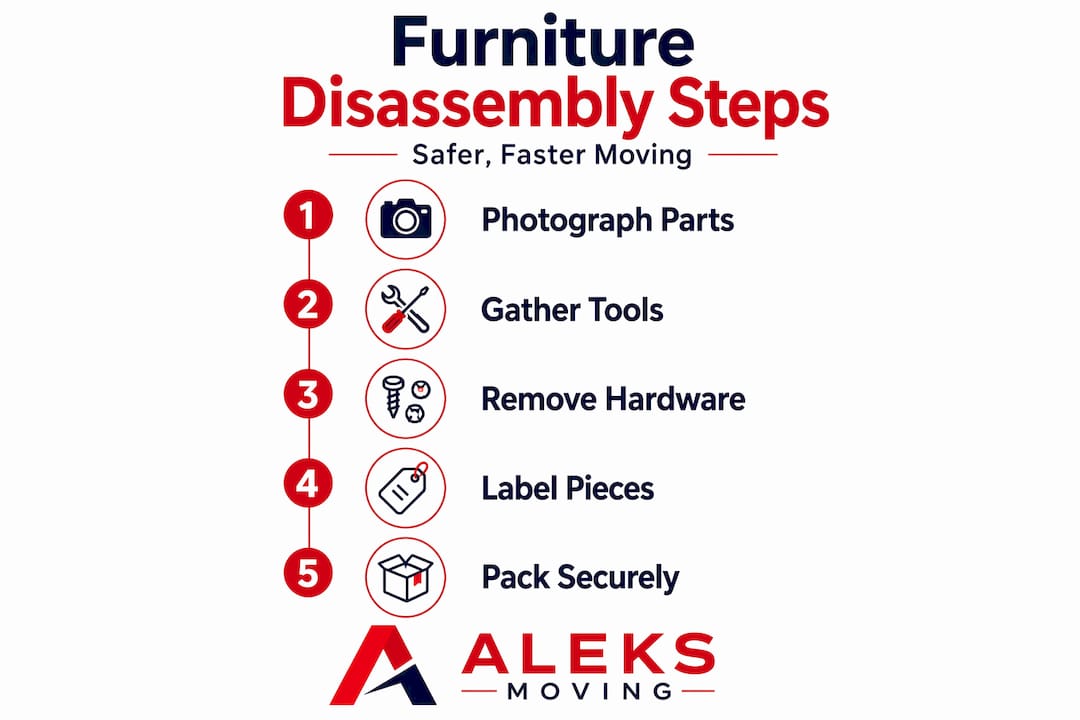
- Gather your tools first. You’ll typically need a set of Allen keys (hex wrenches), a Phillips and flathead screwdriver, an adjustable spanner, and a rubber mallet. Avoid high-torque power drills. High-torque drills strip holes in particleboard and MDF, which are common materials in flat-pack furniture. Use a low-torque electric screwdriver or a manual tool with care.
- Clear the workspace. Remove drawers, shelves, and cushions before you start on any frame. This lightens the piece immediately and gives you better access to fasteners.
- Take photos before you start. Photograph each joint, connector, and cable before removal. This is your reassembly manual and it costs nothing.
- Bag and label all hardware. As you remove screws, bolts, and cam locks, place them in small zip-lock bags and label each bag with the piece it belongs to. Labelled and bagged hardware is one of the most important steps professionals take to make reassembly smooth and quick.
- Disassemble in reverse construction order. For a bed frame, remove the slats, then the headboard, then the side rails. For a desk, remove the surface panels before the legs. Following the reverse of the assembly sequence prevents you from removing weight-bearing parts too early.
- Wrap panels immediately. Once a panel or component is off, wrap it in moving blankets or bubble wrap and tape it securely. Don’t leave loose panels leaning against walls where they can fall.
- Know when to call a professional. Glued joints, upholstered frames with hidden fasteners, and Murphy beds all require specialist knowledge. Forcing a glued joint can cause irreparable splits. If you’re unsure, the cost of a furniture disassembly and assembly service is almost always less than replacing a damaged piece.
Pro Tip: Tape the bags of hardware directly to the furniture panel they belong to. That way, even if boxes get mixed up during the move, the hardware travels with its piece.
Reassembly and dealing with tricky furniture
Disassembly is only half the process. Getting your furniture back together properly at the new location matters just as much. When professionals handle both ends of the move, reassembly is generally straightforward because the hardware is organised, the panels are wrapped and intact, and the crew knows what they took apart.
Here’s what to keep in mind when planning the reassembly side of things:
- Confirm reassembly is in your contract. Many movers offer it but do not include it automatically. Ask before the truck leaves.
- Check furniture reassembly instructions early. If you have the original manuals, keep them accessible, not buried in a box. Standardised disassembly instructions and clear labelling significantly improve the reassembly experience, whether you’re doing it yourself or directing movers.
- Set a reassembly priority. Beds and seating should be reassembled first so you have somewhere to sleep and sit on the first night. Shelving and desks can wait.
- Plan for glued or non-disassemblable pieces. If part of your furniture cannot be taken apart, getting rid of furniture before the move may be a more practical option than risking damage in transit.
- Budget extra time for complex items. Sofa beds, bunk beds, and modular wall units take longer to reassemble. If your movers are on an hourly rate, factor this into your estimate.
Fully disassemblable furniture with cam bolt and barrel nut construction is genuinely designed for repeated assembly without damage, which means it should go back together cleanly if the parts are protected and organised during the move.
My honest take on furniture disassembly
Over many years of working in and around professional moving, I’ve seen disassembly cause more last-minute stress than almost any other part of the process. People assume it’s quick. It rarely is.
What I’ve learned is that the furniture most people think they can move intact is exactly the furniture that causes damage. Sectional sofas get forced through doorframes. Tall wardrobes tip in trucks. Bed frames arrive with cracked rails because someone thought removing the legs was enough. The cost of that damage almost always exceeds what professional disassembly would have cost.
My honest advice: if you have any doubt about a piece, take it apart. And if you’re not comfortable doing that yourself, hire someone who is. I’ve also seen moves where proper disassembly protected genuinely irreplaceable pieces: a grandfather’s solid wood dresser, a vintage mid-century sideboard, a custom dining table. These aren’t just furniture. They’re things worth protecting properly.
Balancing DIY and professional help doesn’t have to be complicated. Do the simple stuff yourself: remove shelves, take off table legs, dismantle flat-pack desks. Hand the complex pieces, the sofa beds, the L-shaped wardrobes, the Murphy beds, to the people with the right tools and experience. That split approach saves money without sacrificing the protection your furniture deserves.
— Ali
Ready to move? Aleksmoving handles the hard parts

At Aleksmoving, we understand that furniture disassembly is one of the most time-consuming parts of any move. That’s why our professional moving services include furniture disassembly and reassembly handled by experienced movers who bring the right tools, protective materials, and know-how to every job. Whether you’re doing a local move across town or a long-distance relocation across Ontario, we tailor our service to your needs. We also offer packing services to complement the disassembly process and keep everything protected from start to finish. With over 18 years of experience and flat-rate pricing with no hidden fees, Aleksmoving is the dependable partner you want on move day. Contact us today for a free upfront quote.
FAQ
What is furniture disassembly in moving?
Furniture disassembly is the process of breaking down furniture into smaller components before transport to make it safer, easier to handle, and less likely to be damaged during a move.
Do moving companies disassemble furniture?
Full-service movers typically include disassembly as part of their standard service, while labour-only movers often charge extra or require you to have furniture broken down before they arrive.
What tools do I need to disassemble furniture?
Most furniture requires Allen keys, a Phillips and flathead screwdriver, and an adjustable spanner. Avoid high-torque drills as they can strip holes in particleboard, especially on flat-pack pieces.
Does disassembly help protect furniture during a move?
Yes. Disassembling furniture before transport prevents joint stress and structural damage. Moving large items like sofas without proper breakdown can cause permanent damage that is not repairable after the move.
Is furniture reassembly included when movers disassemble it?
Not always. Reassembly depends on the service level agreed upon in your contract. Always confirm in writing whether your mover includes reassembly at the destination before booking.